

9 December 2025 –
UNCAC at a glance, three years later – tracking UNCAC reviews
Global mapping of anti-corruption progress: tools for success
On this year’s International Anti-Corruption Day on 9 December, we look back on progress made over the past year in UNCAC implementation, visualized through our interactive world maps, as well as take stock of 2nd cycle UNCAC reviews globally and highlight good practices.
Let’s start with some numbers. As a result of the UNCAC Coalition’s efforts and of the engagement of many civil society organizations – often in constructive collaboration with governments – the UNCAC’s reviews have become more transparent and inclusive:
- In 2025, we supported the production and publication of 9 parallel reports assessing national UNCAC implementation, bringing a civil society perspective to the UNCAC review process.
- Our Transparency Pledge has 42 State signatories,
- Our Access to Information campaign has led to 17 governments publishing key documents about their UNCAC reviews.
These are only a few of the Coalition’s achievements. But numbers tell us just one story.
As usual on IACD, we are mapping progress made since launching our world maps – now exactly three years ago. At a glance, see what the status of UNCAC implementation reviews is in countries around the world, who is complying with our Transparency Pledge, and in which countries civil society involvement has brought a fresh perspective to UNCAC implementation. These tools are designed to help civil society organizations (CSOs) and government officials be better informed in their fight against corruption. The maps are updated on a rolling basis: should you spot any inaccuracies, please contact us at danella.newman@uncaccoalition.org.
- Our UNCAC Review Status Tracker map brings together all available information on countries’ reviews in one place. The review processes are typically difficult to follow;
- Our Transparency Pledge compliance map shows both the level of compliance of States Parties that have signed the Pledge and which States have not signed it yet;
- Our Civil Society Parallel Reports map shows where we have supported civil society organizations in providing a complementary perspective to the 2nd UNCAC review cycle, as well as other reports that were published independently. These reports look not only into the legal but also the practical implementation of the UNCAC at the national level;
- Our Access to Information Campaign map reflects where civil society organizations have already sent requests for access to information related to UNCAC implementation country reviews. Requests are needed to get crucial missing information on UNCAC implementation, which is not always published voluntarily.
1. UNCAC Review Status Tracker
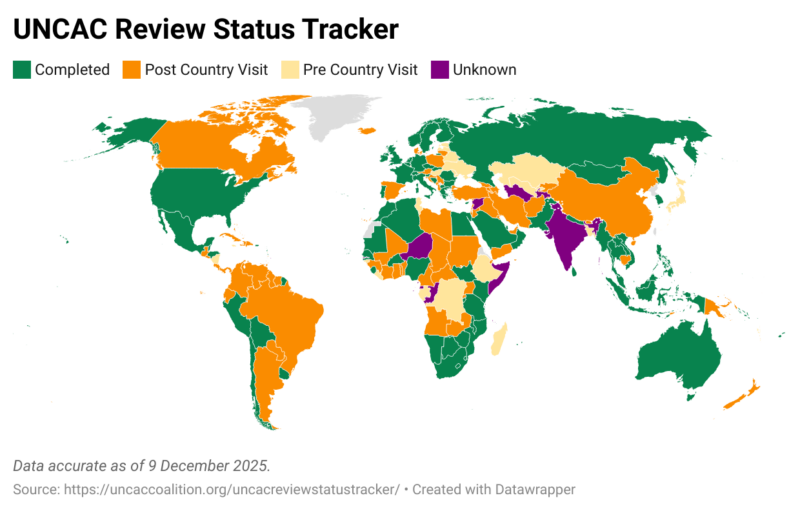
This map complements the Coalition’s UNCAC Review Status Tracker spreadsheet. Visualizing the status of UNCAC implementation of 2nd cycle reviews shows that a lot of countries are opaque in how they are conducting their reviews, with little to no information available. From a civil society perspective, this makes it difficult to engage with and to participate in the reviews.
For several years now, the UNCAC Coalition has been trying to identify government officials responsible for the UNCAC, known as ‘focal points’, to get updates on their review status and encourage them to include civil society in their reviews. Since International Anti-Corruption Day 2024, the latest information we have is that out of 192 States Parties:
- 96reviews are still ongoing:
- 25 reviews are in the pre-country visit stage;
- 71 reviews are in the post-country visit stage –
- 83 reviews have been completed; of which only 14 (16,9%) have published their self-assessment checklist, but 49 countries (59%) have published their full country report on their UNODC country profile page;
- for 13 reviews, the review status is unknown – with no updates for years.
Not a single review has been completed within the six-month period foreseen in the Implementation Review Mechanism’s (IRM) Terms of Reference.
- Quickest reviews: Liechtenstein, Malaysia and South Africa (1-1.5 years)
- Longest reviews: Bolivia and Honduras (9 years).
In almost all regional groups, the longest review took around eight years to complete.
The overall average time of completed reviews is 5.3 years.
Through our continued engagement with focal points, we were not only able to update this information in our tracker, but to find out about upcoming country visits prior to them happening. We pushed for those States to involve a wide range of civil society stakeholders in the reviews, following good practices in terms of timing of such a meeting, allowing for them to meet the reviewers without the government under review present, among others. This helped civil society organizations navigate this technical process and coordinate their key messages, particularly in Rwanda, New Zealand and Denmark, where we briefed CSOs ahead of the country visits. This led to more meaningful participation of civil society in these country visits, which resulted in more impactful UNCAC review outcomes overall.
We’ve created a database systematizing the information presented on UNODC country profile pages to create a cohesive overview image on the available documents, information and length of reviews. This database is available here: Country Profile Scrape Database – 4 September 2025
How can States Parties make their UNCAC reviews more transparent and inclusive of civil society?
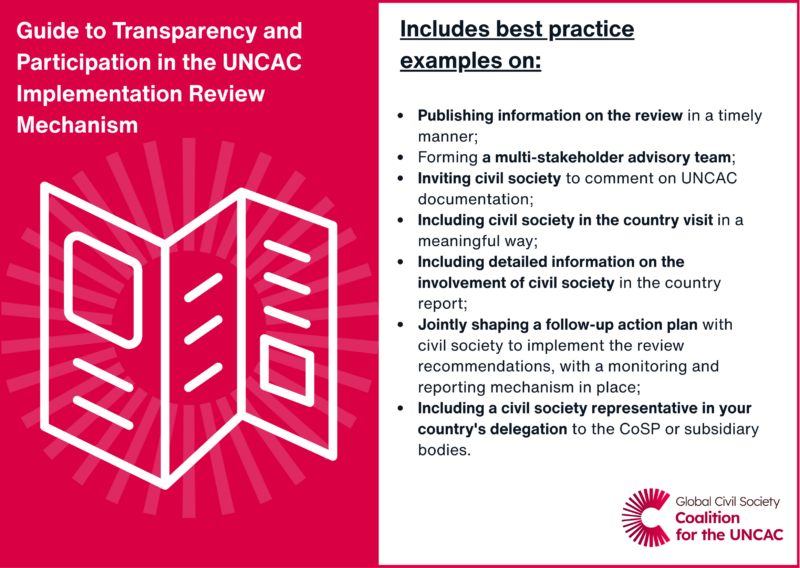
Our Guide to Transparency and Participation in the UNCAC Implementation Review Mechanism (also available in Spanish and French) includes best practice examples, including:
- Publishing information on the review proactively and in a timely manner;
- Forming a multi-stakeholder advisory team to consult on the review;
- Inviting civil society to comment on drafts of the self-assessment checklist and draft country report;
- Including civil society in the country visit in a meaningful way;
- Including detailed information on the involvement of civil society in the country report;
- Jointly shaping a follow-up action plan with civil society to implement the review recommendations, with a monitoring and reporting mechanism in place;
- Including a civil society representative in your country’s delegation to the Conference of the States Parties or subsidiary bodies.
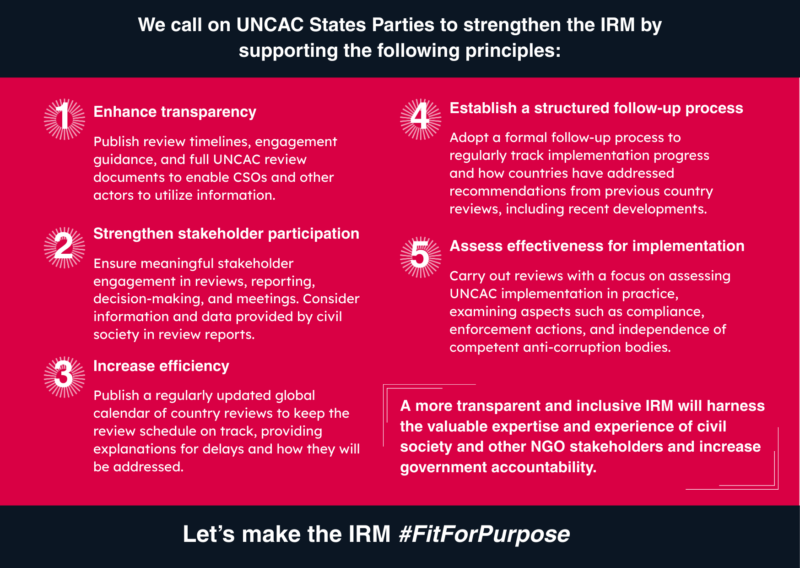
With discussions on how the next phase of the UNCAC implementation review mechanism (IRM) should look like going forward, we have developed key recommendations on strengthening its next phase in terms of transparency, civil society participation, effectiveness and efficiency.
For more specific examples of how to meaningfully engage civil society in UNCAC reviews and ensure high standards of transparency, please refer to this blog post.
2. Transparency Pledge Compliance Status
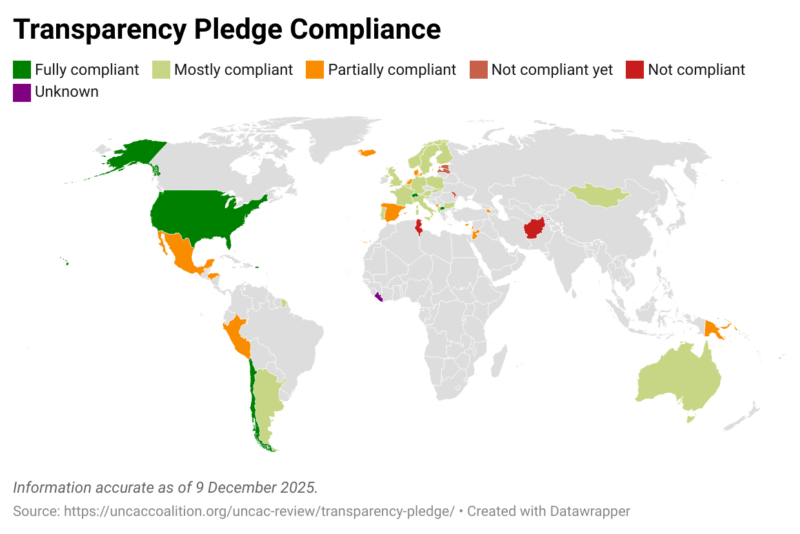
Many States Parties that claim to be transparent and open to civil society involvement have not yet signed the Pledge. And some of those who did, are not (yet) complying.
The UNCAC Coalition is encouraging States Parties to sign up to the Transparency Pledge for the second UNCAC implementation review cycle. The Pledge is a voluntary commitment for elevated standards of transparency and civil society participation in the UNCAC review mechanism.
42 out of 192 UNCAC States Parties have signed the Transparency Pledge so far, with 21 new signatories since December 2019, 2 more signatories in 2024 (Denmark and Moldova) and 3 more in 2025 (Jordan, Armenia, and Papua New Guinea). This upward trend is an encouraging sign in the face of the shrinking civic space we have observed in UNCAC-related fora over the past few years.
Pledge signatories were once again asked to provide detailed information on their compliance status in October and November 2025. Similar to last year, several have yet to reply.
Disclaimer: Reviews in some of the signatory countries are still ongoing, which means that they have not had a chance to publish documents or hold follow-up briefings yet, since they have not reached this stage of the review process yet.
Fully compliant
As shown on the map, in 2025, two additional countries became fully compliant with the Transparency Pledge, Switzerland and Chile – joining North Macedonia and the United States of America. Both Switzerland and Chile follow best practice in:
- publishing key information on its UNCAC review on a dedicated governmental website, including the UNCAC focal point, the review schedule (Switzerland, Chile)
- Including civil society organizations at key stages of the review, including in the country visit, enabling them to meet with the peer reviewers without the government under review present.
- publishing both the self-assessment checklist and the full country report on their UNODC country profile page (Switzerland, Chile)
- holding a follow-up briefing with civil society organizations to discuss the country report findings and recommendations:
- in Switzerland, as part of the workshop of the Interdepartmental Working Group on Combating Corruption of 10 September 2025. The Basel Institute on Governance, Public Eye and Transparency International Switzerland actively contributed to the discussions. Other CSOs were also invited but did not attend;
- in Chile, as part of the multi-stakeholder Alianza Anticorrupción UNCAC, which civil society is a part of, both in specific Working Groups as well as at the General Assembly;
- continuously supporting the participation of civil society observers in UNCAC subsidiary bodies in UNCAC fora.
Mostly compliant
The number of States Parties that are mostly compliant with the Pledge’s principles and spirit has increased by three countries since last year, now at 19 countries. This number more than doubled between 2022 (8 countries) and 2023 and keeps increasing – a positive sign for transparency and inclusiveness.
These countries are: Austria, Albania, Australia, Argentina, Belgium, Bulgaria, Finland, France, Germany, Italy, Mauritius, Mongolia, Norway, Poland, Portugal, Slovak Republic, Slovenia, Sweden and the United Kingdom – with Bulgaria, Finland, Norway, being the newest additions. Noteworthy examples of their commitment to transparency and civil society participation include:
- Sweden’s dedicated governmental website, which outlines each step of the review process, including the participation of civil society in both the self-assessment and country visit stage, as well as the governmental UNCAC focal point and their contact information.
- In Mongolia, the review was completed in 2025, civil society organizations were involved in the review, the self-assessment checklist and full country report have been published on Mongolia’s UNODC country profile page, and the findings of the report were discussed both during a workshop aimed at developing a roadmap for implementing the National Anti-Corruption Program, with over 30 CSOs present, as well as during a short training session for NGO representatives on 25 June 2025.
- Bulgaria moved from its compliance status being unknown – since no emails were responded to – to becoming mostly compliant with the Transparency Pledge after providing information on having facilitated a separate meeting of CSOs with the peer reviewers during the country visit, and having published its full country report.
- It is becoming a growing practice for States to include civil society representatives in their country delegations to the CoSP and the subsidiary bodies, such as the IRG, helping to bring civil society expertise to discussions that are otherwise closed to observers. Several States have done this in the past year.
Partially compliant
Several countries indicated on the map are partially compliant with the Pledge, in many cases, due to the fact that the review is still ongoing. Three examples to highlight are:
- Armenia just signed the Transparency Pledge this year, and has already published its UNCAC review schedule and indicating the UNCAC focal point, including their contact details on a dedicated governmental website.
- Denmark invited a broad range of non-governmental stakeholders, including civil society organizations, academia, media, and the private sector to the country visit. Only Finance Denmark, and Transparency International Denmark ended up participating. Denmark has published its self-assessment checklist – the executive summary and country report is currently being written.
- Mexico moved from being not compliant with the Transparency Pledge to being partially compliant, after publishing its full country report on Mexico’s UNODC country profile page.
Not compliant yet, and not compliant
The countries indicated on the map as not compliant yet (Estonia, Latvia, Liberia, Moldova) have not yet had their country visit, with their reviews facing significant delays, but have assured the UNCAC Coalition that civil society will be included in them. Related good practices from the Republic of Moldova include:
- providing an overview of the schedules for their 1st and 2nd cycle UNCAC reviews on a dedicated governmental website, where they also indicate the civil society parallel report by CAPC that was produced on the country’s implementation of the UNCAC.
- including compliance with the Transparency Pledge commitment in their national Open Government Partnership Action Plan 2023-2025.
Unfortunately, two signatory countries (in red on the map), are currently not compliant with their Pledge commitments. In Tunisia, the government has been approached repeatedly about providing information on its UNCAC review and the inclusion of civil society therein, without doing so. The government of Afghanistan signed the Transparency Pledge in 2021 but due to current events and changes in power, is not compliant.
We commend those countries who are truly committed to transparency and the participation of civil society in UNCAC reviews, and anti-corruption more broadly.
There are promising signs that more countries will soon sign the Transparency Pledge. We call on those States Parties who have not done so yet, to sign the Pledge.
3. Civil Society Parallel Reports
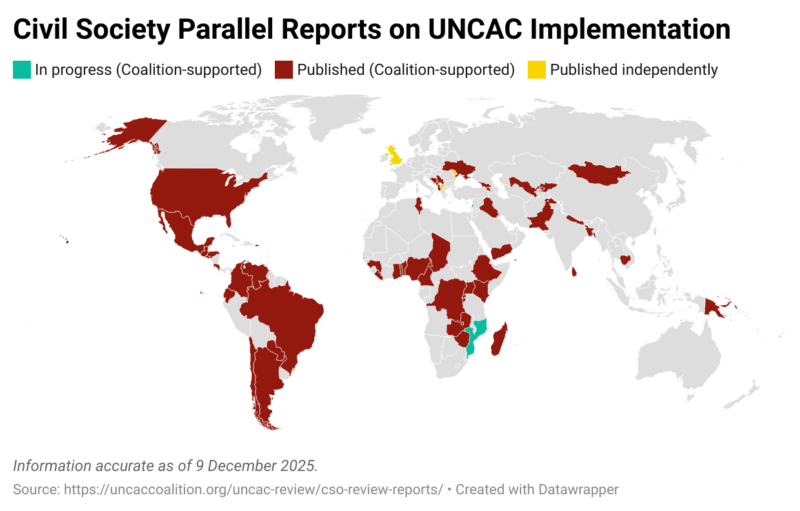
Since May 2020, the UNCAC Coalition has supported the production of over 50 civil society parallel reports on the implementation of Chapters II (prevention of corruption) and V (asset recovery) of the UNCAC. The parallel reports provide a current assessment of anti-corruption, anti-money laundering and asset recovery policies at the national level, but go beyond analyzing the legal framework to really exposing implementation and enforcement (or the lack thereof) in practice.
Civil society organizations that have written these reports with the Coalition’s technical and financial support conducted interviews with relevant government and non-governmental stakeholders and, in some cases, sent numerous access to information requests to obtain statistical and other relevant information. By identifying good practices and deficiencies, these parallel reports highlight what is working in practice and provide recommendations for improvement – all with the aim of making the fight against corruption more effective.
In 2025, the Coalition published 9 parallel reports on 2nd review cycle UNCAC implementation, providing support to civil society organizations from Official Development Assistance (ODA) recipient countries and enhanced its dissemination efforts of the reports even further. By region:
- Americas: Guatemala (in both Spanish and English)
- Asia-Pacific: Sri Lanka
- Sub-Saharan Africa: Cameroon (in both English and French), Kenya, and Rwanda; with the Nigeria report having been published in late 2024 but officially launched in early 2025, and the Mozambique parallel report currently in progress;
- South-West Asia and Northern Africa: Iraq (in both English and Arabic) with the Lebanon parallel report currently in progress.
Besides building civil society organizations’ capacity on UNCAC matters, their engagement with government institutions (through interviews and access to information requests as part of the information-gathering and parallel report writing process) has, in many cases, led to greater involvement of civil society.
Follow-up activities
The UNCAC Coalition’s initiative for civil society organizations aims to promote and act on the recommendations developed in their parallel reports on UNCAC implementation in their country. These follow-up activities seek to enable our members and affiliates to interact with the government, relevant key stakeholders and policy-makers, to create momentum and advocate for reforms on the national level. At a global level, these efforts aim to strengthen the implementation of the UNCAC.
In 2025, we supported follow-up activities by Anti-Corruption Coalition Uganda and Costa Rica Íntegra, both of which managed to substantially advance discussions on strengthening witness and whistleblower protection and transparency and inclusiveness of the UNCAC implementation review mechanism at the national level. We also supported AWTAD – Anti-Corruption Organization in conducting follow-up activities in Yemen, which faced delays due to restricted civic space. See examples of past follow-up activities here.
4. Access to Information Campaign
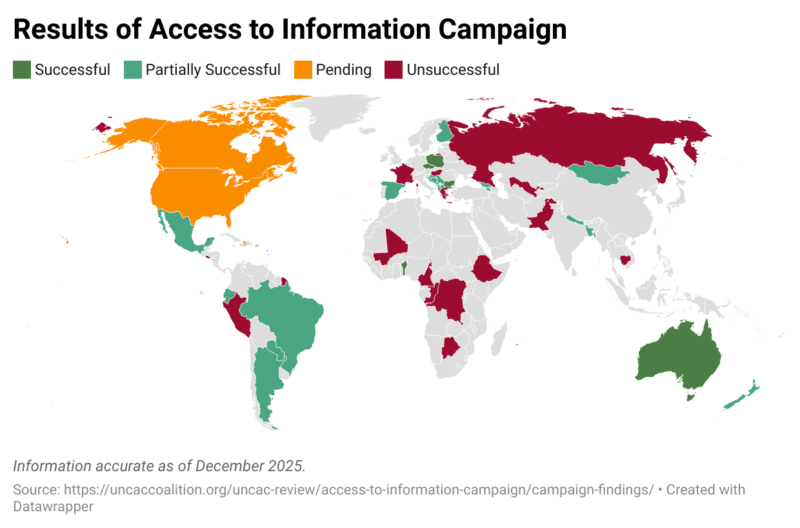
Through Freedom of Information (FOI) requests, the UNCAC Coalition has collaborated with civil society in over 46 countries to assess how governments disclose information on UNCAC implementation review cycles, relying on national access to information laws where available. Where such laws are absent, we encourage the use of UNCAC’s transparency principles under Articles 10 and 13.
Since the campaign was launched in 2023, a total of 27 official UNCAC review documents have been released, ranging from full country reports to self-assessment checklists (first and second review cycles). Before the filing of information requests, these documents were not publicly available. In 15 of the 46 countries (33%) in which information requests were sent for this campaign, the information request was not acknowledged, responded to, or was met with administrative silence. In the remaining 31 countries (67%) where authorities replied, only 5 countries (11%) released all official UNCAC documents and information relevant to the first and/or second implementation review cycles within their possession.
As an example of impact from the past year: Following an appeal brought by Access Info Europe against a partial refusal to release information, a court in Spain ruled that there were no reasons for confidentiality of a self-assessment checklist and established that the release was in the public interest. The government has yet to comply with the ruling.
The release of UNCAC documents supports advocacy efforts and highlights countries’ commitment to their UNCAC obligations. For civil society organizations, the campaign offers a chance to exercise the right to access information and engage in UNCAC implementation reviews, especially in countries awaiting their country visits.
Learn more about the ATI campaign, its objectives and what it involves on our website, and explore the campaign findings table and our campaign analysis.
Endnote: Some UNCAC States Parties (Niue, Cabo Verde, Cook Islands, Saint Lucia and Palestine) are not reflected on the maps due to Datawrapper pre-sets.