


Context in which this group operates
Corruption fuels environmental crime, accelerates climate change, and drives biodiversity loss, with devastating consequences for people and planet. Corruption, including bribery, embezzlement, state capture and conflicts of interest, undermines the integrity and effectiveness of environmental and climate action. Organised criminal networks involved in environmental crimes can depend on corruption at every stage of the global supply chain, enabling their operations and shielding them from accountability. The resulting damage can be irreversible, with far-reaching consequences for economies, the rule of law, public safety, human rights and human health.
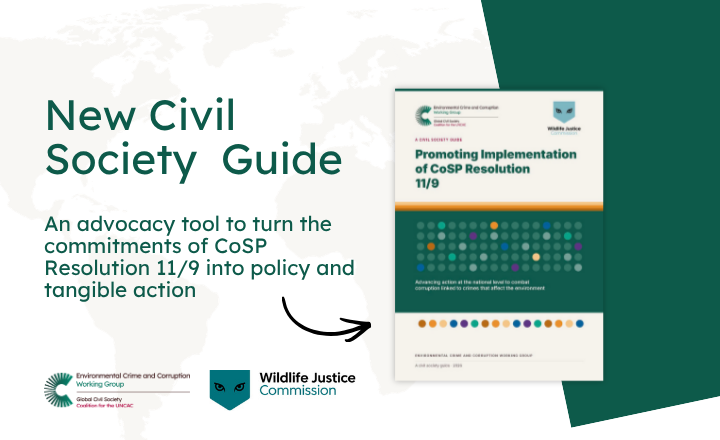
As the only legally binding global anti-corruption instrument, the UNCAC provides a powerful yet underused framework to address corruption driving environmental crime, including biodiversity loss, pollution and climate change. At UNCAC CoSP11, governments adopted by consensus Resolution 11/9 on “Preventing and combating corruption as it relates to crimes that affect the environment”, a milestone outcome long advocated for by the Working Group and reflecting many of its key recommendations. The adoption of the resolution provides an important basis for strengthening international and national action, but its commitments must translate into effective measures at the (sub)national level. Civil society has an important role to play in supporting implementation, monitoring progress and holding governments and other relevant actors to account.
The Global Civil Society Coalition for the UNCAC’s Environmental Crime and Corruption Working Group, comprised of over 230 civil society members worldwide, provides a platform for discussion, information exchange, collaboration and joint advocacy among civil society experts. It focuses on strengthening the effective use and implementation of the UNCAC as a tool to confront corruption linked to crimes that affect the environment, and on ensuring that civil society perspectives and expertise inform relevant policy and advocacy processes.
Objectives
The objectives of the Environmental Crime and Corruption Working Group are to:
- Raise awareness among policymakers about the nexus between environmental crime and corruption, and its harmful impact on the environment, the climate and human rights
- Promote the adoption and effective implementation of robust policies and other measures by States to prevent and combat these issues
- Coordinate joint advocacy efforts at UNCAC fora and other global fora to advance global commitments on environmental crime and corruption, and promote their implementation at the national level
- Encourage the exchange of information, updates and discussion on relevant topics, including policy developments related to corruption linked to environmental crimes, so members stay informed of the latest developments
- Create a space where civil society organisations can present findings, reports and campaigns for dissemination
- Bring together members from across the globe to foster connection and collaboration beyond the formal Working Group setting
Coalition Mailing List Guidelines
Please have a look at our Mailing List Guidelines, which apply to all conversations and exchanges of information across the Coalition. By being a part of our core community and Working Groups, you agree that you have read and will follow these guidelines.