
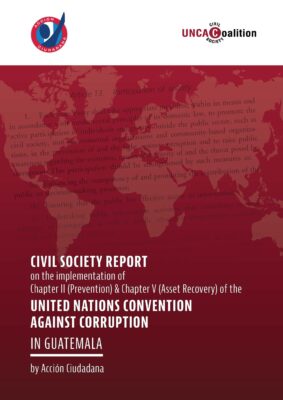
A new parallel report by Acción Ciudadana, the Guatemalan chapter of Transparency International, highlights that while Guatemala has made progress in updating its anti-corruption framework, persistent structural problems, political interference, and attacks on civic space continue to undermine the country’s ability to prevent, investigate, and sanction corruption. The report assesses Guatemala’s implementation of Chapters II (Preventive Measures) and V (Asset Recovery) of the United Nations Convention against Corruption (UNCAC) and was prepared with technical and financial support from the UNCAC Coalition.
Guatemala has taken significant steps to strengthen its preventive anti-corruption measures under Chapter II of the UNCAC. In 2024, the National Anti-Corruption Commission (CNC) was reactivated. It adopted a Code of Ethics for the government and established integrity systems throughout the executive. The CNC has also introduced a digital platform for reporting corruption and strengthened its outreach to public institutions. Yet, these promising developments remain fragile given the lack of autonomy of the institution.
Similarly, although Guatemala has strengthened its legal framework to improve public procurement and public finance management, the effective implementation of these measures continues to face significant obstacles. The persistence of discretionary practices, weak controls at certain levels of the State, and the lack of effective sanctions hinder full compliance. Moreover, there is no law to protect whistleblowers who report acts of corruption, although this is a critical pillar of public sector integrity. Implementation of the access to information legal framework is uneven and, in some cases, journalists or citizens have faced intimidation when exercising their right to access public information.
On UNCAC Chapter V (Asset Recovery), Guatemala has a solid legal framework on paper, including laws on anti-money laundering, asset forfeiture, and international cooperation for asset return. However, implementation is slow and fragmented. The last National Risk Assessment was conducted ten years ago, supervision of non-financial sectors remains limited, and there is no consolidated, public data on suspicious transaction reports, seizures, or the final destination of recovered assets. Confiscated properties often remain in limbo for years due to bureaucratic inefficiencies and weak inter-agency coordination.
Main Findings
Preventive anti-corruption policies and institutional framework
The reactivation of the National Anti-Corruption Commission (CNC) in 2024 was a step forward after years of stagnation. In its first year, the CNC has created 65 offices tasked with promoting integrity and handling internal complaints in the Ministries, issued codes of ethics, and implemented integrity systems throughout the Executive. The CNC is also building a complaints platform to channel citizen reports. However, the commission operates with limited budgetary autonomy, lacks sanctioning powers, and is dependent on the political will of the current administration. Coordination with key actors – such as the Public Prosecutor’s Office, Comptroller General, and municipal governments – is also weak, creating gaps in prevention and enforcement.
- Key recommendation: Guarantee the independence and sustainability of the CNC by granting it a permanent legal mandate, budgetary autonomy and inter-institutional coordination powers, and create a unified national anti-corruption monitoring system to track compliance with UNCAC and other international commitments.
Codes of conduct, conflicts of interest and asset declarations
While a government’s Code of Ethics was adopted in 2024 and ethics committees were established, the legislative and judicial branches remain outside their scope. Guatemala has a system for asset declarations for public officials, which are rarely audited and remain confidential. This opacity makes it difficult to detect illicit enrichment or conflicts of interest. Additionally, there are no rules preventing the “revolving door” between the public and private sectors.
- Key recommendation: Regulate conflicts of interest, guarantee transparency of asset and interest declarations of senior officials, judges and prosecutors, ensure interoperability of the declarations for automatic cross-checks and audits, and regulate the “revolving door” (cooling-off periods, interest registries).
Whistleblower protection
A critical shortcoming in Guatemala’s public integrity system is the lack of a comprehensive whistleblower protection law. While a bill was introduced in 2024 to create a Protection Authority (APRODI), it remains stalled in Congress. In practice, whistleblowers, journalists, and prosecutors face reprisals, including criminalization, imprisonment, or exile. The cases of former prosecutor Virginia Laparra and journalist José Rubén Zamora exemplify how reporting corruption or criticizing powerful actors can result in severe personal risk.
- Key recommendations: Adopt a comprehensive Whistleblower Protection Law covering both the public and private sectors and a responsible authority.
- Guarantee confidential, secure reporting channels and integral protection to whistleblowers.
Public procurement and financial management
Guatemala has solid procurement and public budgeting legal frameworks, which created the platform Guatecompras and the Budgeting Transparency Portal. The Ministry of Finances has promoted initiatives such as the program “transparent suppliers” and incorporated automatic verification mechanisms in contracting. The government has trained civil society organizations through Open Budget workshops. Nevertheless, non-competitive procurement remains widespread, particularly at the municipal level, and budget execution reports are often incomplete or delayed. Complaints filed by the Ministry of Finance frequently fail to result in investigations due to weak coordination with and follow-up by the judiciary.
- Key recommendations:
- Reform the State Procurement Law to ensure supplier integrity and standardized bidding documents.
- Optimize transparency portals such as Guatecompras by including complementary data such as beneficial ownership information and risk alerts, including legally guaranteed civil society involvement.
Access to information and participation of society
Guatemala’s Access to Public Information Law enshrines the principle of maximum disclosure but suffers from poor implementation, particularly at the municipal level. The Secretariat for Access to Public Information (SECAI), within the office of the Human Rights Ombudsman, oversees compliance with the access to information law, receives complaints, and trains institutions on their obligations. However, its institutional influence and sanctioning capacity are limited.
Journalists and citizens might face intimidation when seeking to exercise their right to access information. In 2023, 9,496 attacks on journalists, human rights defenders and other actors were reported, and with aggression of this kind reported every day. Civic participation in policymaking remains ad hoc and highly dependent on the discretion of authorities, leaving citizens with few opportunities to influence decision-making.
- Key recommendations:
- Strengthen the Secretariat for Access to Public Information (SECAI) by granting it sanctioning powers and resources, and establish a standardized, transparent process for public consultations on laws and policies.
- Stop attacks on journalists and civil society actors by ensuring an enabling environment for civil society.
- Institutionalize citizen participation in budget planning and oversight, legally guaranteeing the continuity of mechanisms such as the Open Budget workshops.
Judiciary and prosecution services
While there have been improvements in transparency and access to judicial information with initiatives such as the Open Justice Policy, Guatemala’s justice system continues to face serious threats to independence. The appointment for judges and magistrates is frequently manipulated through opaque selection commissions, and disciplinary procedures have been used to remove or harass independent judges, especially those investigating corruption networks and human rights violations, for instance in the case of the removal of five women prosecutors in 2022. There is a lack of cross-checks with officials’ assets and interests declarations, and of public statistics on sanctions, audits or disciplinary processes to members of the judiciary. The process to start investigations also lacks clarity.
- Key recommendations:
- Ensure transparent and merit-based appointments of judges and magistrates, protect judicial independence.
- Strengthen the autonomy and resources of the Public Prosecutor’s Office.
- Improve international cooperation in complex, transnational cases.
Anti-money laundering
Guatemala has an extensive anti-money laundering and asset recovery framework, and the Special Verification Intendancy (IVE) conducts risk-based analysis on money laundering and suspicious transactions. However, non-financial sectors such as lawyers, accountants, and real estate agents continue with minimal supervision. IVE collaborates with the Public Prosecutor’s Office and issues reports when it detects atypical financial patterns. Nevertheless, integrating this input into judicial processes remains a challenge. The National Risk Assessment is outdated, and data on suspicious transaction reports and asset recovery is fragmented and not publicly available.
- Key recommendations:
- Update the National Risk Assessment, extend supervision to designated non-financial businesses and professions (DNFBPs).
- Improve coordination between IVE and the Public Prosecutor’s Office for more effective criminal investigations.
Asset recovery
Prominent past cases of asset recovery include that of former president Alfonso Portillo, which resulted in the freezing of over USD 2.5 in accounts in France, Switzerland, and Luxembourg, as well as his extradition and conviction in the United States in 2014. According to a former Asset Forfeiture Judge, between 2012 and 2016, Guatemala achieved significant progress in combating money laundering and establishing a system for the recovery of assets, and was recognized by international organizations such as GAFILAT.
Despite such positive precedents, recent years have seen a decline in cases linked to complex corruption structures and, since 2018, the Public Prosecutor’s Office has shifted its focus to prioritizing low-impact cases and neglecting strategic investigations into high-level criminal networks. One of the main obstacles identified is the absence of clear deadlines for formally initiating an asset forfeiture action. This legal gap has allowed assets to remain frozen for years without resolution, sometimes deteriorating or losing value while awaiting judicial resolution.
- Key recommendations:
- Speed up asset forfeiture proceedings where appropriate, with due guarantees, and strengthen international cooperation agreements.
- Strengthen mechanisms for valuation, management, auctioning, and traceability of assets.
- Establish clear rules for the transparent and social use of recovered assets.


