


8 October 2025 –
Widely recognized as a cornerstone of democracy, access to information is a prerequisite for civil society engagement in anti-corruption efforts. The United Nations Convention against Corruption (UNCAC) underscores its importance for preventing and detecting corruption, dedicating Article 10 to public reporting, and Article 13 to the participation of society. In Europe, all countries have by now passed legislation to guarantee public access to information – the last one being Austria, which adopted its new Freedom of Information Act in January 2024.
However, transitioning from a culture of secrecy to an “open by default” practice of sharing information is a long process and, despite the existing laws, today citizens across the region face challenges in accessing government-held information. A thematic report issued by UNODC on the implementation of Chapter II of the UNCAC (preventive measures), launched in April 2025, noted that 60% of States received recommendations to reform or effectively implement access to information laws in their countries. This demonstrates that it is an issue that goes far beyond the European region.
In this context, members of the UNCAC Coalition Europe network met on September 23, ahead of International Day for Universal Access to Information, to explore how to revitalize access to information as a key tool to combat corruption and advance good governance across all sectors. The meeting showcased successful civil society advocacy in different countries and provided a space to discuss challenges and opportunities for anti-corruption organizations to exercise, defend, and expand the right of access to information. The meeting also offered an opportunity to shape a joint statement on anti-corruption priorities in Europe – one of which is access to information – that will be submitted to the 11th session of the Conference of the States Parties to the UNCAC (CoSP11).
Raising the bar on access to information in practice: Lessons from Greece
When referring to access to information, two dimensions always come into play: the right to obtain information upon request, and the proactive disclosure of information. Focusing on the first dimension, Stefanos Loukopoulos, Director and co-founder of Vouliwatch, presented a recently released study on access to information frameworks in 15 European countries. Coordinated by Access Info Europe, the study offered practical recommendations for aligning access to information laws with the Tromsø Convention (the Council of Europe’s Convention on access to official documents) in pilot countries.
In the case of Greece, the legal framework is fragmented and there are no specialized oversight mechanisms to guarantee access to information. This has discouraged civil society organizations and journalists from exercising their right to request information and at the same time public institutions show a low response rate. Vouliwatch identified the system’s weaknesses, developed concrete recommendations, and launched an advocacy campaign to push for legal reforms, raise public awareness, and build stronger coalitions for transparency.
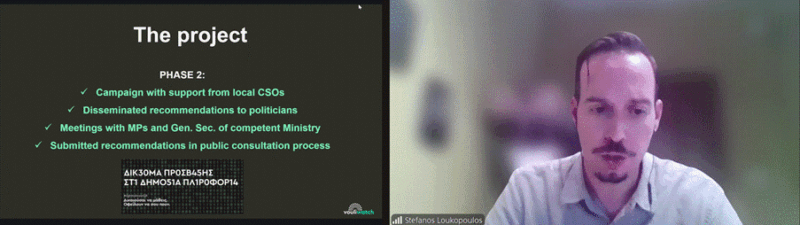
The recommendations from Vouliwatch included:
- Adopting a single law covering all categories of information,
- Removing “reasonable interest” as a precondition for accessing documents,
- Defining exceptions narrowly, and applying harm and public interest tests (to determine whether the harm to third parties of publishing a document outweighs the public interest for granting access to it),
- Training public officials on the right to information,
- Requiring institutions to specify the grounds for refusal and establishing a simple appeal process,
- Creating a specialized, independent oversight body.
With support from local organizations, Vouliwatch disseminated these recommendations and engaged directly with Parliamentarians and senior ministry officials, yielding significant results: the obligation to prove a “reasonable interest” when requesting information was eliminated, anonymous requests are now accepted, and the Code of Administrative Procedure was amended. These outcomes also laid the groundwork for broader reforms to strengthen transparency and accountability in Greece.
Advancing proactive disclosure of information in Armenia
Shushan Doydoyan, President of the Freedom of Information Center of Armenia (FOICA), focused on the other dimension of access to information: proactive disclosure. This implies that information is made public at the initiative of public bodies, without any prior information request. Proactive disclosure of information is crucial for corruption prevention, and the UNCAC encourages the publication of information about matters including recruitment, promotion and retirement of civil servants (Article 7.1), funding of candidatures and political parties (Article 7.3), public procurement systems (Article 9), among other issues.
But beyond preventing corruption, Shushan sees proactive transparency as “a foundational pillar for an effective government”. Indeed, publicly available information helps citizens make informed decisions, take part in policymaking, and hold public institutions accountable, all of which can, in turn, lead to better policies and public service delivery.
Given these advantages, what information should governments publish and what are the challenges of proactive disclosure? In the case of Armenia, the law defines 13 categories of information subject to mandatory publication. Every government body has an official website and there are 108 online platforms of digital services available, such as e-request.am. These numbers could be considered a positive trend, but proactive disclosure is not a matter of publishing any information: it has to be relevant and useful (“of public interest”), timely, and made available in accessible channels and formats (open data formats).

Shushan noted a lack of global guidance on proactive disclosure. For governments, the challenges begin with defining the scope of what to publish – which topics should be prioritized and what qualifies as “public interest” information. Too often, the data published are fragmented, non-standardized, hard to find and to understand for citizens, and high-value data are missing – for instance, data on public spending are not consistently published. Another challenge is to establish few and clear exceptions, and balance these with the public interest of disclosing the information. In addition, the topic of access to information is losing interest in donor agendas.
From the perspective of citizens and civil society organizations, Shushan proposed to revitalize access to information in the context of other reforms gaining traction, such as open data initiatives, and the growing influence of social networks. Above all, we should continue to show that transparency is effective and impactful, an enabler of sustainable development and democratic resilience. Meaningful transparency for public oversight and participation requires deliberate choices, not the publication of random and bulk data, and civil society plays a central role in pushing governments to provide:
- Clear legal guarantees – defining categories of information for mandatory disclosure,
- Relevant, complete, timely and updated information,
- Accessible and reusable data – open, machine-readable, structured formats,
- High-value datasets such as public expenditure, public procurement, governmental performance data, asset and interest declarations, beneficial ownership data, etc.
Climate and access to information: New developments
One area in which access to information is of vital importance is on climate change prevention and mitigation.David Banisar, currently Visiting Senior Fellow at the London School of Economics and Political Science – Department of Government and Honorary Member of the UNCAC Coalition, explained how corruption impacts on climate-related policies, and how international environmental law and court rulings are promoting access to information as an accountability mechanism to facilitate knowledge on states activities which affect the climate, and their consequences on human rights.

The significant association between corruption levels and climate risk has been widely recognised, as corruption amplifies both the frequency and consequences of climate disasters. There is a particularly pronounced impact observed in developing countries where corruption compounds existing infrastructural vulnerabilities (see study “The impact of corruption on climate risk – An international evidence Environmental Development” (2024)). Furtherly, UNODC and the World Bank noted in “Addressing Corruption Risks to Safeguard the Response to Climate Change” (2024) three key challenging factors:
- the growing demand for energy,
- the management of climate funds,
- and the uncertainty of carbon markets.
In this context, transparency enables all stakeholders – governments, international organizations, private investors, CSOs and citizens – to pressure both states and markets into reducing greenhouse gas emissions that cause global warming and climate change. In fact, as David argued, a transition to a world with less emissions may only be possible if the relevant information becomes available to all interested parties.
Climate information is also important to understand the impact of climate change on human rights. According to a report by the UN Special Rapporteur on the promotion and protection of human rights in the context of climate change, published in 2024, this includes information on:
- Causes, extent and effects of climate change, to ensure the public understands whether climate-related conditions are improving or worsening;
- Potential and actual negative impacts of climate change on human rights, to support the public’s resilience and adaptive capacities to respond to these impacts;
- Proposed and ongoing climate response measures and their impact on human rights, to empower the public to assess the adequacy of State action to combat climate change and promote, protect and fulfil human rights.
In June 2024, the Grantham Research Institute on Climate Change and the Environment at the London School of Economics and Political Science sent a submission to the United Nations Special Rapporteur on the promotion and protection of human rights in the context of climate change with recommendations to States.
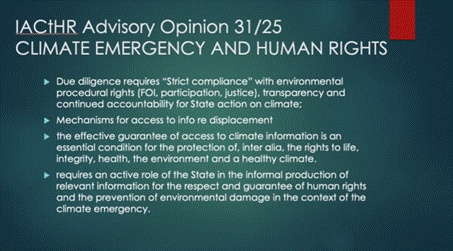
Finally, the jurisprudence is supporting the proactive provision of information on climate, such as the Inter-American Court of Human Rights (IACtHR) and the European Court of Human Rights (ECtHR). The IACtHR Advisory Opinion 31/25 on “Climate emergency and human rights” highlighted that guarantees of access to climate information are an essential condition for the protection of, inter alia, the rights to life, integrity, health, the environment and a healthy climate. Therefore, States must establish appropriate systems and mechanisms for the production, compilation, analysis and dissemination of information relevant to the protection of human rights in the context of the climate emergency; early warning systems to provide timely information on disaster risks; data necessary to establish, implement and update mitigation and adaptation goals, plans and strategies. States should ensure that companies report information in a public, accurate and accessible manner on the climate impacts of their activities, including:
- sufficient information to assess the adequacy of measures taken to prevent human rights abuses in the context of the climate emergency,
- the climate footprint of their products and services,
- the characteristics and impacts of high-emission projects and available technologies,
- details on their sustainability initiatives, environmental compliance and investments in renewable energy and environmentally friendly technologies.
Finally, States should encourage citizen participation in climate action and take measures to counteract climate disinformation.
In Europe, a 2020 court ruling by the European Court on Human Rights (ECHR) stated that information of importance, held by public authorities, that sets out how to implement the relevant regulations and measures to tackle climate change must be made available to the public. This is especially relevant to those persons who may be affected by the regulations and measures in question or the absence thereof. In this regard, procedures must be available to ensure that the public can have access to the conclusions of the relevant studies, allowing them to assess the risk to which they are exposed, and that the views of the public can be taken into account in the decision-making process.
Renewing interest in access to information
In the subsequent discussion, participants exchanged remarks on how the European region continues to face significant setbacks and uneven implementation of access to information frameworks. Many countries still struggle with long delays in responding to requests, overly broad exceptions, or weak enforcement mechanisms that leave citizens with limited remedies when their rights are denied. In certain contexts, civil society actors face obstacles, intimidation and harassment, including strategic lawsuits designed to discourage them from using access to information as a tool for accountability.
These obstacles are particularly concerning at a moment when disinformation, declining trust in institutions, and shrinking civic space pose growing challenges to democracy and good governance. While technological innovation has opened new opportunities for proactive disclosure and the provision of information through open data platforms and digital tools, civil society, governments and oversight bodies must work to ensure that transparency commitments remain high on the political agenda, and that access to information is protected, strengthened, and meaningfully exercised by all, including communities that often face the greatest barriers to participation.
If you are a civil society activist from Europe and would like to become involved, please contact our Regional Coordinator Ana Revuelta Alonso at ana.revuelta@uncaccoalition.org.