


19 September 2025 –
A recent report by International Governance Institute – Cameroon exposes how, despite progress in developing an anti-corruption legal and policy framework, the country struggles with weak implementation of key provisions under UNCAC Chapters II (Preventive Measures) and V (Asset Recovery). The report is intended as a contribution to the second cycle of the UNCAC implementation review process, produced with technical and financial support from the UNCAC Coalition.
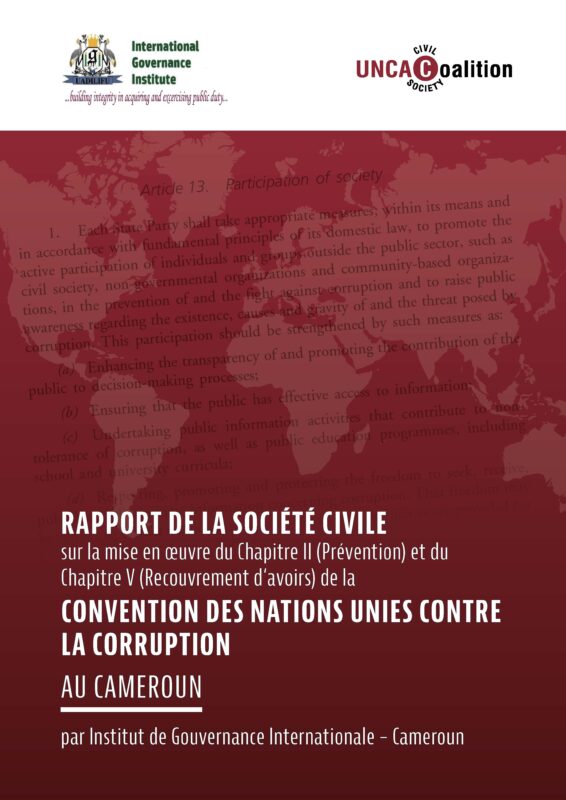
Cameroon has taken notable steps to prevent corruption in line with UNCAC Chapter II, establishing several institutions such as the National Anti-Corruption Commission (CONAC), which leads prevention and awareness-raising efforts, the Supreme State Audit Office (CONSUPE) and the Budgetary and Finance Disciplinary Board, among others. However, the effectiveness of these bodies is undermined by limited independence and insufficient resources. In addition, public sector integrity remains weak, with poor enforcement of asset declarations, inadequate whistleblower protections, and a lack of transparency and oversight of public procurement and political financing. Judicial independence is also a concern, with allegations of selective prosecutions undermining trust in anti-corruption efforts.
Furthermore, civic engagement in anti-corruption and governance efforts has declined significantly, with civil society organizations raising concerns about bureaucratic hurdles, limited access to information, and weak participation in anti-corruption policy implementation. The absence of a Freedom of Information Law and a whistleblower protection law restricts government accountability and citizen participation. The Extractive Industries Transparency Initiative (EITI) has found Cameroon’s civic engagement to be inadequate, raising concerns about the lack of transparency and public oversight mechanisms.
Regarding the fight against money-laundering in line with UNCAC Chapter V and other international initiatives Cameroon is part of, persistent deficiencies remain in financial supervision and enforcement. This has led the country to be placed on the Financial Action Task Force (FATF)’s grey list. Asset recovery is an area that continues to present substantial gaps. Banking secrecy rules and insufficient guarantees to whistleblowers hinder investigations. Besides, Cameroon lacks a dedicated agency to manage recovered assets.
The UNCAC review process of Cameroon by Sierra Leone and Vanuatu officially started in 2017 and the country visit took place from 25 to 27 February 2019. The extent to which other stakeholders, including civil society organizations, took part in the country visit, is unclear. The executive summary of the Country Review Report was published on Cameroon’s UNODC country profile page, but the full report is still in progress.
For detailed findings and recommendations, read the full civil society parallel report in English here. A French translation of the report is here.
Main Findings
Codes of Conduct, Conflicts of Interest in the Public Sector, and Asset Declarations
Cameroon has a legal framework in place to prevent conflicts of interest and promote ethical conduct among public officials, which includes a Code of Ethics for Public Servants and a Law on Asset Declarations. Specific government employees and senior public officials have to declare their assets before assuming office and after leaving their positions. However, enforcement remains a significant challenge. Asset declaration compliance is low, and the absence of legal sanctions for non-compliance renders the system largely symbolic. Additionally, the mandate of the National Agency for Financial Investigation does not cover asset declaration oversight, leaving critical accountability gaps.
Key recommendation:
- Ensure compliance and verification of asset declarations, including by imposing sanctions for non-compliance, and strengthen the enforcement of conflict-of-interest rules for public sector servants.
Public Sector Employment
Recruitment and promotion of civil servants in Cameroon are governed by legal frameworks designed to ensure fairness, transparency and accountability. Those willing to enter the public service have to pass competitive exams and are bound by ethical codes of conduct. Nevertheless, political patronage and nepotism undermine merit-based hiring, especially at higher administrative levels, and distort the selection of the best candidates for public sector roles. Furthermore, the absence in practice of effective monitoring and disciplinary mechanisms against corrupt officials contributes to a culture of impunity and erodes citizens’ trust in public institutions.
Key recommendation:
- Ensure transparency and fairness in recruitment processes, and apply disciplinary measures to public officials who have engaged in corrupt practices.
Political Financing
A legal framework governs political financing in Cameroon, with disclosure requirements for parties and candidates in electoral campaigns. The financing of campaigns is specifically subject to spending limits and the obligation for political parties to report who is funding them and how they have spent the public funds allocated to them. Such legal requirements are a good practice, but enforcement remains weak. In practice, political parties submit reports inconsistently and oversight mechanisms are not fully enforced, which allows political party financing to occur through opaque channels and go unchecked. This lack of transparency in campaign finance creates opportunities for illicit financial flows and corruption, and electoral processes are reportedly influenced by corporate donors, foreign entities, and illicit funds.
Key recommendation:
- Strengthen reporting obligations and conduct independent auditing of political party accounts and campaigns to improve accountability.
Access to information
Without a Freedom of Information law, transparency and citizens’ access to public information are significantly limited. While some existing laws partially address UNCAC obligations related to public sector transparency and civil society participation – such as Law No. 2018/011 on Transparency and Good Governance in Public Finance Management (which mandates the publication of budgetary and financial reports), Law No. 90/053 on Freedom of Association, and Law No. 99/014 governing the legal status and operation of NGOs – they fall short of establishing a comprehensive right to information. Moreover, the implementation of transparency measures is inconsistent, and no legal provisions require authorities to disclose information upon request. This weakens institutional accountability and limits public oversight of government actions.
Key recommendation:
- Adopt and implement a Freedom of Information Law that guarantees citizens, journalists, and civil society organizations unrestricted access to government-held information.
Participation of civil society
Civil society participation in anti-corruption efforts remains informal and unstructured. Despite the Freedom of Association Law, organizations continue to face bureaucratic hurdles, restrictive administrative controls, and limited engagement in policymaking. While the National Anti-Corruption Commission has established certain structures such as the National Anti-Corruption Coalition, civil society organizations report a significant decline in participation in practice.
Key recommendation:
- Institutionalize mandatory public consultations in anti-corruption policymaking to improve government engagement with CSOs, media, and academia. In particular, grant the National Anti-Corruption Commission (CONAC) broader consultative powers to actively involve non-governmental stakeholders in policy development and enforcement of anti-corruption measures.
Reporting Mechanisms and Whistleblower Protection
Despite some steps to establish corruption reporting mechanisms, there is no dedicated whistleblower protection law, leaving individuals who report corruption vulnerable to retaliation. Several reporting mechanisms have been developed to facilitate corruption reporting, both by public institutions and by civil society organizations. For example, the International Governance Institute (IGI) Cameroon has established the corruption denunciation platform BIPROMAP, which integrates mobile and web-based reporting tools to enhance citizen engagement in anti-corruption efforts. Separately, the National Anti-Corruption Commission (CONAC) operates its own whistleblowing platform, which includes an online portal and procedural guidelines for submitting reports. However, public confidence in these mechanisms remains low, with many citizens fearing retaliation and a lack of follow-up on corruption complaints.
Key recommendation:
- Swiftly adopt a comprehensive whistleblower protection law, ensure independent oversight of reporting mechanisms and guarantee confidentiality to individuals reporting corruption.
Public Procurement
Cameroon shows several good practices in the institutional framework for public procurement. The Public Contracts Code mandates competitive bidding for contracts exceeding a certain threshold. The Cameroon Online E-Procurement System (COLEPS) was launched in 2018, to promote electronic procurement processes. The Public Contracts Regulatory Agency (ARMP) has improved its oversight. However, persistent challenges undermine these efforts. Bid rigging, favoritism, and weak enforcement continue to limit transparency and fair competition. There is not enough oversight of contracts’ implementation. For instance, the high-profile “Covidgate” scandal revealed systemic failures, with audits uncovering extensive mismanagement of these funds through overbilling, non-delivery of supplies, and falsified procurement documents.
Key recommendation:
- Strengthen the autonomy of the Public Contracts Regulatory Agency (ARMP), systematically use the Cameroon Online E-Procurement System (COLEPS) and apply strict procurement sanctions. In addition, enhance civil society oversight of procurement and ensure adequate training to procurement officials.
Judiciary and Prosecution Services
Cameroon has adopted several laws aligned with UNCAC Article 11 to strengthen the judiciary and prosecution services. Key legal reforms include amendments to the Penal Code expanding offences such as bribery, misappropriation, and abuse of function. To support the Special Criminal Court (SCC), Law No. 2013/131 established the Specialised Officers of the Police. The court has prosecuted some high-profile corruption cases, targeting officials involved in embezzlement and financial crimes. In 2023, it handed down 23 final judgments for public funds misappropriation, involving twelve public entities, including the Ministry of Finance, the Ministry of Basic Education, and the Ports Authority of Douala, among others. Yet, several high-profile cases remain unresolved, and the SCC faces credibility issues due to allegations of selective prosecution.
Key recommendation:
- Remove executive control over judicial appointments and ensure effective prosecution of corruption cases by strengthening the Special Criminal Court.
Measures to Prevent and Combat Money Laundering
Cameroon has taken steps to combat money laundering and financial crime through legal reforms aligned with its international commitments and participation in global and regional initiatives, including those of the Financial Action Task Force (FATF) and the Task Force on Money Laundering in Central Africa (GABAC). However, sectors such as real estate, mobile money services, and the extractives industries, pose significant money-laundering risks and remain poorly regulated. The National Agency for Financial Investigation (ANIF) has placed dedicated correspondents within banks, insurance companies, and money transfer agencies. These correspondents monitor transactions in real-time and report suspicious activity. However, challenges persist, including weak oversight of politically exposed persons, limited enforcement of asset confiscation, and gaps in financial intelligence-sharing mechanisms. Therefore, Cameroon remains on the FATF grey list.
The National Agency for Financial Investigation (ANIF) has placed dedicated correspondents within banks, insurance companies, and money transfer agencies. These correspondents monitor transactions in real-time and report suspicious activity. However, challenges persist, including weak oversight of politically exposed persons, limited enforcement of asset confiscation, and gaps in financial intelligence-sharing mechanisms. Therefore, Cameroon remains on the FATF grey list.
Key recommendation:
- Ensure strict compliance with anti-money laundering laws by increasing penalties for financial institutions that fail to report suspicious transactions and increase oversight on politically exposed persons.
Asset recovery
Domestic asset recovery efforts have improved but remain insufficient. In 2023, Cameroon lost 114 billion CFA francs (USD 190 million) to corruption, but recovered only 8.49 billion (USD 14.15 million), leaving a large gap. At the international level, Cameroon has signed asset recovery agreements with several European and African countries, but bureaucratic and diplomatic obstacles continue to delay the repatriation of stolen assets. The country faces major challenges in recovering illicit wealth held abroad, with legal proceedings in France and Switzerland stalled by procedural delays. The lack of bilateral repatriation agreements hampers the return of stolen assets, while bank secrecy laws and a lack of whistleblower protection undermine enforcement and deter insider cooperation.
Key recommendations:
- Improve institutional collaboration and reporting mechanisms, and enforce financial crime regulations to ensure that asset recovery efforts yield tangible outcomes.
- Establish an independent asset recovery agency to effectively manage the tracing, freezing, confiscation, and return of assets derived from corruption.