


9 March 2026 – Guest blog by Åsa Eldén and Janithrika Jayasundara from the Uppsala University Research Environment on Sexual Corruption, and members of the Sexual Corruption Legal Taskforce of the Gender, Inclusion and Corruption Working Group
In December 2025, leading researchers and practitioners gathered in Uppsala, Sweden, to reflect on and advance the development of the emerging and vibrant field of sexual corruption. This was the first ever international workshop devoted entirely to this topic. The workshop was hosted by the Uppsala University Research Environment on Sexual Corruption (UU-RESC) at the Department of Government, and the event marked the official launch of UU-RESC. It was also the starting point of the establishment of a sustained international expert network, which closely collaborates with the Coalition’s Gender, Inclusion and Corruption Working Group, having the principal investigator of UU-RESC, Elin Bjarnegård, as the Sexual Corruption Legal Taskforce lead.
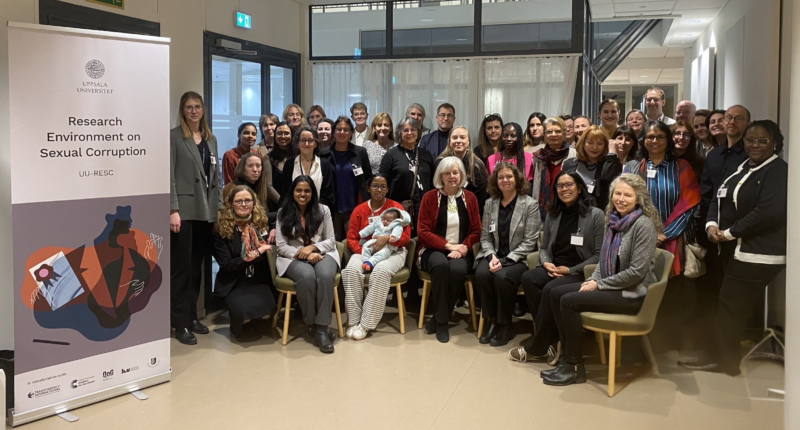
Over three days, participants discussed ongoing and future research, policy directions, advocacy efforts, and opportunities for collaboration. The program was designed based on participants’ proposals, and the workshop was truly interactive as a result; throughout, all participants took part in joint full-group discussions, fostering cross-disciplinary, cross-sector, cross-context, and research-practitioner conversations.
The workshop kicked off with a keynote conversation between pioneer Nancy Hendry and the UU-RESC lead Elin Bjarnegård. They spoke about the foundation and history of the work against sexual corruption, the development of research and advocacy efforts over the years, as well as future trajectories. The first day included sessions about concrete manifestations of sexual corruption across contexts, and cutting-edge methodologies developed to capture and measure a phenomenon that is stigmatized, sensitive, and silenced. These panels drew on cross-sectoral experiences of sexual corruption from migration, water and sanitation to law enforcement, and discussed the importance of data while highlighting challenges in collecting data on such an unspoken phenomenon in many contexts.
The second day of the workshop focused on policy and legal frameworks, perpetration and impunity, and ethical considerations for responsible research and practice. During the keynote of the day, Monica Kirya (U4), Ketakandriana Rafitoson (TI), and Jennifer Sarvary Bradford (UNODC) shared experiences and insights from the intersection of research and policy. Special attention was drawn to the historical step of recognizing sexual corruption as a particular form of corruption in Resolution 10/10, adopted at the 10th session of the Conference of States Parties to the United Nations Convention Against Corruption, in 2023. The day continued with sessions on efforts to map legislation and challenges in local processes of developing legal frameworks, on powerful perpetrators and factors that enable abuse of power and impunity, but also men as agents for change, and on “do no harm” approaches to mitigate unintended harm and support ethical and responsible practices. These sessions were followed by an open panel that focused on sexual corruption in Sweden, where the self-image of Sweden as a leading gender-equality champion and a non-corrupt country was debated in the context of instances of sexual corruption and recent legal amendment efforts.
On the final day of the workshop, focus shifted to the global strategies for change. A session sharing experiences of early, groundbreaking, persistent, and long-term advocacy against sexual corruption which brought together local experiences from around the globe. Best practices and mobilisation were showcased, as were strategies to address key challenges such as victim-blaming, weak institutional responses, and impunity for sexual corruption.
This historical international workshop concluded with a collective reflection on three days of discussions in Uppsala. Participants left with already identified concrete opportunities for synergy and opened new avenues for collaboration between researchers and practitioners. The discussions led into a set of forward-looking priorities that will shape research, advocacy, and reform efforts in the years ahead. The main takeaways from the workshop were as follows:
- Sexual corruption is not confined to specific regions but manifests worldwide, requiring both context-sensitive responses and shared analytical frameworks that focus on abuse of entrusted authority.
- Naming and clearly defining sexual corruption is essential to make the phenomenon visible, maintain focus on abuse of power, and prevent it from being diluted within broader anti-corruption or gender-based violence agendas.
- Data and measurement are critical for understanding prevalence, risk factors, and contextual dynamics. Yet stigma, silence, and gendered norms make these phenomena difficult to measure adequately. Strengthening data collection therefore requires methodological innovation and sustained collaboration.
- As countries adopt varied legal approaches to sexual corruption, comparative learning is needed to identify effective models, strengthen victim protection, ensure accountability, and address remaining legal gaps.
- Prevention requires shifting focus to perpetrators and systems through ethics, education, sanctions, and accountability mechanisms, rooted in collaboration across research, practice, policy, and advocacy.
Read more about the workshop and UU-RESC.
Visit the Gender, Inclusion and Corruption Working Group to find out more on the Sexual Corruption Legal Taskforce.