


15 December 2025 –
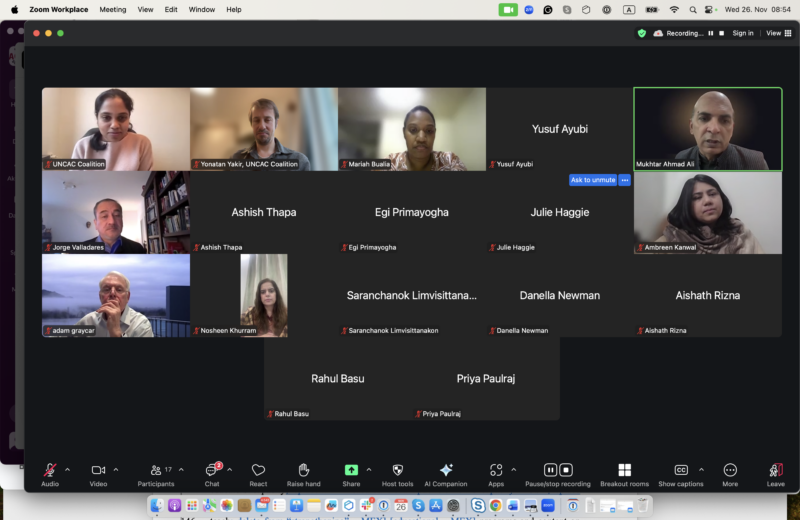
As States prepare for the 11th Conference of the States Parties (CoSP 11) to the United Nations Convention against Corruption (UNCAC) in Doha this December, members of the Asia-Pacific regional network of the Global Civil Society Coalition for the UNCAC gathered for their 23rd regional meeting. The discussion centred on two themes: civil society resilience amid shrinking civic space, and coordinated advocacy ahead of CoSP 11.
Shrinking civic space: Reflections from across the region
Civil society actors across the Asia-Pacific continue to operate under increasingly difficult conditions, new restrictions, and complex challenges. Anti-corruption and anti-government protests from Indonesia to Nepal have been met with violent crackdowns. Governments in India, Pakistan, and Afghanistan have imposed social media and digital blackouts. Repressive laws targeting activists and journalists have emerged from Hong Kong to Thailand. Ongoing conflicts in Myanmar, Papua New Guinea, and the Philippines further limit civic engagement.
Despite these pressures, civil society has adapted, persisted, and found new pathways to influence national and global anti-corruption agendas. Regional group members’ contributions from Southeast Asia, South Asia, Central Asia, and the Pacific during the first segment of the meeting revealed consistently deteriorating civic freedoms, with many countries now classified as “repressed,” “obstructed,” or “closed” by CIVICUS. Yet members also highlighted renewed mobilisation, especially among youth and grassroots communities.
Southeast Asia: Rising repression and hope with youth-led mobilisation
“Stronger solidarity across regions is needed.” (Egi Primayogha, Head of Advocacy at Indonesia Corruption Watch, and Coalition Board member on behalf of East Asia, Central Asia and Pacific)
Civic space restrictions are increasingly tied to corruption issues, leading to people’s protests in many countries. Primayogha outlined escalating crackdowns on such protests as well as broader civic space across Southeast Asia from Indonesia, Malaysia, Cambodia, Thailand, the Philippines, Lao, Myanmar and Vietnam, among others. He highlighted that attacks on civil society activists, journalists, and citizens are becoming more frequent, including by weaponising the law against them, arbitrary arrests and long-term imprisonment, online surveillance and use of excessive force to crack down on protests across these contexts.
Yet, Primayogha noted that youth-led movements continue to mobilise despite repression, using digital platforms more cautiously and strengthening digital security practices to navigate the shrinking spaces.
Nepal: New uncertainties and way forward
“A new hybrid modality of demanding accountability” where Gen-Z protests and demands meet civil society approaches can emerge. (Ashish Thapa, the Executive Director of Transparency International Nepal)
Thapa described how a wave of youth-led protests in September 2025 overturned the government in just two days, reshaping Nepal’s political landscape. CSOs in Nepal continue to face indirect restrictions with registration requirements, burdensome annual renewals, and multi-agency approvals. Consequently, the limited capacity, lack of resources for internal governance and funding constraints affect how far the organisations can provide oversight to government irregularities. This results in a public trust deficit in the organisations. However, he noted that the role of civil society and grassroots movements that reach rural and marginalised communities, through their advocacy and awareness-raising campaigns, helps people realise their rights and empower them to mobilise on a larger scale against corruption.
Thapa explained that civil society must deepen engagement with youth and explore more independent funding sources to tackle the increasing indirect challenges to the civic space.
Afghanistan: Community-based approaches to anti-corruption
Yusuf Ayubi, the Partnerships Manager at Integrity Watch Afghanistan, described a sustainable civic space model, not only fighting against shrinking space but also mobilising funding to support CSOs and communities inside Afghanistan. After the political changes in 2021, many CSOs closed their doors in Afghanistan, either due to a lack of funding or expertise, given the broader political and economic situation. However, Integrity Watch adopted an “inside-out” strategy through partnering with other struggling grassroots civil society organisations at the provincial level in 15 provinces by providing them with financial and technical support. Through offering sub-grants and technical support, Integrity Watch supported struggling CSOs and communities to engage in the delivery of local public services via implementing its Community-Based Monitoring (CBM) model. While adhering to strict safety measures given the operating environment in Afghanistan, CBM facilitated collective action, collaborative problem solving and local advocacy through citizen monitoring, which proved to be a successful model given Afghanistan’s fragile context. Ayubi highlighted that, given the current operating environment in Afghanistan, empowering grassroots organisations from within is critical to sustaining civic space and engaging with authorities in highly restricted environments.
Papua New Guinea: Expanding controls and strategic pushback
Mariah Bualia, the Partnership and Policy Officer at Transparency International Papua New Guinea, highlighted emerging trends of restrictive legislative and policy developments targeting civil society in Papua New Guinea. She noted that the recent passing of the National Counter-Terrorism Act by parliament in 2024 has raised concerns due to its overly broad definition of “terrorist”, which civil society fears may be used to stifle public discourse and criminalize citizen’s opinion that may be critical of the government. Powers under this law have already been invoked to justify a blanket shutdown of Facebook access during politically sensitive periods.
On the other hand, the Cybercrime Act 2016, while intended to criminalise cyber-related offences, has in recent times been used to suppress freedom of expression through the initiation of Strategic Litigation Against Public Participation (SLAPP) lawsuits against activists and citizens.
While the government has shown willingness to include civil society in key policy and legislative dialogues, what remains a challenge is the lack of avenues for wider citizen engagement with the government outside of the election cycle. Bualia noted instances of consultation periods often being rushed through, and the stakeholder input is rarely reflected in final policy outcomes.
Nevertheless, Bualia highlighted that multistakeholder platforms such as the Open Government Partnership (OGP) and other joint coalitions comprised of diverse stakeholders, such as civil society, youth, private sector and trade unions, continue to play an important role in driving national advocacy priorities and inclusive participation. Civil society continues to play a leading role in ensuring information remains accessible to citizens so as to make sure they are well informed and are able to contribute meaningfully to policy reforms.
Pakistan: Polarisation and funding shrinkage
Mukhtar Ahmad Ali, the Executive Director at Centre for Peace and Development Initiatives in Pakistan, the Coalition’s current Chair and board member representing South Asia, described an environment of political polarisation, restrictions on media and civil society, and frequent complaints of political victimisation by the governments of their opponents.
Access to international funding is also a major challenge, as the process for registration and approval from relevant authorities is tedious and time-consuming. An additional set of challenges lies in the reaction from the banks, as they sometimes impose compliance burdens that delay or prevent the receipt of funds and, hence, the project implementation. Regional Conflicts pose additional mobility and security challenges for organisations.
Overall, across countries, participants identified the following common patterns, which will inform the regional network’s priority-setting in 2026:
- Youth activism is reshaping civic space, often emerging outside traditional civil society structures.
- Digital spaces are both opportunities and threats, with online surveillance and cybercrime laws weaponised against activists.
- Restrictions on funding and registration are used to indirectly impede civil society’s work.
- Civic space and anti-corruption are increasingly interlinked, where protests across the region are triggered by high levels of corruption.
- Multistakeholder coalitions (e.g., OGP) remain critical spaces for influence.
Looking toward CoSP 11: Coordinated advocacy and key priorities of the region
The second half of the meeting focused on preparations for the upcoming CoSP, as States are currently negotiating draft resolutions that will shape global anti-corruption standards in the years to come.
Advocacy Priorities for the UNCAC Coalition
The proposed resolutions on the next phase of the Implementation Review Mechanism of the UNCAC, Corruption and crimes that affect the environment, and political finance transparency, are prioritised by the Coalition this year. Cross-cutting themes of civic space in the fight against corruption, access to information, human rights and implementation of adopted resolutions will also be given a priority. These priorities were chosen based on the consultations that the Coalition conducted among its membership during the past few months.
Members of the network, as well as broader civil society, are welcome to make use of the new advocacy and communications toolkit developed by the Coalition with key messages, social media materials, and country-specific guidance when advocating for these priority areas.
Political Finance Transparency: A historic resolution
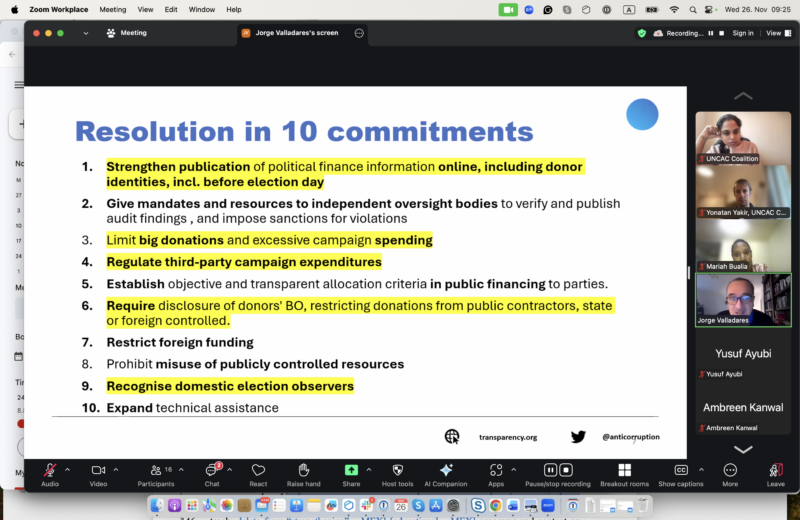
Jorge Valladares, Political Integrity Policy Lead at Transparency International Secretariat, presented the groundbreaking draft resolution on political finance transparency, the first in the CoSP’s history. Co-sponsored by Norway, Ghana, Albania, and Mongolia, the draft resolution aims to advance 10 key commitments, including:
- Publishing political finance data online, including donor identities
- Strengthening independent oversight bodies
- Limiting large amounts of donations and excessive campaign expenses
- Regulating third-party campaign expenditure
- Establishing mechanisms for transparent and objective public financing allocation for parties
- Regulating high-risk donations (e.g., from public contractors) and requiring disclosure of beneficial ownership details of the donors
- Restricting foreign funding
- Prohibiting misuse of public resources
- Recognising domestic election observers
- Expanding technical assistance
Members of the regional network are encouraged to raise awareness about these commitments in the resolution and sign the open letter. Civil society in the region can advocate with the Country delegations to CoSP 11 to advance these commitments by providing them with key messages, offering expert advice, and asking them to join the negotiations and support the above-mentioned asks. This resolution should become the new global standard in this field of high risk of corruption, a key tool and a blueprint for advancing national reforms on political finance transparency.
Important resources: Digital disclosure of political finance in Africa, Asia and the Pacific, and Latin America and the Caribbean
Next Steps for the Asia-Pacific Network
Members of the regional network are encouraged to:
- Register for the Civil Society Preparatory Day on 14 December in Doha.
- Use the Coalition’s toolkits to engage governments ahead of and during CoSP11.
- Use and disseminate the Asia-Pacific regional submission to the CoSP 11 of the Coalition.
- Continue reflecting on civic space developments and lessons learnt for 2026 strategic planning.