


21 July 2025 –
by Danella Newman, Project Manager at the UNCAC Coalition and the Anti-Corruption Coalition Uganda
With support from the UNCAC Coalition, civil society in Uganda advanced discussions on witness protection, asset recovery and UNCAC implementation at the national level. Stories like this one from our member organization in Uganda are one way we can measure impact at the national level.
Following the publication of their civil society parallel report UNCAC implementation in Uganda in late 2021, the UNCAC Coalition continued its support of Anti-Corruption Coalition Uganda (ACCU) to conduct follow-up activities on the key recommendations of their report. Through engagement with key stakeholders from government and civil society alike, ACCU managed to substantially advance discussions on strengthening witness protection, asset recovery, as well as transparency and participation in UNCAC implementation in Uganda.
Strengthening witness protection, asset recovery and UNCAC implementation
In the absence of a whistleblower protection framework and an environment in which the government was cracking down on media and journalists for exposing corruption, one of ACCU’s parallel report’s key recommendations was the establishment of a legal and institutional regime for the protection of witnesses and whistleblowers. Since 2021, little progress has been made.
However, in the framework on the follow-up activities, ACCU developed three position papers on the Witness Protection Bill, the Proceeds of Crime Bill, and on UNCAC implementation, which were disseminated to a wide range of other CSOs for input and validation. This culminated in a civil society advocacy coordination meeting for continued action. ACCU subsequently disseminated the position papers to key government stakeholders to advance its key recommendations and seek a clear position on which steps key institutions were taking towards the enactment of the Bills.
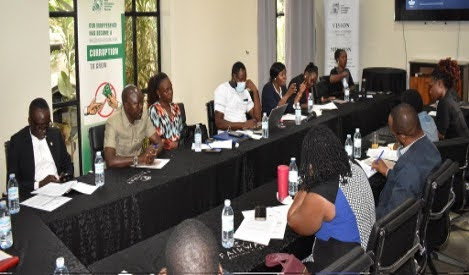
The next step was a multi-stakeholder advocacy meeting with CSOs, Members of Parliament and representatives of key government anti-corruption agencies. During this meeting, ACCU facilitated the development of a legislative roadmap on the enactment of the Witness Protection Bill 2015 and the Proceeds of Crime Bill. Its key features included proposals for new sponsors of the bills, and targeted training on the importance of these bills for Members of Parliament. The discussion also covered the role of the media in creating awareness on key proposals of the bills.
As an outcome of a previous gathering of the UNODC’s Eastern Africa Anti-Corruption Platform, ACCU alongside other CSOs and government officials, participated in a three-day launch of the Uganda Baseline Mapping Exercise on accelerating the implementation of the UNCAC. This meeting aimed to review the state of affairs of three thematic areas, including asset recovery and whistleblower protection. Through the identification of best practices and the needs for technical assistance, this meeting represented a key advocacy opportunity for ACCU to contribute its expertise and advocacy to.
Increasing awareness and dialogue around UNCAC implementation and the need for a more transparent and inclusive IRM
ACCU enhanced public discourse around transparency, whistleblower protection, asset recovery, and UNCAC implementation through a multi-pronged nation-wide social media campaign on Facebook and X, featuring specifically-designed online flyers and posters. This campaign reached over 3,500 people and generated 25 re-posts.
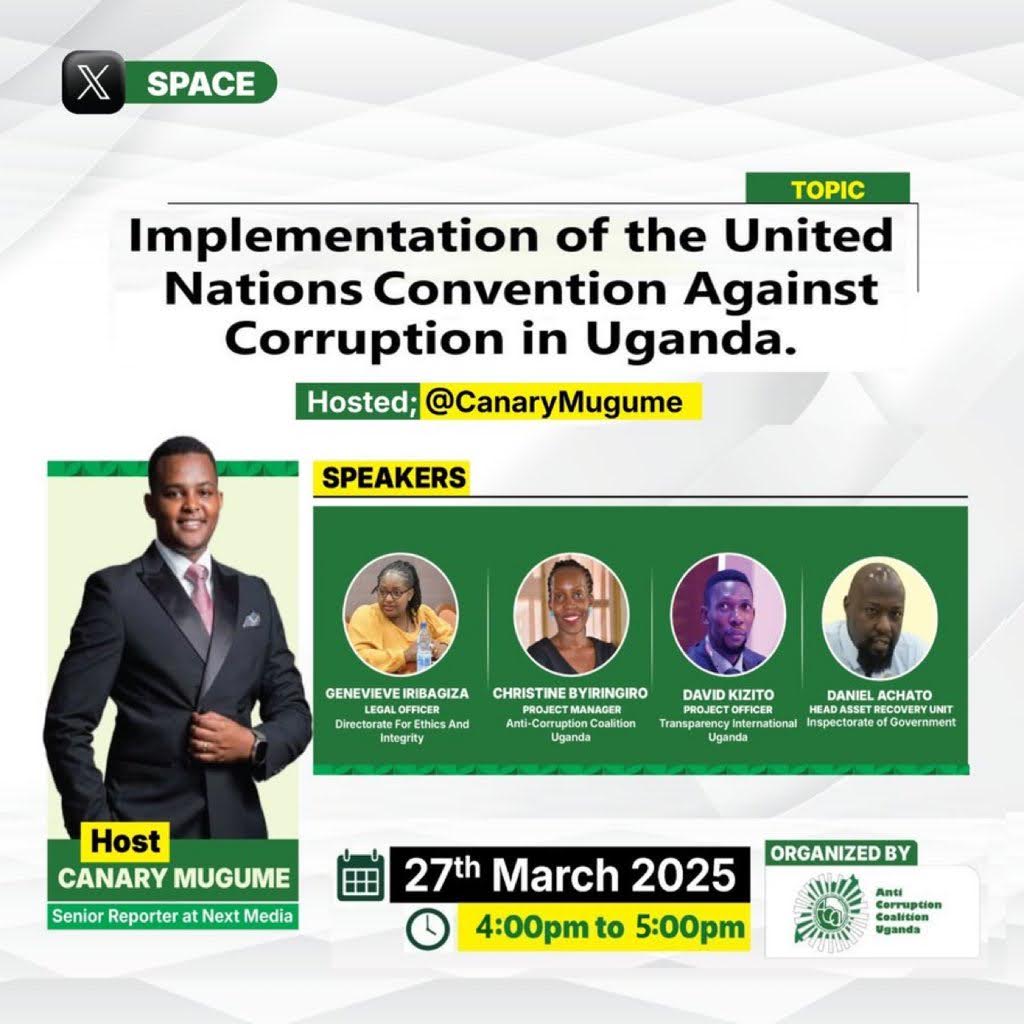
They also convened an X-space conversation on implementing the UNCAC in Uganda, which was moderated by well-known investigative journalist Canary Mugume. Panelists from ACCU and TI Uganda, as well as governmental agencies such as the Asset Recovery Unit of the Inspectorate of Government, and the Legal Affairs Department of the Directorate of Ethics and Integrity, discussed how to ensure participation of society in anti-corruption efforts, the government’s position on ACCU’s parallel report findings, as well as actions the government is undertaking to advance whistleblower protection, asset recovery and transparency more generally. This space generated great interest, with almost 2000 views.
Additionally, ACCU featured on a radio talk show on Next Radio Uganda, where they discussed the importance of witness and whistleblower protection.
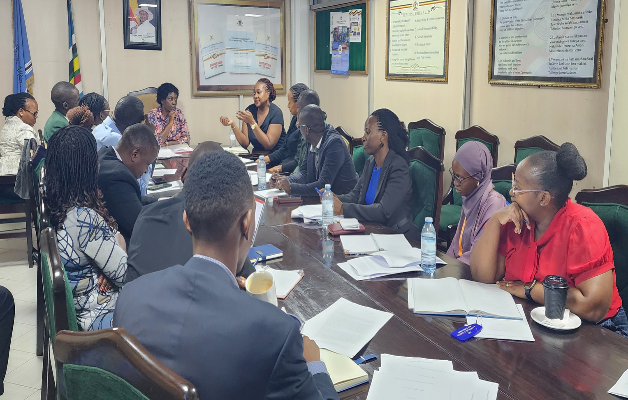
To reinforce their recommendations on whistleblower protection, asset recovery, as well as on increasing transparency and inclusiveness of the UNCAC review mechanism, ACCU convened follow-up meetings with the Asset Recovery Unit of the Inspectorate of Government, the Governance and Security Programme and the Directorate of Ethics and Integrity, together with several of its member CSOs. The meetings opened a space for participants to discuss challenges in advancing these key anti-corruption issues and revealed entry points for further collaboration in the fight against corruption in Uganda.
Successes and impact
Through its follow-up advocacy activities, Anti-Corruption Coalition Uganda was able to significantly contribute to anti-corruption efforts in Uganda. Key examples of their impact include:
- Increased awareness and amplified engagement on the need for more effective UNCAC implementation and particularly for whistleblower protection and asset recovery reforms by both state and non-state actors.
- Mobilized CSOs to become more actively engaged in coordinated advocacy efforts on whistleblower protection, asset recovery and UNCAC implementation, and to collectively advocate for stronger anti-corruption standards.
- The legitimization of the CSO position papers ACCU coordinated on these three anti-corruption issues, which have significantly shaped and influenced official discussions by both state and non-state actors. This shows that evidence-based advocacy can be very powerful. For instance, after highlighting capacity gaps in implementing the guidelines for public prosecutors to determine witness protection parameters and the scope of protection during investigations, the Office of the Director of Public Prosecution conducted a training for prosecutors to address this shortcoming.
- Strengthened collaboration between civil society and state actors on issues of anti-corruption, policy reforms, legislative reforms, and UNCAC implementation, and a willingness from the government to continue engaging in civil society recommendations on UNCAC implementation.
- A commitment by the Directorate of Ethics and Integrity to present the UNCAC Review Transparency Pledge to Cabinet.
- The appointment of a designated governmental contact point to sustain conversations and advocacy efforts towards Uganda’s implementation of the UNCAC.
- An invitation for CSOs to contribute to the 2025 Anti-Corruption Rules and standards on asset recovery, which the government was in the process of developing, including in an in-person meeting. This represents a significant shift toward more inclusive and participatory policy formulation. ACCU will now coordinate the drafting of a matrix of recommendations to inform the Anti-Corruption Rules, 2025, by setting up a working group of CSOs.
- The President of Uganda directing the Attorney General to fast-track the enactment of the Witness Protection Bill 2015.
Outlook and next steps
Uganda now has the building blocks in place to keep advancing anti-corruption efforts, with government stakeholders showing openness to further engagement. As stated by Marlon Agaba, Executive Director of Anti-Corruption Coalition Uganda, “this initiative was not just a critique but a roadmap; as civil society, we will continue to engage government, push for legal reforms, and build citizen capacity to demand transparency and accountability across all levels as well as call for a full implementation of the UNCAC in Uganda.” Sustained advocacy, strategic monitoring, and broadened civic engagement will be crucial to ensure implementation, especially in light of the upcoming general elections in Uganda in 2026.
ACCU will now focus on deepening its role as a watchdog, supporting technical input, and ensuring public accountability in the enforcement phase. The organization will monitor progress on the bills, continue raising awareness on these issues, and maintain regular communication with key stakeholders. Funds allowing, they will undertake a cost-benefit analysis of a formal witness protection program in Uganda, as suggested by government agencies; and establish a civil society observatory on UNCAC implementation to document, publish, and publicize Uganda’s progress against UNCAC commitments. Finally, collaboration with regional and international stakeholders remains crucial to ensure Uganda meets international standards and best practices.