


6 July 2026 –
The Asia-Pacific region is home to some of the world’s richest natural resources and ecosystems. From minerals to timber to fisheries to agricultural commodities, the region plays a vital role in global supply chains. Unsurprisingly, these sectors remain particularly vulnerable to corruption, in which licensing and permitting, conflicts of interest, opaque ownership structures, illicit financial flows, and State capture by powerful economic and political actors can undermine both sustainable development and environmental protection. Therefore, as countries increase the extraction of critical minerals to meet growing demand for the energy transition, strengthening transparency, accountability and integrity in natural resource governance has never been more important. This requires moving beyond viewing natural resource governance solely as an environmental or economic issue and recognising it equally as an anti-corruption priority.
Against this backdrop, the 26th Asia-Pacific Regional Meeting of the Global Civil Society Coalition for the UNCAC brought together anti-corruption practitioners, environmental justice advocates and governance experts to explore corruption vulnerabilities in natural resource governance across the region. The discussion was prompted by interest expressed by several members through the Coalition’s regional community survey, and took place at a timely moment following the adoption of two key Resolutions at the eleventh session of the Conference of the States Parties to the United Nations Convention Against Corruption (UNCAC). Resolutions 11/9 on Preventing and combating corruption as it relates to crimes that affect the environment, and 11/3 on strengthening the implementation of UNCAC in small island development states, together include new commitments that reaffirm, directly and indirectly, the importance of transparency, public participation, and accountability in tackling corruption in climate finance and natural resource governance.
From “windfall revenue” to “shared inheritance”
The main discussion was opened with Rahul Basu, Research Director at Goa Foundation in India, who challenged one of the most fundamental assumptions surrounding natural resources: who they actually belong to. Rather than viewing minerals as a source of government revenue to be extracted and spent, Basu argued that they should be understood as a shared inheritance held in trust by the state on behalf of both present and future generations. Under this approach, governments are not owners of natural resources but trustees with a duty to ensure that extraction does not diminish the inheritance of future generations.
Using evidence from the Indian state of Goa, Basu illustrated the consequences of weak natural resource governance. Between 2004 and 2012, the state received less than 5% of the value of the minerals extracted (resource rent). Studies show that this is not an isolated case, noting similar patterns observed across many resource-rich countries. For example, Australia’s estimated loss rate between 2002 and 2012 was approximately 82%. Diving deep into this data challenges the common assumption that increasing extraction necessarily benefits the public. Governments often argue that extracting more minerals will generate more income for the economy, but in reality, these numbers show a loss of wealth rather than a gain. On the other hand, miners and politicians have incentives to collude to continue rent-seeking practices. Anyone who stands in this way, including local and indigenous communities, activists, or nature itself, is considered an obstacle. Basu explained how these dynamics fuel conflicts, reminding that some of the world’s deadliest violent conflicts are fought over natural resources.
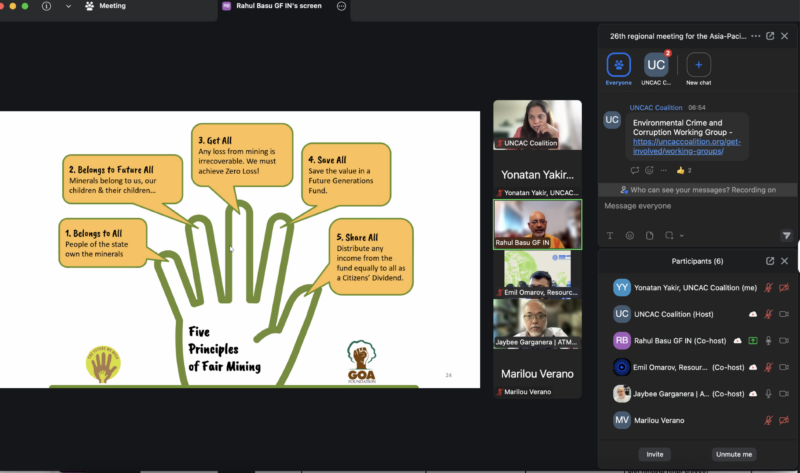
To address these challenges, Goa Foundation proposes five principles of fair mining: minerals belong to all people and future generations; governments should ensure zero loss in extraction; proceeds should be safeguarded through a Future Generations Fund; and investment returns should ultimately benefit all citizens equally. Framing minerals as a shared inheritance also strengthens the case for integrity measures such as integrity due diligence (including fit and proper person tests, beneficial ownership transparency and conflict-of-interest safeguards), whistleblower protection and stronger legal frameworks such as anti-money laundering laws that encompass illegal mining and related practices.
Perhaps the most powerful takeaway was a simple shift in language. Rather than treating minerals as a source of windfall revenue that we get one-time and eagerly spend, Goa Foundation encourages us to think of them as the family gold: an inheritance that governments have a responsibility to protect and preserve for future generations as well, rather than spend and lose. See here the full presentation
Transparency beyond revenue
The discussion then turned to practical tools for strengthening accountability in the extractive sector.
Emil Omarov, Head of the Eurasia and Asia-Pacific unit at the Resource Justice Network, highlighted the importance of transparency initiatives and regional collaboration to combat corruption in the natural resource sector. He explained the potential of the Extractive Industries Transparency Initiative (EITI) standards, particularly in exposing governance weaknesses within state-owned enterprises, monitoring contract implementation and identifying deviations between agreements and practice. Beyond disclosure alone, transparency frameworks such as EITI can help civil society generate evidence, monitor commitments and strengthen public oversight throughout the extractive processes.
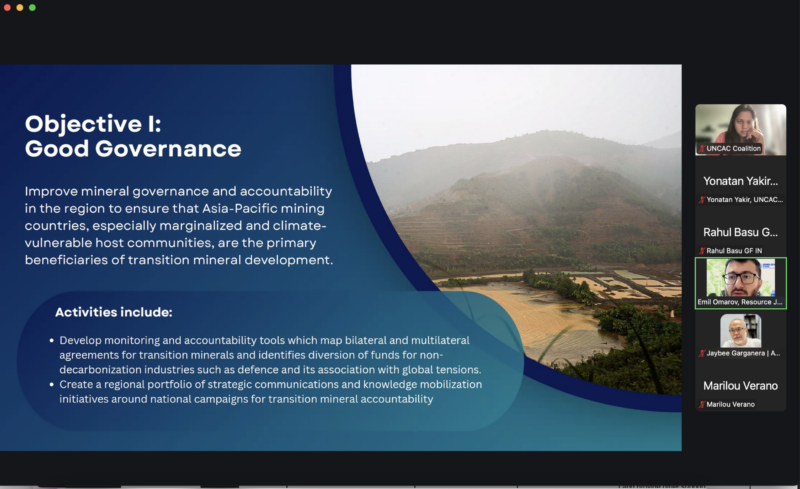
He also noted the growing importance of regional cooperation as countries across the Asia-Pacific navigate the governance challenges posed by the global demand for transition minerals. Such regional platforms also become critical spaces to provide a voice for the affected communities, to bring evidence from the ground and channel those voices and demands for inclusive and effective policy reform processes. As the region becomes increasingly central to the energy transition, ensuring that mineral extraction respects both environmental standards and principles of accountability will require stronger collaboration among governments, civil society and affected communities across the region. Therefore, he concluded by inviting the Coalition’s Asia-Pacific regional network to collaborate more closely with the Asia Pacific-Transition Mineral Accountability Working Group (AP-TMA) and the Resource Justice Network, emphasising that joining forces can help better influence policy decisions at the local, regional, and global levels. For instance, the Resource Justice Network and the Global Civil Society Coalition for the UNCAC’s Working Group on Environmental Crime and Corruption will be conducting an open multistakeholder webinar (more details and register here) on the commitments made under the aforementioned CoSP Resolutions, discussing practical anti-corruption reforms to strengthen resource and transition governance. See here the full presentation.
Real owners behind mining companies
The session concluded with a compelling example of how transparency and access to information can expose corruption risks that would otherwise remain hidden and devastate the accountability structures of a country, particularly in the natural resource sector. Jaybee Garganera, National Coordinator of Alyansa Tigil Mina and Board Member of Bantay Kita, presented a pioneering study tracing the beneficial ownership of 44 major mining contracts in the Philippines. The study sought to test a long-held hypothesis: that regulatory failures are often linked to political actors and their family members who are themselves the ultimate beneficiaries of mining operations. This research also reminds the importance of tackling the issue of secrecy around beneficial ownership information, as discussed in the UNCAC Resolution 11/9.
Using ownership mapping and publicly available corporate information, the research uncovered complex ownership structures connecting mining companies, investment schemes and politically influential families. The findings suggest that beneficial ownership transparency is not simply a technical governance reform but an essential tool for identifying conflicts of interest, exposing regulatory capture and understanding why environmental protections are often weakened or poorly enforced. The presentation also underscored the value of evidence-based advocacy. By systematically documenting ownership structures, the research provides a stronger foundation for future policy reform, public debate and accountability efforts surrounding mining governance in the Philippines. See here the full presentation.
No planet B: Confronting corruption in the natural resources sector
While each speaker approached natural resource governance from a different perspective, a common message emerged throughout the discussion: transparency and access to information are the foundation of accountability and equitable governance. Whether through rethinking minerals as a shared inheritance, strengthening contract and revenue transparency, or exposing beneficial ownership behind extractive industries, the meeting demonstrated that corruption risks in natural resource governance cannot be addressed in isolation. They require cooperation between anti-corruption practitioners, environmental advocates, and human rights defenders. The recent adoption of UNCAC Resolutions further reinforces this direction by recognising corruption as an enabler of environmental crime and encouraging States Parties to strengthen integrity frameworks, improve public access to information, protect reporting persons, including indigenous peoples and local communities, and address professional enablers who facilitate corruption and illicit financial flows.
As demand for natural resources for the Asia-Pacific region continues to grow, ensuring that these resources benefit people rather than vested interests will require governance systems built on transparency, accountability and meaningful public participation. The discussions during this regional meeting made one thing clear: natural resource governance is no longer solely an environmental or economic issue; it is fundamentally an anti-corruption issue. The Coalition will continue to engage in these conversations, facilitate and encourage regional cooperation and advocacy, particularly leveraging UNCAC as a framework to address the corruption aspect of crimes that affect the environment. Asia-Pacific members working on corruption in natural resources are encouraged to join the Coalition Working Group on Corruption and Environmental Crimes, which facilitates discussions, exchange of information and joint advocacy among civil society experts working on this issue.
Looking ahead
The Coalition is developing a guide for civil society on the implementation of CoSP resolutions 11/9 and 11/3. This guide, which will be launched in September 2026, will provide practical ideas on how to turn these global commitments into national-level action.
The Coalition is also preparing for the special session of the Conference of the States Parties in November 2026, which will convene for one day to formally adopt the key review template documents of the next phase of the Implementation Review Mechanism, officially concluding the deliberations on the IRM’s next phase. As Countries’ deliberations on the key review documents are entering their final stage, our regional communities will have an important role to play in urging States Parties to adopt comprehensive review documents which will lead to the fulfilment of the IRM’s potential as envisioned in CoSP resolution 11/2. In particular, yielding more precise, transparent, inclusive, and credible review outcomes for countries to enhance their UNCAC implementation. More details on the next steps will be shared in the coming weeks.