


7 May 2026 –
The real estate sector is one of the most vulnerable areas to corruption and money laundering. It has multiple entry points for abuse, and has negative consequences affecting society as a whole. Inflows of illicit capital into property markets can drive up prices, make housing unaffordable, and reinforce the very criminal activities that generate such funds. These dynamics are especially visible in major cities and in fast-growing urban and tourist areas, including in European countries. Against this backdrop, the European network of the Global Civil Society Coalition for the UNCAC convened a regional meeting on April 16, 2026, to explore the intersection between real estate, corruption, and money laundering in Europe, with the aim of identifying main trends and existing opportunities for civil society action.
An attractive destination for corrupt money
Real estate is an attractive destination for illicit proceeds as it allows corrupt actors – domestic and transnational – to launder and store wealth acquired through bribery, embezzlement, or other crimes by purchasing real estate assets, often hiding behind opaque financing mechanisms. Real estate can also be a vehicle for corruption when governmental decisions on land-use or construction permits are captured by vested interests and criminal networks.
These challenges are closely linked to the implementation of the United Nations Convention against Corruption (UNCAC), particularly its provisions on corruption prevention and public sector integrity, asset recovery, and the regulation of private actors. The persistence of corruption risks in the real estate sector is, in part, due to gaps in the oversight of real estate agents and other professional service providers (lawyers, notaries, accountants, etc.), also called “enablers”, who play key roles in property transactions and, knowingly or as a result of insufficient safeguards, can facilitate corruption and money laundering.
Key findings from the OREO Index in Spain
At the same time, anti-money laundering (AML) regulatory frameworks often struggle to effectively address the risks involved and hold enablers to account. Illustrating this, David Martínez, Executive Director of Transparency International Spain, presented a new measurement tool designed by Transparency International and the Anti-Corruption Data Collective (ACDC) which was launched in 2025: the Opacity in Real Estate Ownership (OREO) Index.
This index evaluates 24 jurisdictions – important financial hubs with dynamic real estate markets (18 members of the G20, Spain and Norway as guest countries, as well as Hong Kong, Panama, Singapore and the United Arab Emirates), and analyzes two pillars: the quality of real estate data, and the strength of AML frameworks.
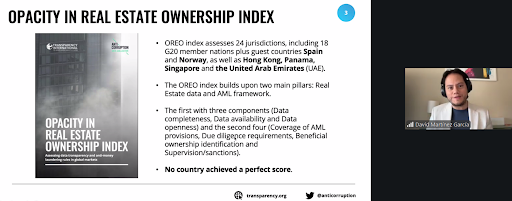
While no country achieved a perfect score, the case of Spain is particularly interesting because it shows a deep imbalance: Spain obtained among the highest scores in AML provisions, and among the lowest in data transparency. As David explained, Spain’s AML framework is relatively robust and extends obligations to all professionals involved in real estate transactions. Compared to many other jurisdictions, this is a notable strength, even if important gaps remain. For instance, the verification of the source of funds is only required in high-risk cases, and due diligence rules do not clearly ensure that payments are made through traceable financial channels. The law requires professionals to identify beneficial owners before carrying out a transaction; however, it allows for the naming of a senior officer or director as a substitute for the beneficial owner. In addition, foreign companies are not required to register their beneficial owners locally to purchase real estate.
The most critical weaknesses, however, lie in the data ecosystem. Property registration is only mandatory in the cadastre (physical and administrative information about real estate), but not in the property register (legal ownership of the assets). The property register does not record beneficial ownership (BO) information, which means that real individuals behind legal entities owning property might remain hidden. Access to data is also restricted: it is costly, not available in bulk, and not provided in machine-readable formats, thus limiting its usability for large-scale analysis and cross-referencing with other datasets.
Additionally, the biggest corruption risks in the Spanish real estate sector are linked to influence peddling in urban planning, given the discretionary power of local authorities to reclassify land, and change the permitted use of the land – decisions that can dramatically increase land value. Taken together, these challenges not only expose systemic vulnerabilities but also point clearly to where reforms and civic action can make the greatest impact:
1) reducing administrative discretion;
2) strengthening proactive transparency and disclosure, particularly through mandatory identification of beneficial ownership;
3) improving judicial oversight;
4) reinforcing whistleblowing protection;
5) better connecting of data and legal frameworks to close loopholes and ensure maximum transparency.
This is precisely where ongoing initiatives by Coalition members are beginning to translate these priorities into practice. For instance, Transparency International Spain, Libera (Italy), the Center for the Study of Democracy (CSD) (Bulgaria), and governmental partners, are jointly working on the project “Open the Whistle: Protecting Whistleblowers through Transparency, Cooperation, and Open Government Strategies” that aims to create a safer environment for whistleblowers.
Linking ownership data for land and legal vehicles to strengthen asset transparency
The second presentation also illustrated why data openness is crucial: With comprehensive, quality and interconnected datasets, not only authorities, but also public watchdogs might be able to detect patterns and identify suspicious ownership structures.
Tymon Kiepe, Head of Policy & Research at Open Ownership, presented their latest research on ownership data for land, titled “Bridging the gap for effective asset transparency”. While significant progress has been made in beneficial ownership transparency (BOT) for companies and other legal vehicles, Tymon noted that the focus of attention is shifting towards assets such as real estate. Understanding who ultimately owns and controls land assets, including land, real estate and property, is essential for anti-corruption efforts, as well as for taxation and sanctions enforcement. Two examples of this global policy push are the OECD Framework for the Automatic Exchange of Readily Available Information on Immovable Property, and the financing for development process (General Assembly resolution “Sevilla Commitment”) and ongoing negotiations towards a UN tax convention about the creation of a global register covering assets, companies and ultimate owners.
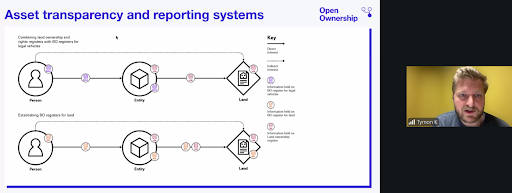
In this context, Open Ownership’s study analyzed three types of registers and the information they provide, across a sample of jurisdictions (England and Wales, Scotland, Estonia, British Columbia in Canada): BO registers for companies and legal vehicles (revealing the individuals behind them), land registers (containing information on legal ownership), and specific BO registers for land. Depending on the country, these registers include different data. Two main approaches were identified to strengthen transparency. One consists in establishing separate beneficial ownership registers specifically for land; the other approach is to strengthen the existing BO register for companies and the land register.
The study found that, where land ownership information can be connected with BO information for companies/legal vehicles (for instance, in Estonia), this might be a better option than establishing a new BO register for land. It requires, however, the fulfillment of key conditions: 1. Consistent and reliable identifiers for land, legal entities, and people; 2. Comprehensive, well-structured and verified information of rights and interests; and 3. Access to BO information, including of foreign companies or legal vehicles that own land. Overall, Tymon concluded that, if high-quality information, comprehensive coverage, and interoperability of registers are ensured, strengthening and connecting existing systems is likely to be more efficient than creating parallel ones.
How investigative journalists expose real estate owned by shell companies
Usually, investigative journalists are those who make corruption cases in the real estate sector public by uncovering scandals and exposing wrongdoing. Leila Bičakčić, Executive Director of the Center for Investigative Reporting (CIN) of Bosnia and Herzegovina, shared insights on a case study about opaque ownership structures, an investigation on the recent surge in real estate developments around Sarajevo, that aimed to uncover who was behind these developments and how land acquisition was taking place.
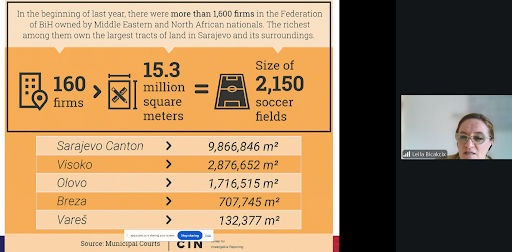
CIN’s investigation relied on land registry data and company financial records, although this information was fragmented and costly. It found that approximately 15 million square metres of land had been acquired by foreign-owned companies, many of which were shell entities, while the legislation forbids foreign nationals to own land in Bosnia and Herzegovina unless they come from countries with reciprocity agreements. CIN suspected that, to circumvent the law, investors had established local companies to purchase property and identified that around 160 such companies were in fact shell companies – with minimal capital and no real business activity. Further analysis revealed widespread irregularities: Many developments were built illegally or only partially completed, numerous companies were registered at the same addresses or had no physical presence at all, and financial records suggested that transactions were taking place outside the formal accounting system.
Leila highlighted the role of professional enablers, particularly lawyers, in designing and facilitating these schemes: Legal advisors promoted the use of companies as a way to bypass ownership restrictions and connected foreign investors with local intermediaries. The case illustrates how weaknesses in legal frameworks and enforcement capacity, and the lack of accessible data, enabled large-scale, illegal investment in real estate.
Transparency and data interconnection
A dynamic discussion followed on the role of lawyers and other enablers, the access to data, and the challenges of connecting ownership information across jurisdictions. Both the Spanish and Bosnian cases reinforced the need for open, machine-readable and interoperable datasets to support transparency efforts. The international dimension added another layer of complexity: Linking land and company data becomes even more difficult when foreign companies are involved. Emerging regulatory approaches, particularly in Europe (both in the UK and the EU), aim to require foreign companies owning property to disclose beneficial ownership information locally in the BO registers and to interconnect national BO registers (in the case of EU member states, this is done through the BORIS system). However, challenges remain regarding duplication, data consistency and verification across jurisdictions.
Finally, speakers emphasized the importance of collaboration between journalists, civil society organizations and policy actors. While investigative journalism uncovers opaque practices, institutional change depends on advocacy and policy reform, which is sustained by civil society organizations. Cooperation between them, at both national and international levels, is essential to translate findings into policy recommendations and calls for reform.
___________________________
If you are a civil society activist from Europe and would like to become involved, please email ana.revuelta@uncaccoalition.org