


13 March 2026 –
Despite a challenging and volatile geopolitical context, it seems some windows of opportunity are opening for renewed and coordinated action in the global fight against corruption. This is what civil society advocates discussed in the last meeting of the European network of the Global Civil Society Coalition for the UNCAC, held on February 24, 2026. In particular, participants analyzed three recent events and regulatory developments with global and regional outreach, identifying opportunities for civil society engagement:
- the 11th session of the Conference of the States Parties to the UNCAC (CoSP11),
- the EU Directive on combating corruption, that has been agreed pending formal adoption,
- the United Kingdom’s new Anti-Corruption Strategy and forthcoming Summit on Illicit Finance.
Bringing distinct views “from the ground”, three speakers analyzed where anti-corruption momentum is coming from and how to promote compliance and anti-corruption reforms.
Embedding CoSP11 resolutions in national reforms
CoSP11 was more successful than expected: States agreed to launch the next phase of the UNCAC Implementation Review Mechanism (IRM), in a revised format that, on paper, appears as more robust, transparent, inclusive and with greater potential to carry out effective reviews of UNCAC implementation in each country. In addition, States also adopted a series of other substantive resolutions aimed at advancing UNCAC implementation across areas where sustained civil society advocacy played a decisive role. While some of these commitments represent significant breakthroughs and others more incremental progress, the priority now, in any case, is to ensure their effective implementation and sustained monitoring. The Coalition has recently published an analysis of CoSP11 adopted resolutions.

Most importantly, Dragana linked CoSP outcomes to domestic reforms. Montenegro has established a parliamentary committee working on a comprehensive electoral reform that will include changes to the law on the financing of political parties, partly in response to European Commission recommendations (Montenegro is a candidate country to EU accession). This committee includes government and opposition parties and also civil society representatives. In this reform process, urged by the accession negotiations, Dragana sees a real opportunity to embed the implementation of the political finance resolution into concrete changes in a live national reform process. Beyond this topic, she flagged other ongoing domestic processes where CoSP outcomes and UNCAC monitoring can be leveraged: the implementation of a national anti-corruption strategy and the reforms touching public procurement.
The EU Directive to combat corruption: state of play and advocacy opportunities
After three years of discussions, European Union decision-making institutions agreed at the end of 2025 on a new Directive on combating corruption. At the same time, the European Commission is preparing the first EU Anti-Corruption Strategy, which should be presented during 2026 following an open consultation. The first EU Strategy for Civil Society (to which we provided our input) was also adopted recently.
The directive stems from a 2022 commitment by Commission President Von der Leyen and forms part of the 2023 anti-corruption package, which announced three instruments:
- an anti-corruption strategy (non-binding and currently under development),
- a sanctions-related initiative (currently stalled), and the directive itself, aimed at harmonising criminal law standards and strengthening efforts to prevent, investigate, prosecute,
- and sanction corruption offences throughout the EU.
On the timeline, he outlined the next steps: the European Parliament is expected to hold a plenary vote for a final confirmation of the new rules on 26 March; the Council will then adopt it, after which the text will be published in the Official Journal of the EU. A two-year transposition period will follow, during which member states must adapt their national laws, regulations and administrative frameworks.
While Nick recognized that the EU Parliament had reached a stronger position than that of the final text, which is the product of a co-legislator compromise (and “a missed opportunity in key areas”), he argued that it still creates several advocacy opportunities, especially during transposition. In particular:
- The potential to build out victims’ rights (linked to the EU Victims’ Rights Directive),
- A major win: standing rights for civil society organizations in corruption cases,
- Preventive measures (asset declarations, lobbying transparency, conflicts of interest, political finance transparency) are non-binding options but could become a leverage in domestic debates to raise standards.
- He also pointed to the parallel process of developing the EU’s first anti-corruption strategy and national strategies, framing them as imperfect but still important venues for civil society engagement.
Insights from the UK Anti-Corruption Strategy and the Illicit Finance Summit 2026
Finally, Helen Taylor, Deputy Director of Spotlight on Corruption, introduced the United Kingdom (UK)’s new Anti-Corruption Strategy, a comprehensive policy framework that has been welcomed by civil society in the UK (the UK Anti-Corruption Coalition) as a significant step forward. The strategy emphasises the protection, implementation, and enforcement of key international anti-corruption standards, including the UNCAC. It commits the UK to greater enforcement against corruption, intensifying efforts to dismantle kleptocratic networks by scaling up capacity to pursue professional enablers who facilitate corruption and wider economic crimes, and closing the loopholes that criminals exploit. It also seeks to reinforce the country’s international leadership through hosting an Illicit Finance Summit.
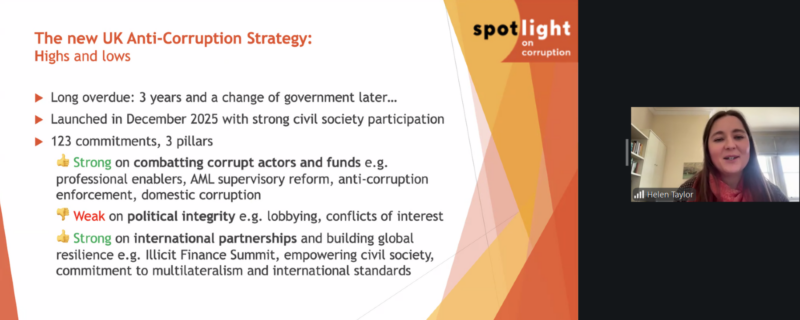
Helen highlighted why the strategy might be relevant now in the international scene:
- Leadership: In a difficult geopolitical context and a perceived leadership vacuum, there is space for other countries and broader coalitions to shape anti-corruption outcomes. This strategy is the product of a strong political leadership and ownership by multiple departments.
- Coordination: Reform efforts are increasingly aimed at leveling up standards and tightening coordination across resultations and jurisdictions.
- Implementation: Relevance will depend on how countries shift from commitments to actually making anti-corruption systems work in practice. In that sense, the strategy includes an oversight structure with civil society participation.
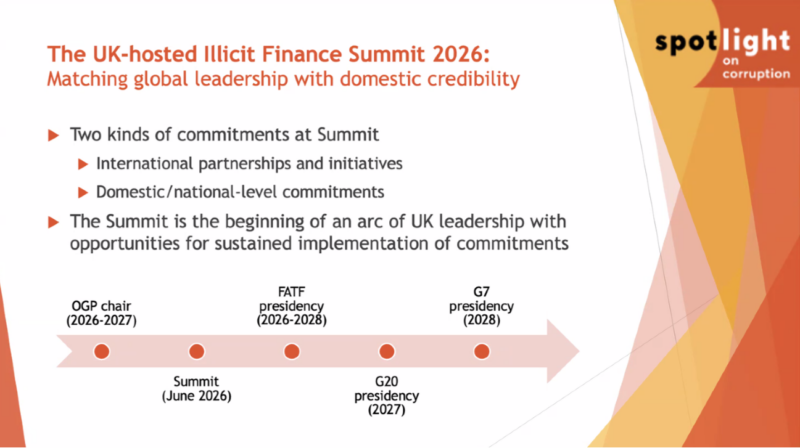
As part of the strategy, an Illicit Finance Summit will take place in London on 23–24 June 2026 to which the UK will invite governments from all regions and other stakeholders, to build “coalitions of the willing”. The Summit will be structured around three challenges: information-sharing between the private and public sectors to tackle illicit flows, professional enablers, and asset recovery, and focus on three sectors: gold, property, cryptoassets. Helen emphasized that this summit should be seen as part of a broader “arc” and connected to other instances where the UK will have convening power, including its forthcoming presidency of the FATF and, later in the year, its role as co-chairs for the Open Government Partnership (OGP).
Complementing the presentation, Peter Munro, Senior Policy Officer at Transparency International UK focused on how civil society can practically engage around the summit. UK-based CSOs are organizing to take the lead on each of the thematic areas and will be available to convey any international inputs (Spotlight on corruption: asset recovery and gold; Transparency International: property; RUSI: crypto). Therefore, he encouraged organizations to:
- Engage early if they have specific expertise;
- Prepare to advocate with governments to make domestic commitments at the summit that are realistic and concrete;
- Think beyond June: follow-through and accountability will depend on how commitments are carried forward across other fora.
Defending civic space and compensating victims of corruption
The final discussion brought participants together to reflect on how civil society can make the most of policy windows such as the upcoming summit, while also preparing for political pushback or attempts to delegitimize their work. Drawing on experiences from the EU and other national contexts, a piece of advice pointed to the importance of coordinating early across sectors, expecting and accepting different approaches within civil society, and not being afraid of speaking out, even with institutional allies.
The conversation also turned to the question of victims of corruption, an issue indirectly referenced in the UK strategy through its commitment on compensation for victims of foreign bribery – a commitment that is, however, framed as an exploration and is not time-bound. Yet, although the UK summit does not include “victims” as a central issue, it can be naturally connected with asset recovery. Civil society might be able to use the summit to showcase the negative impacts of illicit finance flows on communities and push the topic of victim compensation forward into the agenda.
More broadly, CSOs from the UK and across the world were encouraged to approach the summit as a strategic opportunity to advance national priorities -pressing governments on overdue anti-corruption reforms, aligning domestic advocacy with the summit’s themes, and feeding concrete proposals into UK-led policy conversations-.
___________________________
If you are a civil society activist from Europe and would like to become involved, please contact our Regional Coordinator Ana Revuelta Alonso at ana.revuelta@uncaccoalition.org.