


11 December 2025 –
As the year draws to a close, it brings an important milestone for civil society organizations engaged in the fight against corruption: the 11th Session of the Conference of the States Parties to the United Nations Convention against Corruption (UNCAC), known as CoSP11. The Conference will take place in a few days, from 15 to 19 December 2025, in Doha (Qatar). It will bring together governments, international organizations, and accredited observers, including the Global Civil Society Coalition for the UNCAC and many of our members, among other civil society organizations, to assess global progress against corruption and shape the direction of future action.
In this context, the last meeting of the year of the Coalition’s Europe network, held on the 25th of November 2025, offered the opportunity to present our communications and advocacy plans for the CoSP, to exchange on past experiences and to align advocacy priorities so that we maximize our collective impact at the Conference.
Preparing civil society engagement at CoSP11
The CoSP is the Convention’s highest decision-making body, responsible for steering States Parties in the implementation of the UNCAC. Every two years, it reviews emerging corruption trends, evaluates how existing commitments are implemented, and adopts resolutions to operationalize aspects that are not sufficiently developed in the Convention itself.
For civil society, this major event remains a paradoxical situation. While the UNCAC recognizes in Article 13 the crucial role of civil society in preventing and combating corruption, opportunities for civil society engagement at the CoSP – and its subsidiary bodies – remain limited. While accredited civil society organizations (CSOs) can attend plenary sessions and co-host side events, they continue to be excluded from the closed negotiation rooms where resolutions are drafted and finalized.
Despite these constraints, the UNCAC Coalition and its members are actively working to influence the outcomes of CoSP11. In the lead-up to the Conference, we have issued open letters and advocacy statements, such as calls to strengthen transparency, inclusiveness, efficiency, and effectiveness in the next phase of the Implementation Review Mechanism (IRM) – a key priority. Network members have also presented joint regional submissions identifying common challenges and outlining concrete reforms, including long-standing recommendations to institutionalize civil society participation within anti-corruption frameworks. These issues are expected to feature prominently in Doha.
Civil society and institutional efforts to track UNCAC commitments in North Macedonia
The President of the Center for Civil Communications from North Macedonia, German Filkov, presented the actions that a group of civil society organizations have been carrying out to raise awareness on UNCAC commitments and monitor the progress in implementing resolutions adopted at the last Conference of the States Parties to the UNCAC (CoSP10).
In June 2024, the Center for Civil Communications, the Macedonian Center for International Cooperation (MCIC), Transparency International Macedonia and other CSOs, alongside key anti-corruption institutions, held a follow-up workshop to assess the status of implementation of CoSP10 resolutions, identify persistent gaps, and define the steps required to advance progress. The collective action and the collaborative approach with public institutions represent good practices in translating global commitments into tangible national reforms.
Monitoring progress is central to this joint effort. Therefore, CSOs intend to track implementation of key resolutions by elaborating parallel reports on the resolutions on public procurement, beneficial ownership information to strengthen asset recovery, protection of whistleblowers, societal impacts of corruption and the issue of sexual corruption.
Where reforms stall, CSOs have found avenues to promote implementation of these resolutions in other useful platforms, for instance by including related commitments into the Open Government Partnership (OGP) National Action Plan of North Macedonia for 2024-2026. One such commitment, for which CSOs succeeded after two years of advocacy, involves the publication of beneficial ownership information for companies awarded public contracts, a step that would greatly enhance public accountability. Another avenue is seeking to include a number of CoSP10 resolutions’ demands in the upcoming 2026–2030 National Strategy for Prevention of Corruption and Conflict of Interest, which would reinforce their standing as national priorities.
Sanctions and state capture: Bridging gaps through cooperation at CoSP11
Tihomira Kostova, Senior Analyst from the Center for the Study of Democracy (CSD) from Bulgaria presented their latest study on illicit financial flows in the European Union, and shared CSD’s plans for CoSP11. The research paper “Shadow Economies: The Rise of Illicit Networks and Alternative Markets in Sanctions Circumvention” was produced in the framework of the Governance & Integrity Anti-Corruption Evidence (GI ACE) Programme at the Centre for the Study of Corruption, University of Sussex, and published in October 2025.
The study examines how illicit financial flows (IFFs) have surged across the Western Balkans, the Black Sea region and Central Asia, shedding light on their scale, drivers, and consequences. In particular, Tihomira explained the dynamics of IFFs in trade with a focus on sanction evasion. The analysis shows that, despite the existing sanctions (export bans and restrictions) imposed by the European Union on trading with Russia, the flow of “dual-use goods” from European countries to Russia has not stopped in the past years. Dual-use goods are products, technologies or materials that can be used for both civilian and military purposes, and potentially pose security threats. CSD found that some third countries have been enabling Russia’s access to dual-use technologies and critical supplies, thus increasing IFFs and sustaining the war in Ukraine.
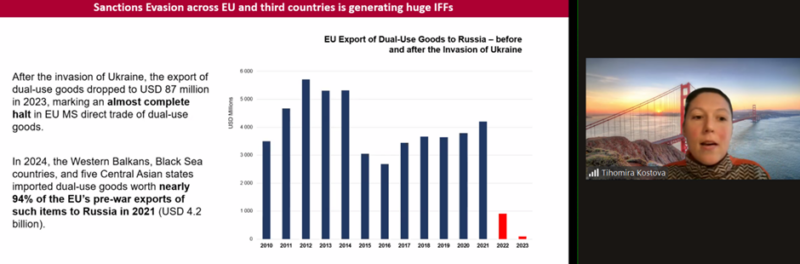
One of the goals of CSD’s participation in person at the CoSP will be to present their research findings and the impact of their work, for instance in a side event entitled “West Fault Lines: Sanctions and State Capture” that will take place on December 16. They will also use the platform to network and engage with potential partners in Europe and other regions, for collaborative projects around state capture and strategic corruption.
Advocacy at the CoSP
All civil society groups that want to leverage the Conference for anti-corruption advocacy, both on-site in Doha and from afar, can do so by:
- Promoting the Europe network’s submission on anti-corruption priorities in the region, and all our other thematic submissions;
- Using the messages from our “Communications and Advocacy Toolkit for CoSP11” in advocacy actions and social media, tailoring them to the national context;
- Following the CoSP agenda and attending – in person or online – the side events co-organized by the Coalition and its members on topics related to anti-corruption and human rights, gender and corruption, environmental crimes, the IRM, among others;
- Checking out key takeaways that we will be posting on the Coalition’s CoSP11 dedicated webpage;
- And continue calling on your government to defend a strengthened, truly transparent and inclusive IRM in its next phase.
We look forward to engaging with many of you at the CoSP!
If you are a civil society activist from Europe and would like to become involved, please contact our Regional Coordinator Ana Revuelta Alonso at ana.revuelta@uncaccoalition.org.