


3 February 2026 –
Eleven resolutions and 1 decision were adopted at the 11th UNCAC Conference of States Parties that took place from 15-19 December in Doha, Qatar. The backdrop for this conference was an extremely challenging geopolitical context, the further shrinking of civic space in countries across the globe, and dramatic funding cuts for anti-corruption work. This rapidly evolving landscape contributed to difficult negotiations, particularly on the issues of environment and climate, protection and participation of civil society, gender and corruption, and opposition to references and linkages to the sustainable development agenda, as well as other relevant UN fora. Everything seemed set for a first-time vote to adopt at least some of the CoSP resolutions, given these geopolitical challenges and early indications. However, all resolutions were eventually adopted by consensus.
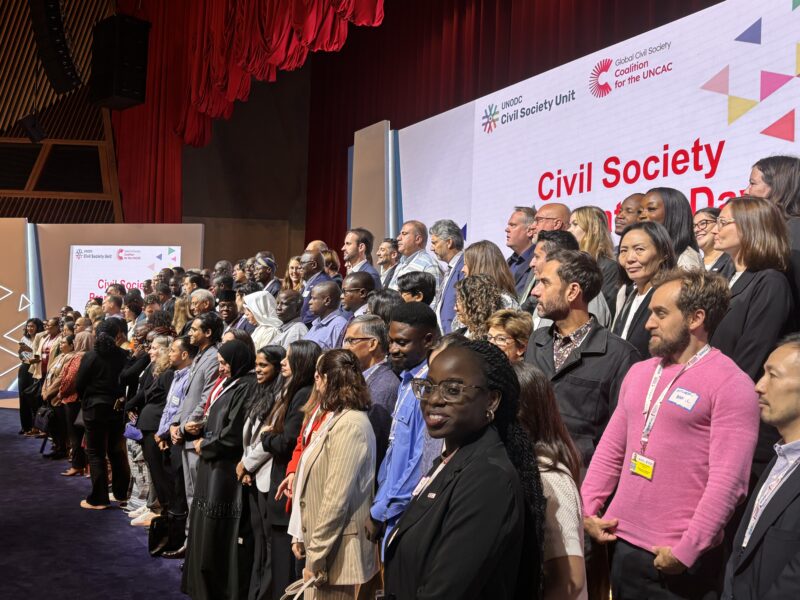
Despite these challenges and the relatively limiting CoSP rules on civil society’s participation, the Conference featured strong CSO participation; Civil society was able to significantly contribute to the CoSP agenda and outcomes and to the adoption of important resolutions and meaningful progress on certain UNCAC-related commitments and their effective implementation.
Key commitments from a civil society perspective
A major milestone was the adoption of a resolution to lay out the 2nd phase of the UNCAC Implementation Review Mechanism, with country reviews to start in 2027. While the agreement for the next phase did not go as far as civil society hoped, the resolution paves the way for a higher level of transparency, inclusiveness, and implementation in practice, and lowers the barrier for civil society contributions. The resolution invites States to frequently publish up-to-date country review timelines, to allow reviewing States to consider other sources of information and contributions from civil society in the review, and to reflect those in an annex to the country review reports. The next phase also includes a structured, public but voluntary progress reporting process following the completion of the country review, and a call to review “implementation in practice”. If these changes, alongside other technical improvements, are effectively implemented, it has the potential to make the next phase of the review mechanism more effective, transparent, and inclusive, leading to stronger UNCAC implementation that brings about real changes on the ground in curbing corruption.
Following strong and concerted global advocacy by civil society, States Parties adopted the first-ever dedicated resolution on the crucial topic of political finance transparency, another major milestone. The resolution, “Preventing and combating corruption through enhancing transparency in the funding of political parties, candidatures for elected public office, and electoral campaigns”, had a record 59 co-sponsors, containing the most detailed recommendations on political finance transparency and integrity globally, providing essential guidance on how to implement UNCAC article 7.3 effectively.
States also adopted two resolutions to help advance global efforts to address corruption that facilitates environmental crime and to strengthen climate finance governance. The resolution, “Preventing and combating corruption as it relates to crimes that affect the environment,” lays out commitments to strengthen UNCAC implementation to address this crucial issue, including preventive measures, enforcement, international cooperation, asset recovery, civil society participation, and whistleblower reporting. The resolution also includes a new commitment to tackle the role of enablers in facilitating corruption related to crimes that affect the environment.
The resolution, “Strengthening the implementation of the United Nations Convention against Corruption in small island developing States (SIDS)” recognizes climate change as an existential threat to SIDS and includes a new commitment focused on enhancing transparency, integrity, and accountability mechanisms in climate finance and natural resources management, the first time the CoSP has addressed integrity risks in climate finance. However, this commitment falls far short because it applies only to SIDS countries when it should apply to all States Parties.
The picture was mixed on civil society protection and participation. Civil society and human rights was referenced more times across resolutions than in any other UNCAC CoSP, and it was the first time direct references to “indigenous peoples” and “local communities” were included in a CoSP resolution (in both the corruption and crimes that affect the environment resolution and the SIDS resolution). However, other language proposals on civil society participation were weakened or taken out, including proposalsalthough based on agreed language from previous CoSP resolutions. There is no mention of the specific risks civil society faces or calls for specific measures to address these risks, such as developing and supporting early warning and protection mechanisms, which was one of the Coalition’s priority asks ahead of the CoSP.
At the same time, the Marrakech follow-up resolution on corruption prevention is noteworthy for laying out more details for how States should ensure effective access to information, and for addressing the interlinkages between human rights and corruption prevention. The resolution includes mandates for the UNODC to collect information from States on access to information and for the UNCAC Working Group on Prevention to develop recommendations on “practical measures for ensuring the active participation of individuals and groups outside the public sector”. For these follow-up measures to be meaningful and credible, the views and input of civil society actors must be solicited and considered.
Other topics proved to be more challenging. For example, recalling, reaffirming, or promoting linkages with the 2030 Agenda for Sustainable Development was often deleted from drafts due to opposition from a few States. There was no language in any of the resolutions addressing the victims of corruption, and despite a specific commitment in the SIDS resolution to “includ(ing) corruption-related disaggregated data on the impact of corruption on people in vulnerable situations”, there were no direct references to links between Gender and corruption.
Promoting resolution implementation- civil society’s role
CoSP resolutions, albeit not considered legally binding, provide important guidance and elaborate on ways States should implement the Convention’s articles fully and effectively. They represent the latest global consensus on anti-corruption, and therefore, countries are expected to work towards their realisation. Civil society has an important role in monitoring and promoting their implementation in practice, such as through:
- Urging States to publish comprehensive information on their implementation efforts, including by responding to UNODC’s official requests to share such information,
- Strongly encouraging the UNODC and States to take into account civil society’s input when compiling information on good practices and challenges in national implementation, in developing new practical guides and tools, and to engage civil society actors in capacity building and technical assistance delivery,
- Submitting and presenting independent assessments on the state of implementation of certain resolutions of interest and expertise, and
- As long as CoSP subsidiary bodies remain closed to civil society’s formal participation, encourage States to include civil society representatives in their country delegations to the subsidiary bodies’ sessions, and facilitate non-government’s’ active engagement and input on discussions where its expertise and input are crucial to complement States’ self-reporting on the implementation of the UNCAC and its resolutions.
We call on States Parties to effectively implement the resolutions adopted at CoSP11 and to engage civil society in these efforts.
A detailed analysis of all adopted CoSP 11 resolutions will be published shortly, referring to key commitments, missing elements, and follow-up actions, including from a civil society perspective.