
Strong governance and accountability are essential to ensuring that climate funds reach their intended goals and that the communities most vulnerable to climate change benefit. Yet climate resources are frequently misallocated, projects are poorly monitored, and those most at risk are often the last to see results.
On May 12th, the 22nd meeting of the Coalition’s Working Group on Environmental Crime and Corruption focused on user-friendly tools civil society can use to strengthen climate governance. Experts from the Wildlife Justice Commission (Working Group Chair), Transparency International (TI), Transparency International Pakistan (TI Pakistan), SouthSouthNorth and Global Civil Society Coalition for the UNCAC discussed how to use TI’s Resource Guide on Climate Finance and Social Accountability as a practical resource, and how recently adopted UNCAC Conference of States Parties (CoSP) resolutions can serve as advocacy tools for enhancing transparency, integrity, and accountability in climate finance.
Using UNCAC resolutions to strengthen climate governance
(see slides in video recording from 04:50)
Lisa Hartevelt (Director of Policy, Wildlife Justice Commission and the ECC Working Group Chair) and Corinna Gilfillan (Senior Analyst for the Global Civil Society Coalition for the UNCAC and ECC Working Group Policy Lead) presented on two UNCAC CoSP11 resolutions and how civil society can use these as advocacy tools to strengthen climate governance at the national and international levels.
- Resolution 11/9 on “preventing and combating corruption as it relates to crimes that affect the environment” is the most comprehensive set of anti-corruption commitments to date on this topic, covering prevention and integrity, enforcement, financial transparency, and civil society protection. Although the resolution does not explicitly reference climate finance, its commitments are directly relevant to climate governance with concrete follow-up mechanisms, including a voluntary reporting process for States and a focused discussion at the 2027 UNCAC Working Group on Prevention. Civil society can engage governments in these processes, monitor and report on implementation, and raise the resolutions in other fora.
- Resolution 11/3 on “UNCAC implementation in Small Island Developing States” includes the first-ever CoSP language calling for enhanced transparency, integrity, and accountability in the planning, disbursement, and oversight of climate finance, as well as strong commitments to civil society participation and specific references to Indigenous Peoples and local communities (also included in Resolution 11/9).
Lisa concluded, “The UNCAC provisions and commitments reflected in the resolutions can and should also be applied more broadly to strengthen integrity, transparency, and accountability across other processes and fora, including those related to climate governance, climate finance, and social accountability.”
For more details on these resolutions, see the Global Civil Society Coalition for the UNCAC’s Analysis of CoSP11 Resolutions.
A practical guide for accountable climate governance
(See presentation in video recording from 19:55)
Anoukh de Soysa (Climate Governance Specialist, Transparency International) presented TI’s recently published Resource Guide on Climate Finance and Social Accountability, co-authored with Brendan Halloran. The guide is a practical and adaptable tool for strengthening accountability in climate governance in response to rising climate finance flows, weak oversight, resource misallocation, shrinking civic space, and civil society’s demand for practical accountability guidance. The guide is not intended as a one-size-fits-all prescriptive guide; instead, it shows how civil society actors can think through what is most relevant to the political realities and how to adapt social accountability initiatives to their institutional context.
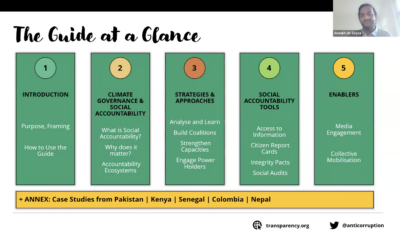
Anoukh laid out how the guide explains climate accountability as an ecosystem involving vertical (citizens, CSOs engaging with governments), horizontal (formal oversight institutions), and hybrid accountability (collaboration between CSOs and oversight institutions). The Guide is organized in the following way:
- Four strategic elements: analyzing the political economy before acting; building inclusive coalitions; strengthening collective capacities through iterative learning rather than one-off trainings; and engaging power holders and duty-bearers (decision-makers) to promote accountability that is responsive to the needs of the public, particularly communities and groups most vulnerable to climate change.
- Four people-centred tools: access to information requests to trace climate finance flows; citizen report cards that collect and publish public feedback on climate governance services; integrity pacts, multi-stakeholder collective action agreements, to safeguard public procurement from corruption, that can be applied to sectors such as infrastructure; and civil-society-led social audits to verify whether funds were used as planned and reached intended groups.
- Two enablers: media engagement and collective mobilisation to amplify these efforts, built in from the start rather than adding on later.
Anoukh explained, “Decision-making is very much multi-level. Climate finance flows from large global funds, like the Green Climate Fund, for example, to national governments. And then from national governments, it flows down to subnational implementers, and then on to local contractors. And as you can imagine, responsibility can get diluted very quickly. The guide emphasizes that social accountability must operate across all these levels, connecting local action to national and international processes.”
The Guide features five case studies, and two of the case studies in Pakistan and Senegal were presented during the session by Kashif Ali (TI Pakistan) and Hannah Sack (SouthSouthNorth)
Access to information as a climate governance tool: lessons from Pakistan
(See presentation in video recording from 47:45)
Kashif Ali (Executive Director, TI Pakistan) presented on TI Pakistan’s work using access to information and evidence-based advocacy to improve transparency and disclosure in climate governance in a country highly vulnerable to climate impacts.1
Kashif described how TI Pakistan combined advocacy, institutional capacity-building, public hearings, dialogues, youth and journalist fellowships to improve transparency, climate budgeting, and citizen engagement. TI Pakistan’s State of Data Disclosure of Climate Related Departments as per Access to Information Laws reviewed 59 federal and provincial climate-related departments, and found that most provincial departments did not publicly disclose critical information on budgets, community participation, or environmental impact assessments. It used this evidence to advocate for improved disclosure practices. Carbon markets were highlighted as a particularly high-risk area, with governments often reluctant to disclose information on transactions, emissions measurement, and benefit-sharing.
Kashif also raised a broader challenge: democratic backsliding, resulting in the targeting of access to information laws. UNCAC commitments, including on whistleblower protection, are an important framework for pushing back against this backsliding.
“Access to information should be treated not only as a transparency tool, but as a broader mechanism for climate accountability and environmental governance”, Kashif concluded.
He pointed out that Resolution 11/9’s commitments on open government, transparency, and effective public access to information are particularly important to the situation in Pakistan and should be leveraged to give further momentum to their work.
Improving transparency and accountability in climate finance: lessons from the Green Accountability Platform
(See presentation in video recording from 1:00:10)
Hannah Sack (EbA and Global Coordinator, SouthSouthNorth) presented on the experiences of the Green Accountability Platform2 a multi-country initiative supporting 25 civil society organizations to improve transparency, participation, and accountability in climate finance governance across Bangladesh, Brazil, Cameroon, Mexico and Senegal.
Hannah shared examples from Senegal and Brazil to illustrate how citizen-friendly tools, local monitoring, and collaboration with affected communities can expose misuse of funds and strengthen safeguards. Budget Senegal developed a climate finance tracking tool (Tracka), including a mobile app, enabling citizens to access project and expenditure data in local languages and report possible corruption. In Brazil, civil society work led to an investigation into the use of funds in a carbon market program, a mandate for free, prior, and informed consent in the national REDD+ program, and a government agreement on disclosure of environmental information and protection of environmental defenders3.
Hannah identified several key lessons emerging across these projects: early government engagement to ensure institutional buy-in, access to information, creative multi-stakeholder engagement, and recognizing how different actors bring different strengths. Flexibility and persistence are also essential, as political changes can affect government relationships.
Hannah concluded, “Social accountability for climate finance really has to be adapted to the local contexts, and projects have to be designed and be flexible in their approach.”
The need to adapt to local contexts is also linked to Resolution 11/9, which includes important commitments on the role of civil society, with specific references to Indigenous Peoples and local communities.
What comes next
Based on feedback from participants, the ECC Working Group and Transparency International plan to hold practical follow-up training sessions for civil society organizations to delve deeper into specific aspects of the Resource Guide, giving participants a chance to think strategically about social accountability initiatives and share experiences with each other.
TI encourages you to reach out to Anoukh de Soysa (adesoysa@transparency.org) on TI’s Climate Governance team for more information or to discuss how you might use the guide in your own work.
The Working Group will continue to coordinate on joint advocacy and engagement opportunities to strengthen climate governance, using CoSP Resolutions 11/9 and 11/3 as advocacy tools to advance national-level action, document good practices and implementation gaps, and bring evidence into UNCAC fora and other international processes.
Recording of the meeting
- Pakistan contributes less than 0.8% of global greenhouse gas emissions but is among the countries most exposed to climate impacts. The 2022 floods affected nearly 33 million people and caused an estimated $30 billion in losses, and the country estimates it will need $565.7 billion to address the effects of climate change by 2035. See: Climate Change Tracker, “Pakistan: Progress and Recent Impact,” https://climatechangetracker.org/nations/greenhouse-gas-emissions/pakistan/progress-and-recent-impact Government of Pakistan, Ministry of Climate Change and Environmental Coordination, Pakistan’s Third Nationally Determined Contribution (NDC 3.0) (Sept. 2025), pp. 4, 15–16, 26, https://unfccc.int/sites/default/files/2025-09/Pakistan_NDC3.0_24%20Sep.pdf. Government of Pakistan, Ministry of Planning, Development & Special Initiatives, Asian Development Bank, European Union, United Nations & World Bank, Pakistan Floods 2022: Post-Disaster Needs Assessment — Main Report (Oct. 28, 2022), https://thedocs.worldbank.org/en/doc/4a0114eb7d1cecbbbf2f65c5ce0789db-0310012022/original/Pakistan-Floods-2022-PDNA-Main-Report.pdf; ↩︎
- The Green Accountability Platform was funded by the World Bank’s Global Partnership for Social Accountability and implemented by the World Resources Institute, SouthSouthNorth, and the WARU Commission. ↩︎
- For more information, please see Green Accountability Platform’s policy brief: “Strengthening the role of civil society actors in climate finance”, and the case study booklet: “Enhancing transparency, inclusion and accountability in climate finance: stories from Bangladesh, Brazil, Cameroon, Mexico and Senegal”. ↩︎
