


23 October 2025 – written by Janithrika Jayasundara, Regional Coordinator for Asia Pacific
When effectively implemented, asset and interest disclosure (AID) of public officials can prevent conflicts of interest, detect illicit enrichment, and eventually strengthen public trust in governance. The United Nations Convention Against Corruption (UNCAC) highlights this in Articles 7 and 8, which call for “systems that promote transparency and prevent conflicts of interest”. The G20 High-Level Principles on asset disclosure and in several Resolutions at the Conferences of States Parties have also reaffirmed its importance.
Yet, despite the global momentum, the Asia-Pacific region still lacks up-to-date, comparative data on AID systems, unlike in Europe and Latin America, where initiatives by the Global Data Barometer have mapped disclosure frameworks. Against this backdrop, members of the UNCAC Coalition’s Asia-Pacific network convened their 22nd regional meeting to examine how AID can be used more effectively as a tool to manage conflicts of interest and prevent illicit enrichment.
Ahead of the meeting, a poll was sent out to evaluate the extent to which AID was a priority amongst participants. The results revealed an interesting dynamic and a significant gap: while 93% of participants viewed AID as a priority area, only a quarter had prior experience working in it. This gap between recognition and practice underscored the need for peer learning and coordinated advocacy.
Accordingly, the discussion also focused on strategies for stronger advocacy, identified patterns in implementation challenges, and reflected on how civil society can fill information gaps through collective mapping exercises.
From Law to Implementation: Sustained Advocacy in Sri Lanka
“The work of civil society does not end with passing legislation. Monitoring and follow-up are just as crucial.” – Maheshi Herat, Deputy Executive Director, Transparency International Sri Lanka (TISL)
Maheshi, in her presentation, explored Sri Lanka’s experience in demonstrating how persistent advocacy can turn an overlooked legal tool into an important vehicle for accountability. The country has made declarations of assets and liabilities a requirement since 1975, yet for decades, these were neither centralised nor accessible to the public. Following nearly two decades of sustained advocacy, TISL adopted a two-pronged approach: pushing for legal reform while also encouraging and providing a platform for voluntary disclosure by willing Members of Parliament. This combination helped normalise the concept of proactive transparency and public access long before it became law.
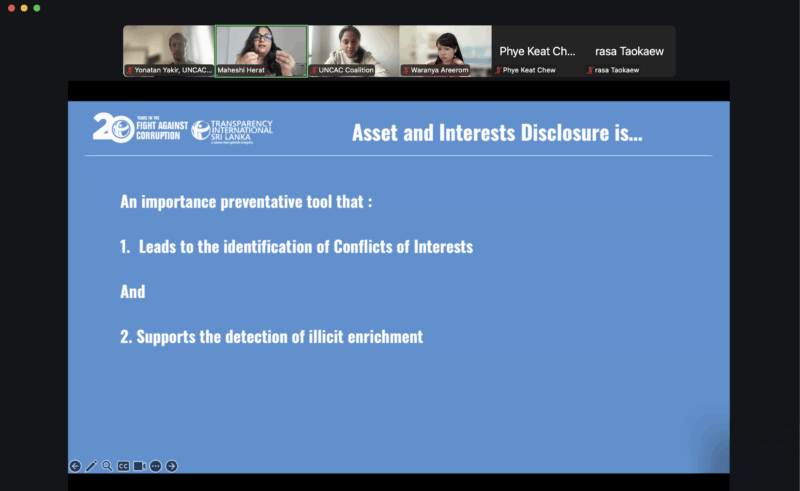
The Anti-Corruption Act of 2023 in Sri Lanka now mandates a centralised electronic AID system with public access to redacted declarations, which is a milestone driven by civil society persistence. TISL was closely involved in the development of the new Anti-Corruption Act. Sustained TISL advocacy not only secured public disclosure provisions in the new Act, but also led the International Monetary Fund to integrate corrective implementation measures: excessive redactions as a benchmark requiring government action. This persistence demonstrates that reform is rarely a one-step victory, and that progress depends on engaging stakeholders at multiple levels while sustaining public interest.
However, Maheshi further highlighted that the journey from law to impact remains ongoing. As she emphasised, civil society now faces the challenge of ensuring that the new electronic AID system translates into meaningful transparency rather than a procedural exercise. She also warned that both public institutions and watchdog organisations must adapt to increasingly sophisticated forms of corruption, remaining proactive to safeguard the gains achieved through this multi-year advocacy effort. From a civil society perspective, the mere fact that there is such a disclosure system built into the country’s anti-corruption landscape outlines the societal expectation for holding public officials accountable.
From Form to Substance: Lessons from Thailand
“Asset declarations too often become bureaucratic exercises – filed, published, and then forgotten.”- Waranya (Cherry) Areerom, Human Rights Lawyer, Manushya Foundation
Through the use of two emblematic cases, Cherry showcased that whilst Thailand’s framework for AID may appear comprehensive on paper, its credibility is weakened by implementation gaps. The cases illustrated how legal loopholes can hollow out the system: a former prime minister’s undisclosed wealth and use of complex financial tools, and a former deputy prime minister’s undeclared luxury watch collection. In the latter case, the investigation was considerably delayed, and key findings were withheld until forced for release by a court order.
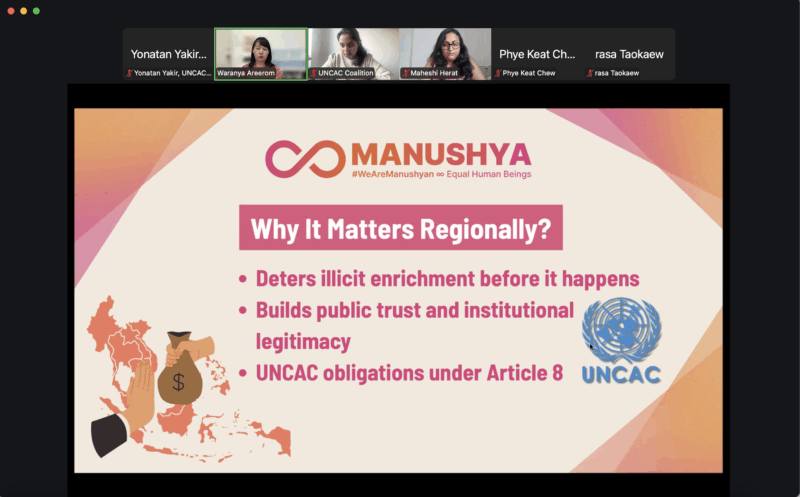
Her analysis revealed a regional pattern: laws exist, but enforcement is inconsistent, verification is weak, and political interference is pervasive. As a result, AID systems risk becoming symbolic gestures rather than genuine safeguards. Based on that analysis, she called for four strategic approaches in advocacy:
- Establish stronger regional standards, especially on high-risk categories such as luxury assets, offshore holdings, and family wealth;
- Develop knowledge-sharing platforms to exchange investigative tools and legal strategies;
- Demand real enforcement through independent, well-resourced anti-corruption bodies;
- Mobilise people’s power to sustain public pressure and rebuild public trust in institutions.
Her intervention reminded participants that AID is not a bureaucratic exercise but an accountability mechanism, which is central to bridging the trust gap between citizens and institutions, especially amid growing authoritarian tendencies and institutional fragility in the Asia-Pacific region.
Strengthening Enforcement and Monitoring
During the open discussion, participants raised the issue of monitoring and enforcement of the AID systems. In response, Maheshi described Sri Lanka’s forthcoming electronic system, which includes provision for red flags, designed to detect inconsistencies as red flags in declarations automatically. Civil society, she noted, must play a role in shaping these systems, ensuring the red-flag criteria are rigorous and transparent.
Interoperability across systems, such as the databases of the tax authorities and beneficial ownership registries, was also identified as another measure to advocate for. Inter-agency coordination and political will remain crucial for transforming these paper frameworks into credible functioning systems. Participants shared that in countries like Malaysia, AID exists as administrative directives rather than law, highlighting that legal foundations matter, as only enforceable legislation can provide sanctions for non-declaration or false disclosure.
Towards a Regional Evidence Base
Another key takeaway was the need for comparative, evidence-based data on AID systems across the Asia-Pacific. Cherry noted that replicating the study in Europe conducted by the UNCAC Coalition and Global Data Barometer, together with other organisations, would fill a major knowledge gap, enabling regional stakeholders to identify patterns of weakness and areas for reform, highlight best practices, and develop a shared advocacy framework based on empirical data. Such a study would also guide civil society advocacy strategies.
Collective Progress, Shared Responsibility
The meeting concluded with a reflection that countries across the region are at different stages of developing and implementing AID systems, some with advanced electronic disclosure frameworks, others still pushing for enabling legislation. Despite these variations, members in their responses to the survey and the speakers in their presentations pointed to a common goal to position AID as a regional priority and leverage collective experience for mutual learning.
Key Lessons from the 22nd Asia-Pacific Regional Meeting of the UNCAC Coalition
- Persistence pays off: Long-term, multi-level advocacy is key to converting technical reforms into lasting transparency.
- Civil society must stay engaged post-legislation to monitor enforcement, mobilise their local presence to detect false declarations and keep public pressure alive. Public interest in topics such as AIDs is crucial for persistent advocacy.
- Regional cooperation and comparative data can amplify advocacy and help advance regional standards.
- Public trust in the institutions is built when systems signal credibility and are well-enforced.
If you are a civil society organization from Asia Pacific and would like to become involved, please contact our Regional Coordinator Janithrika Jayasundara at janithrika.jayasundara@uncaccoalition.org