
11 June 2026 –
Recognized as a human right since the Universal Declaration of Human Rights was proclaimed in 1948, access to public information plays a pivotal role in the context of the UN Convention against corruption (UNCAC). Accessing information held by States is a prerequisite for the Convention’s implementation, the enabling condition allowing citizens, journalists, civil society organizations and other stakeholders to monitor the actions of governments, demand accountability, and track the use of public funds.

While access to information (ATI) is embedded throughout the UNCAC, two articles particularly highlight its importance for corruption prevention: Article 10 on public reporting, calling on States to enhance transparency and allow the public to obtain information on the functioning and decision-making processes of the administration; and Article 13 on the participation of society, requiring States parties to promote the active participation of civil society actors in the fight against corruption, such as by ensuring that the public has effective access to information.
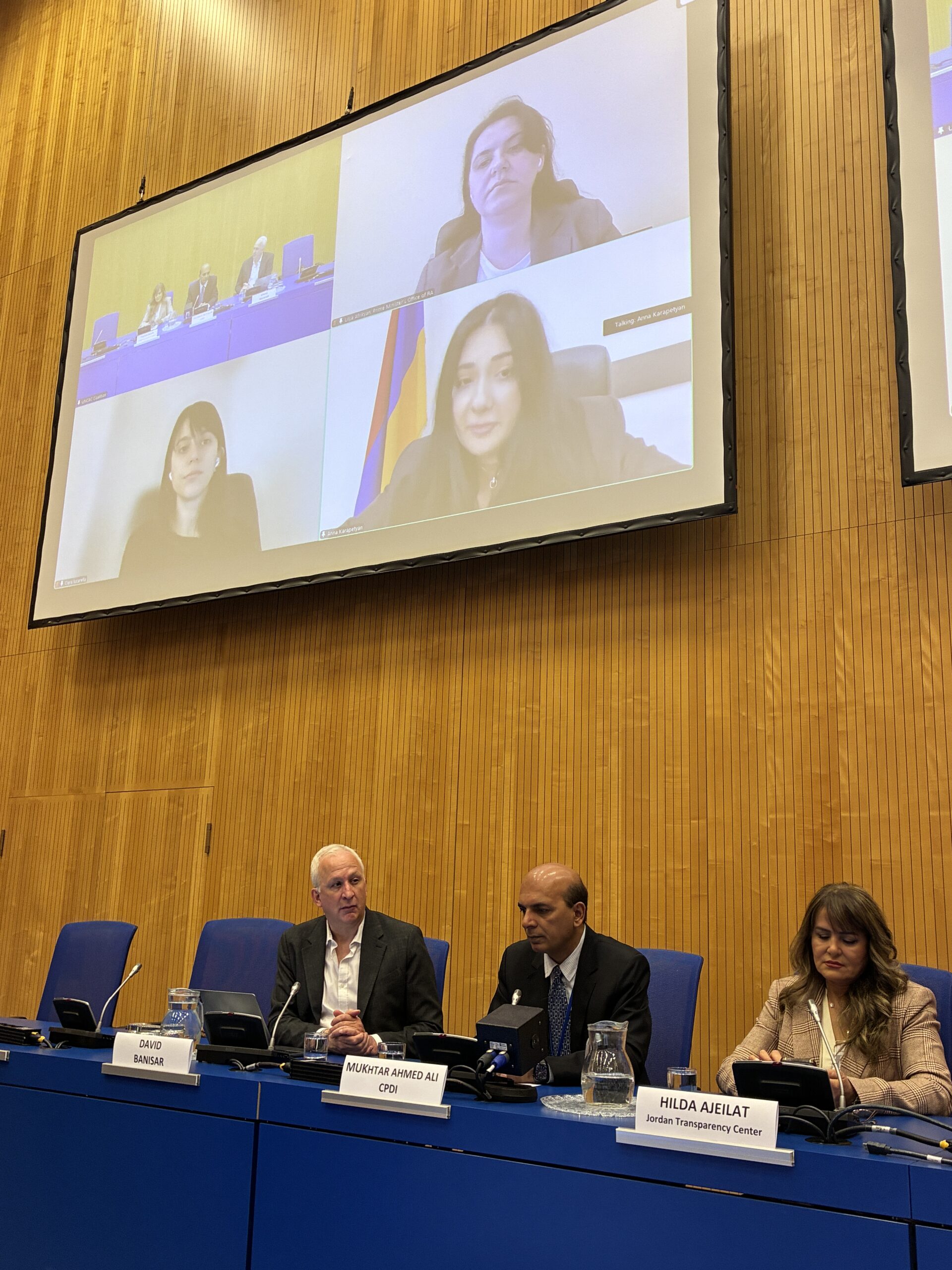
To discuss current challenges of access to information across the world, the Global Civil Society Coalition for the UNCAC convened a hybrid event on May 21, 2026, on the margins of the 17th session of the UNCAC Implementation Review Group and Working Group on Prevention. Organized with the high-level involvement of the Government of Armenia, the event brought together government representatives, civil society experts and practitioners from different regions to take stock of the state of access to information frameworks in the context of the fight against corruption.
The Executive Director of the Centre for Peace and Development Initiatives (CPDI) from Pakistan and Chair of the Coalition, Mukhtar Ahmad Ali, acted as moderator and laid out the context. A recent report by UNODC analyzing UNCAC implementation revealed that 60% of States Parties have received recommendations to adopt, reform, or more effectively implement their ATI legal frameworks. Although a majority of countries (over 130 according to civil society reports) have laws in place, they fail to ensure citizens’ access to information in practice.
Within a context of democratic backsliding over the past years, we have seen right-to-information laws being weakened in their design and/or their enforcement and decreasing transparency in practice, and new challenges emerging. Nevertheless, limited attention has been given to this issue in UNCAC fora: the last reports on measures taken by States Parties on access to information date back to 2022 and 2016, and draw from a few contributions by States. Moreover, UNCAC CoSP resolutions have been mostly repeating the related text from the Convention, without providing further clarification or guidance on the actions necessary to promote effective ATI in practice.
States showing good practices: From formal transparency to effective access
“Access to information is not only a legal right and administrative obligation, but a key element of democratic governance that strengthens transparency, accountability and public trust.”
Anna Karapetyan, Deputy Minister of Justice, Armenia
In her opening remarks, Armenia’s Deputy Minister of Justice, Anna Karapetyan, exposed how ATI can become part of a broader anti-corruption and democratic governance agenda. Armenia’s ATI law is built around the principles of broad access, maximum disclosure, and proactive transparency: Public authorities are expected not only to respond to information requests, but also to publish information of public interest, including draft legislation, procurement data, budgetary information, or governmental decisions. The law applies broadly across public authorities and entities performing public functions, includes relatively short response deadlines and proactive disclosure obligations, and appeal and oversight mechanisms. All these features make Armenia’s ATI legal framework among the most advanced in the region. Lilya Afrikyan, Head of the Department for Participatory and Open Governance at the Prime Minister’s Office of Armenia, also highlighted this in her intervention.
Beyond the law on paper, the Armenian example illustrates that the effectiveness of ATI frameworks reflects on their use. Transparency becomes meaningful when civil society actively uses ATI mechanisms to monitor reforms, contribute to policy discussions and support anti-corruption efforts. This is the case of the e-Draft.am platform, which allows the general public to comment on draft legal acts and through which public authorities must respond to comments received. In Armenia, the role of civil society was deemed essential from the outset: civil society organizations, including the Freedom of Information Center of Armenia (FOICA), were instrumental in drafting and passing the Freedom of Information Law in 2003, and Afrikyan acknowledged that implementing the law was a “collective and inclusive” process.
At the same time, implementation challenges remain and, in light of evolving public needs and a context of digital transformation, the ATI framework requires continuous review and modernization. For this purpose, a self-assessment mechanism was introduced, in cooperation with civil society organizations. At the moment, Armenia puts a strong focus on promoting proactive disclosure and, as an engaged member of the Open Government Partnership, has joined the Proactive Disclosure Coalition. Finally, the government is advancing interconnected reforms to strengthen public information governance and open data standards, and cybersecurity, all of which complements the ATI framework.
An essential part of the anti-corruption agenda
David Banisar, currently a Visiting Senior Fellow at the London School of Economics and who has worked extensively on the right to information globally, framed a central problem: Unlike areas such as data protection or public procurement, where more detailed frameworks are available, the anti-corruption field lacks specific guidance on what effective access to information should look like in practice.
Drawing on research in Central and Eastern Europe, where countries have had access to information laws for two decades, he noted that not all performed equally well, depending on the resources and the political will to make information about corruption available – both proactively through open data, public procurement data, asset disclosures, etc. and reactively by responding to information requests in a timely manner.
Banisar warned against treating access to information as a governance add-on that can be sidelined when circumstances become difficult or a government feels threatened by transparency. The COVID-19 pandemic offered a stark lesson to connect the dots between effective ATI and corruption prevention: In countries where ATI systems were suspended or underfunded during the pandemic, public scrutiny of emergency procurement and government spending diminished, and corruption and misuse of public funds emerged.
The author reflected as well on the potential of technology, including AI, to make large volumes of information available at lower cost, to identify corruption red flags, or to enable advanced analysis of data. However, without legal safeguards this is not guaranteed: if citizens don’t have the legal right to demand information and the right is not enforced through effective appeal mechanisms and independent oversight bodies, governments might choose what information is made available.
Finally, he echoed a concern raised by the Armenian representatives: the need to balance openness and transparency with personal data protection, cybersecurity and the resilience of public information systems. Banisar argued that in corruption-sensitive areas, the public’s right to know should by default prevail over privacy claims: if a company receives a public contract, the identity of its owner -the beneficial owner- should be known. However, that is not always the case. Without clearer standards, States and oversight bodies lack practical guidance on how to interpret transparency obligations and this leads to an important gap for UNCAC implementation.
The implementation gap
While historical, legal and political contexts differ, the challenges are strikingly similar across regions. Hilda Ajeilat, Deputy Chair and CEO of the Jordan Transparency Center, described the situation of access to information in the South West Asia and North Africa region (SWANA) as an implementation problem. In the region, Jordan was among the first countries to adopt ATI legislation already in 2007, followed by Yemen, Tunisia, Morocco, Lebanon, Sudan, Kuwait, Saudi Arabia, and Qatar, with the last countries adopting laws in 2021-22. However, implementation remains weak across the region.
A first obstacle is that, in many cases, information coordinators have not been appointed, records are not digitized, and staff have not been properly trained. A further obstacle are the exceptions in the law and the persistence of a culture of confidentiality within public administration. Many officials remain reluctant to release information for fear of being held accountable for disclosing material that may later be deemed sensitive. To address this challenge, civil society organizations and international partners have supported training programmes on information governance, archiving, records management and classification systems. In Jordan, for example, the development of three protocols has helped clarify which categories of information can be disclosed and which legitimately fall under national security exceptions, providing greater certainty for public officials and reducing unnecessary secrecy.
Another major challenge is the limited independence of oversight bodies. In many cases, these institutions lack dedicated budgets, sufficient resources, and the institutional autonomy needed to effectively oversee the implementation of access to information laws. Strengthening their independence is therefore essential. Jordan has taken a positive step in this direction by expanding the membership of its Information Council to include representatives from civil society organizations.
To strengthen ATI implementation across the region, Ajeilat proposed to focus on three priorities: reduce legal barriers and ensure that exceptions are applied narrowly; guarantee administrative and financial independence of oversight bodies; and shift from information requests to prioritizing proactive disclosure. Her intervention also highlighted the importance of international fora, such as the UNCAC and the Open Government Partnership, as frameworks that can enhance standards and support civil society engagement and reform.
In Latin America and the Caribbean, Clara Lucarella, Coordinator of Programs for Strengthening Democracy and Opening Up the Judiciary at ACIJ (Argentina), described a similar landscape in which ATI laws are in place, but implementation gaps remain severe. Oversight bodies have been weakened through budget cuts and political interference. In Mexico, for instance, civil society has raised concerns after the former transparency body was closed in 2025 and its functions transferred to an executive-branch ministry.
At the same time, Lucarella warned of expanding secrecy regimes in several countries, with governments increasingly invoking national security, privacy or vague public interest arguments to restrict disclosure. It happened in Ecuador, or in Argentina, where regulatory changes narrowed the definition of public information in 2024, beyond what the law establishes and limited access to certain types of data, including preparatory documents and internal deliberations. In Colombia, civil society has warned that public institutions deny information requests without properly demonstrating the hypothetical harm of the disclosure. Challenges also extend to the role of the judiciary. In addition to often being the most opaque branch of power, courts have frequently failed to enforce access to information obligations. In Argentina, there is a specific problem related to the lack of production and publication of information on judicial statistics.
Finally, Lucarella also underscored a number of new challenges, including the growing impact of disinformation and the manipulation of public debate, the implications of artificial intelligence, and the relationship between access to information and data protection frameworks. Governments and international organizations must address these challenges with updated responses, while also monitoring how they comply with their access to information obligations.
Next steps: Protecting civic space, establishing new normative standards, enhancing the role of the UNCAC Conference of the States Parties
Closing the meeting, a dynamic discussion revolved around avenues for protecting and strengthening access to information, and reflecting on the role of multilateral cooperation and the UNCAC Conference of the States Parties (CoSP).
Participants highlighted that access to information cannot be separated from the broader environment in which civil society actors are operating today: journalists, organizations, activists and citizens are increasingly facing harassment, strategic lawsuits against public participation (SLAPPs), restrictive laws and other measures aimed at limiting civic space. Protecting the right to seek, receive and use information therefore requires protecting the individuals and organizations that exercise and defend this right, and use it to fight corruption.
While States continue to face practical questions regarding the disclosure of corruption-related information, the application of public interest tests, or the boundaries of proactive publication obligations, they could benefit from common, updated standards. The gap between formal recognition and effective implementation, alongside evolving challenges, presents an opportunity to provide renewed and targeted technical assistance to States. In this context, the CoSP could seize this opportunity to place access to information at the centre of UNCAC implementation by strengthening monitoring, developing updated guidance for States, and drawing on civil society expertise to help States turn ATI legal commitments into tangible outcomes in prevention, detection and prosecution of corruption.