


16 July 2026 –
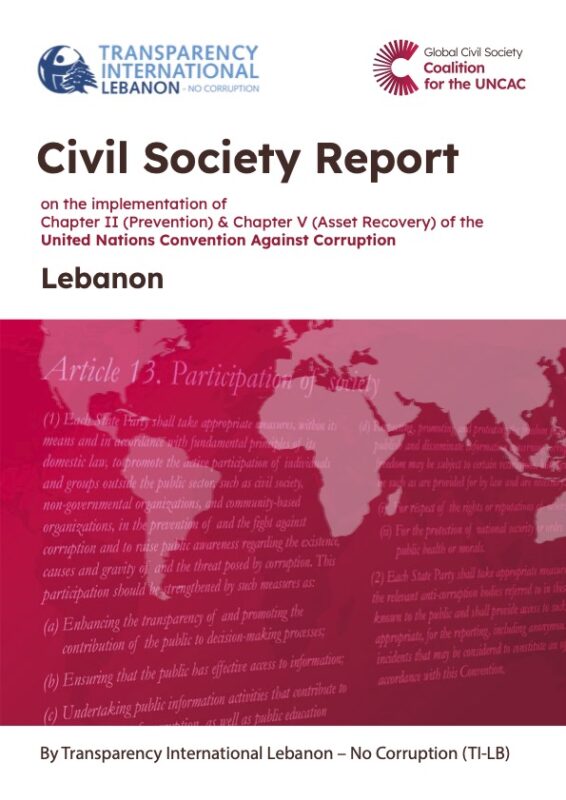
A new civil society parallel report by Transparency International Lebanon – No Corruption (TI-LB) finds that Lebanon has adopted a wide set of legal and institutional anti-corruption measures, but that implementation and enforcement of this framework in practice remains weak across key areas covered by Chapters II (Preventive Measures) and V (Asset Recovery) of the United Nations Convention against Corruption (UNCAC). The report was produced with technical and financial support from the Global Civil Society Coalition for the UNCAC and is intended as a contribution to Lebanon’s second-cycle UNCAC implementation review process, covering developments up to 24 April 2026.
Lebanon has made notable progress in building the legal foundations of an anti-corruption framework. These include the establishment of the National Anti-Corruption Commission (NACC) in 2020, the adoption of laws on access to information, whistleblower protection, asset and interest declarations, public procurement reform, and asset recovery, and the National Anti-Corruption Strategy 2020–2025. However, the report finds that these legal advances have not yet translated into consistent institutional practice. Implementation remains constrained by limited resources, uneven compliance across public bodies, weak publication of implementation statistics and decisions, gaps in review and complaint mechanisms, and limited enforcement of dissuasive sanctions.
Regarding Chapter II, Lebanon has taken significant steps on paper, especially through the gradual operationalization of the NACC and the entry into force of Public Procurement Law No. 244/2021. Yet key preventive tools remain underused or incomplete. Conflicts-of-interest rules are not yet sufficiently enforceable across senior and high-risk public positions, asset declarations lack strong verification and audit systems, whistleblower protection mechanisms remain difficult to access in practice, and access-to-information obligations are inconsistently applied. Consultation of and structured engagement with civil society are not consistently applied in all policy areas. Although recognized in principle, judicial independence and prosecutorial capacity are difficult to guarantee in practice and remain major concerns for the effective handling of corruption and financial crime cases.
Concerning Chapter V, Lebanon has created a legal framework for tracing, freezing, seizing, and confiscating proceeds of crime. In practice, however, the report finds weak operational results. The number of money-laundering investigations and prosecutions appear low compared with Lebanon’s corruption and financial-crime risk profile. There is a limited capacity to proactively trace assets. The national fund to manage recovered funds was created in 2021 but has not been made operational. There is a moderate level of international cooperation for the confiscation of assets, hampered by the absence of a tracking system for mutual legal assistance and limited evidence of proactive requests specifically aimed at identifying, freezing, confiscating, and recovering proceeds moved abroad in corruption-related cases.
Lebanon’s second-cycle UNCAC review began in July 2020, with Mali and Cambodia as reviewing States. The self-assessment checklist was published on the UNODC country profile page for Lebanon in August 2022, and a hybrid country visit took place from 24–26 April 2024, with dedicated sessions with non-governmental actors. At the time of issuing the parallel report, the second review cycle is still ongoing, with the executive summary published in October 2025 and the full country review report not yet publicly available.
For detailed findings and recommendations, read the full civil society parallel report in English here. An Arabic translation of the report is available here.
Main Findings
Preventive anti-corruption laws, policies and institutions
The country’s first comprehensive National Anti-Corruption Strategy was adopted for the period 2020-2025 through a multi-stakeholder process including civil society. It was further strengthened through a package of preventive and integrity-focused measures, such as the Asset and Interest Declarations and Punishment of Illicit Enrichment Law. However, operationalization has lagged behind legislative adoption. The National Anti-Corruption Commission (NACC) provides an institutional and policy pillar, yet coordination has remained a recurring challenge as the clear division of mandates, budgets, staffing and access to data have been under strain during Lebanon’s prolonged crisis.
Key recommendations:
- Ensure the NACC is fully operational by securing an independent budget line, competitive staffing, and clear standard operating procedures for complaints handling, referrals, follow-up, and publication of anonymized outputs and annual statistics.
- Adopt a new anti-corruption strategy with a clear action plan, measurable indicators per institution, and mandatory annual public reporting on implementation.
Codes of conduct, conflicts of interest, and asset declarations
Lebanon does not operate a uniform, enforceable parliamentary ethics and conflict of interest regime with comprehensive public guidance, systematic case review, and transparent sanctioning. Instead, the system remains fragmented between disciplinary bodies, inspection bodies, and courts. Public officials are mandated to periodically submit asset and interest declarations, yet the system remains incomplete, especially regarding conflicts of interest in senior and high-risk public functions. The preventive value of the framework is weakened by limited verification and audit capacity, inconsistent sanctions, and the lack of institutionalized ethics guidance across public administrations.
The Pandora papers uncovered the offshore holdings of a sitting Prime Minister and other high level public officials, bankers and business people, revealing severe loopholes in the asset declaration system.
Key recommendation:
- Implement enforceable conflicts-of-interest rules across high-risk public functions and strengthen the asset and interest declaration regime through digitization, verification, audits, and effective sanctions.
Whistleblower protection and reporting mechanisms
The whistleblower protection framework provides core guarantees for reporting corruption, but it has important scope and design limits. A central limitation of the law is the treatment of anonymous reporting: the system does not grant “full protection” to anonymous disclosures. In addition, protection measures are not clearly enforced, penalties do not appear sufficiently dissuasive, and official data is not routinely published.
Key recommendation:
- Operationalize reporting channels and ensure the protection of whistleblowers in practice by guaranteeing confidentiality, providing fast interim relief and remedies, enforcing protection measures, and publishing annual data on filings, protections, referrals, and outcomes.
Public procurement
The fragmented preexisting regime was replaced by a public procurement law – one of the country’s most significant reforms. It establishes a modernized procurement system, a dedicated oversight authority, and an advanced transparency tool, the development of a public procurement portal allowing the publication of opportunities and procurement information in one place. Despite this progress, implementation of the law has been constrained by delayed institutionalization and incomplete operational capacity. The Public Procurement Authority faces resourcing and staffing issues, compliance across procuring entities is uneven, and the complaints and review mechanism is still not operational.
Key recommendation:
- Complete the implementation of the Public Procurement Law by fully staffing and funding the Public Procurement Authority, operationalizing the complaints mechanism, and publishing procurement information in open and searchable formats.
Access to information and participation of society
Article 13 of the Lebanese Constitution protects freedom of expression and freedom of the press and supports the broader principle that citizens must be able to seek and receive information, but does not, by itself, set enforceable procedures, timelines, institutional duties, or remedy pathways.
The Right of Access to Information Law from 2017 provides an important legal basis for transparency and public accountability. In practice, however, the gap between formal rules and day-to-day compliance remains substantial, especially on proactive publication, responses to requests, broad or expansively applied exemptions, and execution of oversight decisions. Limited access to information in practice directly undermines civil society participation and media oversight.
A landmark development was the episode of the Port of Beirut contract disclosure in 2024 following the devastating explosion in August 2020. Thanks to the strategic action of Transparency International Lebanon, the National Anti-Corruption Commission required the disclosure of the contract related to the management of the Port of Beirut container terminal by the Ministry of Public Works and Transport and CMA Beirut Terminal. This was especially significant as it marked the first time a private entity was obliged to disclose a public contract under an ATI enforcement decision.
The national anti-corruption strategy and related frameworks explicitly recognize civil society’s role in awareness-raising, social accountability, and integrity culture building. While there are concrete examples of structured engagement, in practice opportunities for public and civil society participation in anti-corruption decision-making remain uneven and not fully institutionalized.
Key recommendations:
- Enforce access-to-information obligations by strengthening proactive disclosure, appointing and training information officers, tracking statutory deadlines, narrowing overbroad exemptions through a clearer public-interest and harm-test approach, applying consequences for unjustified refusals and administrative silence, and institutionalize public participation by formalizing consultation mechanisms on reforms.
- Institutionalize public participation by formalizing consultation mechanisms on reforms (procurement, ATI, declarations, whistleblowing), publishing draft regulations for comment, and protecting civic space for monitoring and reporting.
Judiciary and prosecution services
Although Lebanon has attempted to advance a major reform in the judiciary, it has been challenged and annulled by the Constitutional Council in early 2026 because the Higher Judicial Council had not been consulted, leaving the reform framework unsettled and the pre-existing governance regime in place.
The report highlights fragile public confidence in the justice system, limited transparency in inspection and disciplinary processes, and insufficient public reporting on judicial integrity outcomes.
Key recommendation:
- Adopt and operationalize a constitutionally sound judicial reform framework, including publication of ethics rules, greater transparency of disciplinary decisions and outcomes, objective safeguards for judicial formations and case management, and specialized capacity for corruption, money-laundering, and asset recovery cases.
Measures to prevent money laundering
The Law on Fighting Money Laundering and Terrorist Financing requires banks and non-bank financial institutions to apply customer due diligence including identifying their clients’ beneficial owners (in the Lebanese context, “economic right holders”). However beneficial ownership transparency has blind spots, in particular with regard to supervision of designated non-financial businesses and professions (DNFBPs). Overall, the financial system remains significantly exposed to corruption risks. Lebanon was placed under FATF “increased monitoring” (grey list) in October 2024, underscoring that improvements are expected not only in laws and institutions but in measurable effectiveness, particularly in transparency, supervision, and the ability to identify, restrain, and confiscate proceeds in corruption-linked cases.
A prominent case of alleged illicit enrichment, embezzlement and money-laundering is that of Lebanon’s former Central Bank Governor who was charged in 2022 and arrested in 2024. The EU’s criminal justice cooperation body has frozen $130 million Lebanese assets all over Europe linked to these investigations.
Key recommendations:
- Strengthen anti-money laundering supervision across sectors, especially of higher-risk designated non-financial businesses and professions, and apply proportionate and dissuasive sanctions for serious or repeated breaches.
- Create a unified national beneficial ownership register and ensure it is accurate, up-to-date, verifiable, and accessible to competent authorities, with sanctions for false/incomplete filings.
Asset recovery, confiscation, and international cooperation
Lebanon has legal tools to trace, freeze, seize, and confiscate proceeds of crime, including confiscation without conviction under the AML/CFT framework. Yet practical enforcement remains weak.
The report finds limited parallel financial investigations, weak proactive asset-tracing capacity, and no regular systematized policy for identifying, freezing, and confiscating proceeds. The national fund intended to manage recovered or under-recovery assets has not yet been operationalized. International cooperation is also limited by the absence of an end-to-end case-management and tracking system.
Key recommendations:
- Improve freezing/seizure and confiscation effectiveness by adopting time-bound milestones from provisional measures to final confiscation, reducing procedural delays, and pursuing confiscation systematically.
- Activate the national fund for recovered or under-recovery assets, adopting clear procedures for asset identification, freezing, management, disposal, and reporting, and institutionalizing a proactive strategy to follow the assets.
Fullscreen Mode