


11 June 2026 –
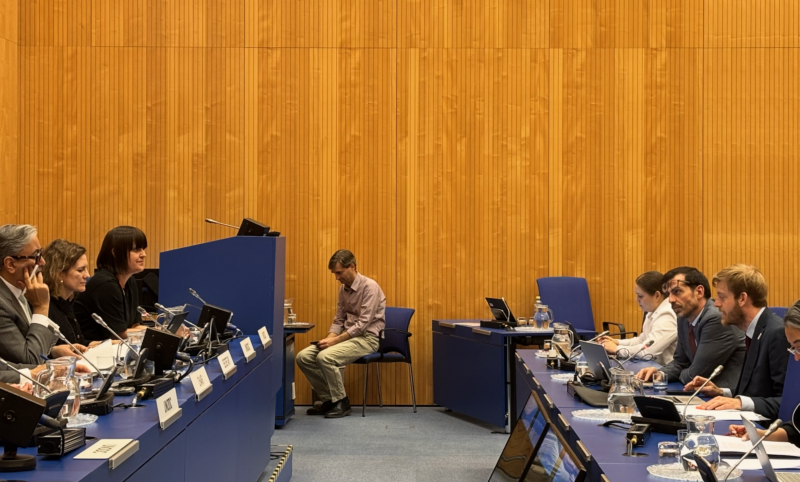
This year’s NGO briefing, on the margins of the 17th session of the UNCAC Implementation Review Group (IRG) featured a more interactive dialogue between civil society representatives and the UNCAC secretariat, with a specific focus on the Implementation Review Mechanism’s (IRM) next phase deliberations. Approximately 70 representatives from civil society and governments participated in the briefing, mostly in person.
Challenges in UNCAC chapter II implementation
As for the meetings’ formal agenda, the Secretariat presented the latest thematic report on implementation of chapter II on preventive measures, highlighting Article 7 (Public sector), 8 (Codes of conduct for public officials), and 12 (the Private sector) as the articles that received the most attention in the 131 country reports analysed; Both in terms of the highest number of States parties that received related recommendations, and the highest number of challenges identified throughout all country reviews. In the context of Article 7, the Secretariat highlighted the lack of comprehensive legislation or administrative measures to regulate the funding of candidates for elected office and the funding of political parties, including in relation to transparency, adequate limits on private donations and the restriction of anonymous and foreign donations, effective disclosure obligations and oversight and audit mechanisms; inadequate procedures for the selection, training and rotation of individuals holding public positions considered especially vulnerable to corruption; insufficient legislation or mechanisms establishing clarity in relation to the prevention, regulation, detection, verification and management of conflicts of interest for all categories of public officials, and the monitoring of the implementation of such legislation or mechanisms; insufficient transparency in the recruitment of public officials and insufficient integrity-related training; lack of the right to appeal appointment and promotion decisions; and limited criteria concerning candidature for and election to public office.
With regards to Article 8, challenges centred around the lack of rules or inadequate measures to prevent, detect and verify conflicts of interest, including on outside activities, secondary employment, the regulation of post-resignation and post-employment restrictions, asset declarations and acceptance of gifts and hospitality; no obligation for public officials to report acts of corruption and limited reporting channels and protection measures for reporting officials; and lack of codes of conduct for public officials or codes excluding certain groups of public officials, and inadequate enforcement of the codes.
Regarding Article 12, Recommendations highlighted, inter alia, the limited cooperation between law enforcement agencies and private entities; lack of codes of conduct for the compliance of business activities; lack of or narrowly defined post-employment restrictions for former public officials; inadequate measures to prevent the misuse of procedures regarding subsidies and licences granted by public authorities for commercial activities.
85 States parties received recommendations related to the implementation of Article 13 on the participation of society. Identified challenges included inadequate measures for effective access to information, including as a result of a lack of or insufficient legislation, lack of application thereof and limited appeal and enforcement measures; limited contribution of the public to decision-making processes and limited participation of non-governmental stakeholders in governmental efforts to prevent and combat corruption; lack of effective measures ensuring that the freedom to seek, receive, publish and disseminate information concerning corruption is respected, promoted and protected; and insufficient measures or lack of legislation providing for the anonymous reporting of acts of corruption;
The IRM’s performance & the implications of the UN funding crisis
The Secretariat provided an update on the IRM’s performance in the 1st and 2nd cycles, still under the first-phase review. As per the 1st cycle, 181 executive summaries of country reviews (out of 190 States parties to be reviewed) were completed. Under the 2nd cycle, 131 executive summaries were finalized, with 17 more pending approval. Delays in the 2nd cycle reviews continued to occur, mainly due to prolonged submission times of the Self-Assessment Questionnaire by the country under review, and delays in approval of executive summaries and country reports. The deteriorating financial situation has also affected the performance of the 2nd cycle. At the same time, the Secretariat noted that the 70% threshold for the completion of the 2nd cycle reviews was met by the deadline of June 2026, which allows for the launch of the IRM’s next phase without further delay.
The Coalition raised concerns about the IRM’s funding horizon and asked whether the UNODC’s funding challenges would affect the 2nd phase and UNODC’s efforts to implement CoSP resolutions. In response, the Secretariat mentioned that staffing under the current situation is indeed a significant challenge, but country reviews have stayed on track. The IRM’s next phase budget will be presented in September as mandated, taking into account the funding restrictions. The Secretariat will rearrange resources internally to improve country visits and desk reviews. As for the resources necessary for resolution implementation, the approach is on a case-by-case basis. The fact that more than 60 States parties co-sponsored resolution 11/7 on political finance transparency, for instance, raises hopes that sponsoring parties will allocate appropriate resources for the resolution’s implementation.
Andrea Rocca from Transparency International (TI) noted the current delays in country reviews and asked whether the UNODC is assessing possible future delays, given the experience from the 1st phase. TI also requested the Secretariat to elaborate on the process of developing the guidance document, which will accompany the 2nd phase reviews, and whether CSOs will be consulted in this process. In response, the Secretariat mentioned that systemic changes will be introduced to the next phase, in line with the States parties’ decisions on the next country review documents and timeline. The Secretariat suggested a review timeline of 13 months, with more time between review stages that risk delays. Another important proposal is to hold all drawings of lots for the reviewing States and the State under review at the very beginning of the review cycle. This will allow more preparation time for most reviews, and can be used more effectively, as countries and other relevant stakeholders will have at least a year of notice. As for the guidance note for the 2nd phase, which is not subject to States parties’ formal deliberation and adoption, UNODC will begin developing the guidance for chapters 3 & 4 (the first cycle of the second phase) in September this year, and encourages CSOs to make submissions to the IRG to inform this process. Most probably, the guidance for the second cycle (chapters 2 & 5) will be drafted at a later stage, closer to the commencement of that review cycle, in a few years.
Participation of Society and Access to Information
TI further highlighted that the 1st phase country review recommendations on Article 13 are poor, and asked what steps can be taken in the 2nd phase to improve the quality of recommendations in general? In this respect, the Secretariat reiterated that moving into the next phase presents a big moment to assess how to make sure country reports’ recommendations are stronger, including on the participation of society.
David Banisar, Board member of the Coalition, asked about steps to address challenges in access to information (ATI) in the fight against corruption. The Coalition’s IRG written submission on ATI highlights persistent barriers to effective ATI, in line with UNODC’s latest study on UNCAC implementation. Resolution 11/4 includes a new commitment specifically focused on user-friendly procedures for submitting and responding to information requests, while Resolution 11/9 on environmental crime and corruption also includes a relevant commitment encouraging States Parties to develop robust frameworks for open government, transparency, and effective public access to relevant information to enhance public oversight and public awareness. The Secretariat noted that this has been a main topic on various occasions. A panel discussion on ATI is taking place this week within the UNCAC Prevention Working Group (which civil society cannot take part in). However, no practical recommendations will follow, and currently, there is no foreseen UNODC questionnaire to collect further information from States parties in this regard, although the information on the UNODC prevention observatory is partial and 10 years old.
Mukhtar Ahmad Ali, from Centre for Peace and Development Initiatives, and Chair of the Coalition board, asked about the Secretariat’s efforts to implement resolution 11/4, which included a request to the Secretariat to “consider, subject to the availability of extra-budgetary resources, carrying out consultations with States Parties to identify practical measures for ensuring the active participation of individuals and groups outside the public sector in anti-corruption efforts, publish reports that summarize the input received, and provide recommendations for the Working Group to discuss and consider.” The Secretariat responded that, so far, no resources were secured for this process, but the topic is indeed on next year’s prevention Working Group agenda.
Enhancing Synergies between the UNCAC & other related fora
Ian Tennant, Chair of the Crime Alliance of NGOs on Crime Prevention and Criminal Justice, stressed that, as part of efforts to enhance efficiencies, the possibility of inviting CSOs to participate in the formal meetings of the UNCAC subsidiary bodies, instead of having dedicated briefings on the margins, should be reconsidered. Such a decision, which depends on the State parties, would also increase information flow between governmental and non-governmental stakeholders. Another measure that could increase efficiencies and thematic synergies is the joint convening of the UNCAC International Cooperation Expert Meeting and the UNTOC Working Group on International Cooperation. Along these lines, Sophia Schärer from the Global Initiative against Transnational Organized Crime, asked whether there are plans for additional activities beyond the discussions of the Working Groups to implement resolution 10/5 on corruption and organized crime , and if there is another way for CSOs to contribute to the collection of data on this topic by the UNODC. The Secretariat highlighted that the UNCAC International Cooperation Expert Meeting will have a discussion on the implementation of resolution 10/5 on its formal agenda this year, which should lead to recommendations on how to further address the evolving links between the two phenomena. As for organizing a joint meeting between the two sister conventions’ working groups on international cooperation, there are no updates, but this area remains relevant to UNODC, which is well placed to respond to these priorities. UNODC’s new strategy will have more attention to cross-cutting topics and existing synergies.
In another statement, the Coalition raised attention to the Human Rights Council (HRC) Resolution 59/6, which requested the HRC Advisory Committee to prepare a comprehensive study, with the input of other stakeholders, in which it should develop concrete guidelines on implementing existing procedural and substantive human rights obligations in the context of preventing and combating corruption, and further requested to share the study with UNODC. In this regard, the Secretariat was asked about its engagement with this process and how it envisages ensuring that this study, which is expected to provide critical guidance in this field, informs and helps shape the agenda of the Working Group on Prevention to further strengthen synergies between human rights and anti-corruption frameworks at the national, regional, and international levels. The Secretariat clarified that it is in close contact with OHCHR, and referred to the study in Southeast Asia comparing recommendations of the HRC Universal Periodic Review and UNCAC IRM. This study proved very insightful, and the UNODC is exploring the possibilities to conduct similar studies in other regions. Later in June, the UNCAC Secretariat, which was asked to review the draft, will be presenting to the HRC and will look at how to engage with the study further to make sure UNODC input is included.
Technical Assistance delivery & improving Youth Engagement in Anti-Corruption
In its final presentation, the Secretariat provided a general overview of UNODC’s technical assistance analysis of needs and delivery, with some details on recipient countries, thematic focus, and the work of the UNODC regional hubs and offices in this respect. It also referred to the paper prepared for the Prevention Working Group’s current session on the Strengthening anti-corruption and integrity education for children and young people. Hilda Ajeilat from Jordan Transparency Center, and Board Member of the Coalition, highlighted that the UNDOC should enhance its technical assistance efforts to become more accessible to youth across countries, in particular where young people face obstacles to participation. She stressed that Youth indeed receive training but should be more involved in actual policy making. The Secretariat mentioned that this is one of the main goals of the GRACE initiative. In 2022, the YouthLED Advisory Board was set up and has co-led the development of tools for young people. The UNODC Regional Hub focal points are in touch with the youth-led advisory board, and capacity-building workshops will grow, where funding is available.