


8 June 2026 –
The next phase of the United Nations Convention against Corruption (UNCAC) Implementation Review Mechanism (IRM) presents a significant opportunity to strengthen how countries assess UNCAC implementation and improve their anti-corruption efforts.
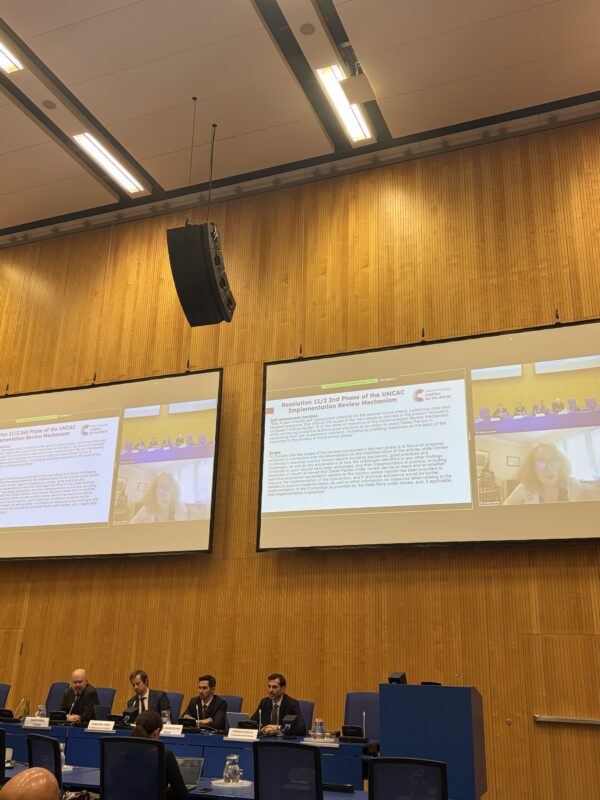
At an informal event on the margins of the resumed sixteenth session of the Implementation Review Group (IRG), government representatives, civil society experts, and anti-corruption practitioners discussed how the key review documents for the next phase of the IRM should be designed to maximize the impact and credibility of future country reviews.
The discussion came at an important moment. The adoption of Conference of the States Parties (CoSP) Resolution 11/2 in Doha marked a major milestone in the negotiations on the future of the IRM. The resolution fosters more transparency and provides important new opportunities for stakeholder participation throughout the review process. It also introduces several innovations, including greater attention to implementation in practice, better identification of technical assistance (TA) needs and reflection on TA outcomes, inviting States under review to address new developments in their anti-corruption landscapes, and opportunities for voluntary follow-up reporting. At the same time, many of these measures are voluntary, meaning their effectiveness will depend on the commitment of individual States parties.
Developing a More Effective Self-Assessment Checklist
A central focus of the discussion was the future Self-Assessment Checklist (SACL), which forms the foundation of the country review, and speakers broadly agreed that the new checklist should be more user-friendly while capturing comprehensive information since the previous review cycles. David Pimm from Global Affairs Canada, who had been involved in the negotiations of the IRM’s first phase in 2008-2009, shared his perspective on the differences between the deliberations back then and now, and commended civil society’s advocacy efforts and support in achieving a more transparent and inclusive IRM. From Canada’s perspective, in the new SACL, countries should explicitly state whether non-governmental stakeholders were consulted. If not, the country under review could explain why and clarify whether such stakeholders would be consulted at a later stage of the country review. He also highlighted Canada’s support for questions that provide a better reflection on past technical assistance delivery. David shed some light on the challenging negotiations regarding the scope of the next phase, so that the country under review will go beyond merely reporting on its efforts to implement the recommendations from the 1st phase reviews, particularly reporting on other new developments since the 1st phase was completed. In this respect, the county under review is asked to provide “other information on measures taken relating to the implementation of the Convention” (Resolution 11/2, Operative Paragraph 4). This language should be interpreted as a way to address new developments in the country under review’s anti-corruption landscape and goes beyond measures addressing review recommendations and observations.
Daniel Mol Marcolino of Brazil’s Office of the Comptroller General highlighted the practical challenges governments face in coordinating responses across multiple institutions and levels of government. He noted that a simplified checklist, supported by technological solutions, could make it easier for governments to engage not only public institutions but also civil society and other stakeholders. Regarding the SACL deliberations, he noted that, while there is still time until its adoption in the November 2026 CoSP special session, he is encouraged by the emerging consensus on important aspects of the checklist. At the same time, on technical assistance, the SACL should reflect a balance between identifying more precisely TA needs to inform future TA delivery and allowing countries under review some leeway and flexibility in this regard. He reiterated that Brazil is a strong supporter of multilateralism and is in a good position to raise its voice in other related international fora. In particular, Daniel highlighted Brazil’s co-chairmanship of the Open Government Partnership Initiative (OPG) in 2025-2026. OGP is a diverse and enriching forum to debate and defend democracy, especially by incentivizing the participation of civil society to fight corruption and to promote transparency and integrity. He stressed that OGP national action plans are a good way to advance UNCAC implementation.
Civil society representatives stressed that while a user-friendly, simplified SACL is important, it should not come at the expense of substance. Corinna Gilfillan of the Global Civil Society Coalition for the UNCAC outlined several areas where the draft checklist could be strengthened. These include requiring countries to report on major developments since previous reviews, corruption trends, implementation challenges, lessons learned, and progress made in response to previous recommendations. She also emphasized the need for more specific questions on implementation in practice and the need to focus on results achieved through anti-corruption measures.
Review Guidance Documents Will Be Critical
Speakers emphasized that the accompanying guidance note being developed by UNODC will be a crucial document that will accompany the checklist itself.
Andrea Rocca of Transparency International argued that the guidance should provide practical examples of the types of information that countries should submit, particularly regarding implementation in practice. This could include statistics on investigations, prosecutions, convictions, acquittals, and other outcomes that help assess the effectiveness of anti-corruption measures. He noted that stronger guidance could help address weaknesses identified during the first review phase, where data was often incomplete, inconsistent or unavailable.
Transparency International and the Coalition for the UNCAC noted that the guidance should draw on the growing body of UNCAC resolutions adopted by States parties over the years. While these resolutions are not themselves subject to review, they provide valuable benchmarks for assessing the Convention’s implementation and identifying emerging good practices, such as in the case of the first-ever dedicated CoSP resolution on political finance transparency. In addition, greater use of information from other international and regional review mechanisms related to anti-corruption could help make reviews more comprehensive while reducing duplication and reporting burdens, as highlighted in paragraph 27 (c) of the IRM’s Terms of Reference.
Civil Society Participation in the Next Phase
One of the most significant innovations in Resolution 11/2 is the stronger encouragement for stakeholder engagement and transparency of the country review process.
The discussion highlighted that meaningful participation requires a structured and proactive approach by both government and non-government stakeholders. Speakers stressed the importance of clearly documenting which stakeholders were consulted, how their input was considered, and whether they will be involved throughout different stages of the review process. Civil society representatives called for review reports and annexes to reflect stakeholder engagement more systematically and transparently.
David Pimm encouraged civil society organizations to begin preparing for the next phase. He emphasized that organizations should engage with governments as soon as possible, coordinate their interventions, build awareness among national focal points, and basically start planning how they can contribute to future reviews. While there is no single model for participation, he stressed that civil society has a critical role to play in advocating to governments to make use of the new opportunities agreed by consensus in Resolution 11/2 in Doha. The drawing of lots for all reviewed countries will take place in May 2027, and first-year reviews should start shortly after that. Second and subsequent year reviews will allow more time for governments and non-government stakeholders to consult and prepare.
Brazil’s experience was highlighted as one example of how institutionalized dialogue can support more inclusive approaches to anti-corruption. The country’s Council on Transparency, Integrity, and the Fight Against Corruption provides a permanent platform through which civil society organizations can contribute to anti-corruption policymaking and monitoring. Such mechanisms can help governments listen to diverse perspectives and facilitate participation, including smaller organizations that may otherwise struggle to engage in international review processes. While commending this inclusive practice, particularly the fact that the agenda of the council is largely driven by non-governmental stakeholders, civil society speakers suggested taking advantage of such institutionalized settings to present upcoming opportunities for civil society’s engagement in international reviews, including the UNCAC country reviews.
Assessing Article 13 in Practice
The discussion also examined how future reviews should assess Article 13 of UNCAC, which concerns the participation of society in anti-corruption efforts.
Drawing on an analysis of more than one hundred country review reports, Transparency International noted that previous assessments often focused heavily on legal provisions while paying insufficient attention to whether civil society could operate effectively in practice. Future reviews should therefore consider broader factors such as freedom of expression, access to information, civic space, protection against reprisals, and the ability of organizations to operate independently. Without these enabling conditions, meaningful participation in anti-corruption efforts cannot be achieved. Stronger assessments of implementation in practice would also lead to more useful and context-specific recommendations and a better identification of implementation gaps and technical assistance needs.
Looking Ahead
As negotiations continue on the key review documents, the coming months will be critical for shaping how the next phase of the IRM operates in practice. The discussions highlighted broad support for a review mechanism that is more transparent, more participatory, and more focused on real-world outcomes.
If implemented ambitiously, the commitments contained in Resolution 11/2 could strengthen the country review to become a more effective tool for accountability, learning, and reform. Achieving that potential, however, will depend on the willingness of States parties to embrace transparency, engage stakeholders meaningfully, and make full use of the opportunities provided by the next phase of the review process. Timely advocacy to governments can help advance this ambition.
With deliberations on the Self-Assessment Checklist and the development of related guidance documents expected to continue in the lead-up to the special session beginning of September this year, governments, civil society, and international organizations all have a role to play in ensuring that the next generation of UNCAC reviews is fit for purpose and capable of delivering meaningful anti-corruption progress.