


1 June 2026 –
As the Global Civil Society Coalition for the UNCAC marks its 20th anniversary, the 25th regional meeting of the Asia-Pacific, held last month, served as a space to reflect on the past year of collective efforts to advance the United Nations Convention Against Corruption (UNCAC). With the Coalition’s strategy currently being restructured, the 2025 community survey highlighted a network of members and affiliates who remain committed to networking, peer learning, and amplifying local voices on the global stage.
Regional community and shifting priorities in 2025
The Asia-Pacific region recorded 16 CSO responses from 10 countries, representing 11 member organisations and 5 affiliated groups in the community survey. Overall, the feedback reflects strong appreciation for the Coalition’s role in strengthening civil society engagement and facilitating knowledge exchange, particularly regarding UNCAC processes and broader anti-corruption efforts. However, the landscape is evolving. This year, access to information and civic space emerged as top thematic priorities, alongside rising concerns regarding natural resource governance, public finance, and debt transparency. Looking ahead, the network requested more structured, practical, and action-oriented support, particularly technical guidance, training, and capacity building. Respondents also highlighted the need for networking opportunities, partnerships, access to global forums, coordinated advocacy, legal and technical assistance on access to information frameworks, and support in translating UNCAC commitments into national-level reforms. Continued peer learning also remains a strong priority.
The 30-year crusade: Freedom of Information in the Philippines
Sigaw ng Kabataan Coalition (SKC) in the Philippines led the main segment of the meeting on the Freedom of Information Bill in the Philippines. While the Philippines currently has an Executive Order (EO 2, s. 2016) that operationalises the constitutional right to information, a fully-fledged, comprehensive legal framework has been under discussion for many years. Following decades of advocacy and several near-adoptions, the Bill now presents renewed momentum. The Bill has also been referenced in the Philippines’ UNCAC second cycle review, while the current Open Government Partnership National Action Plan in the Philippines also places emphasis on freedom of information.
Ellirie Aviles, Founder and Chairperson of the SKC, and Patrick Acupan, Convenor of the FOI Youth Initiative, presented the advocacy struggle that has spanned over three decades in the Philippines for a freedom of information legal framework. They highlighted that despite years of stalled bills and administrative roadblocks, there is now a sense of “cautious hope” surrounding this law. Key features advocated for in this Bill include broad coverage extending beyond national government agencies to include the legislature, judiciary and local government authorities; the establishment of a Freedom of Information Commission as the institutional enforcement body; request classification and clear timelines; measures for proactive disclosure; disclosure of Statements of Assets, Liabilities and Net worth (SALN); clear exceptions structure; appeals and remedies; privacy framework and whistleblower protection. Adopting such a bill will align with many of the Coalition’s recommendations for promoting effective ATI in line with UNCAC-related commitments. Acupan highlighted remaining challenges. These include the risk of passing a diluted and non-comprehensive Bill that would not fully guarantee citizens’ right to information. He also noted the difficulties in consolidating competing versions of the Bill, particularly due to disagreements around exemptions and scope. Reservations from some agencies and legislators regarding SALN disclosure and the security-related provisions also continue to complicate the process.
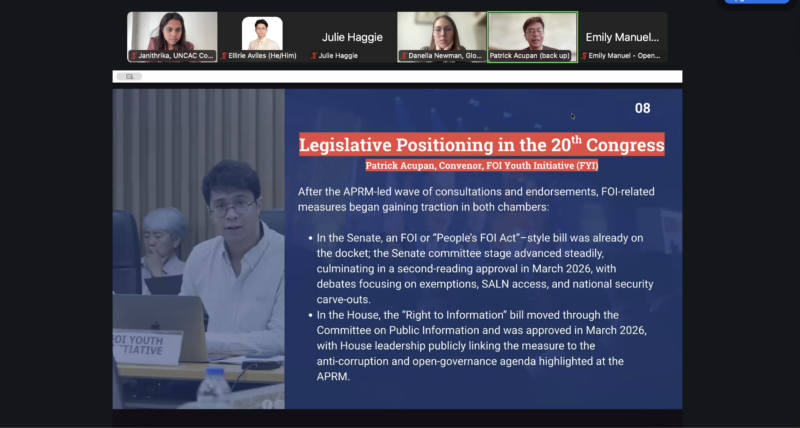
The open discussion that followed demonstrated that the Philippines is not alone in facing these challenges, even if countries in the region are at different stages of developing access to information frameworks.
Cynthia Gabriel from the Center to Combat Corruption and Cronyism (C4) in Malaysia highlighted the difficulties activists face in navigating secrecy laws that often coexist with and undermine emerging freedom of information frameworks. Referring to countries such as South Africa, Kenya, Sri Lanka, and Malaysia, she raised strategic questions about whether securing an FoI law first is sufficient, how secrecy laws and FoI laws operate side-by-side, and how exemption and superseding clauses function in practice. She also reflected on the need for civil society to strategise to ensure that disclosure becomes the norm rather than secrecy. Another concern she raised was the cost and accessibility of obtaining information, noting that open data initiatives, particularly around procurement and contracts, may sometimes offer more accessible pathways. Gabriel also observed a broader regional shift, particularly in parts of ASEAN, where governments in countries such as Indonesia, the Philippines, Malaysia, and Cambodia are increasingly adopting access to information frameworks. She suggested that civil society actors across the region should collaborate more strategically, not only to strengthen existing frameworks but also to promote citizen participation in governance in countries such as Singapore, where administrative systems may be highly developed but opportunities for public participation remain limited.
Priya Paulraj from Transparency International Sri Lanka (TISL) emphasised the importance of the “public interest override” provision in Sri Lanka’s Right to Information Act. She noted that the law has been instrumental in exposing corruption and supporting litigation efforts by enabling access to critical information.
Julie Haggie, Chief Executive Officer of Transparency International New Zealand, brought in a different perspective, noting that New Zealand has had official information legislation for 43 years, yet still faces many of the same challenges discussed during the session, including barriers relating to information availability, overriding provisions, and complaints mechanisms.
Although outside the region, Danella Newman from the Coalition Hub shared the Austrian experience, where a long-standing constitutional tradition of official secrecy was only abolished with the passage of the Freedom of Information law in 2024, making Austria the last country in the European Union to adopt such legislation.
*Update: Since the regional meeting, the Freedom of Information Bill in the Philippines was approved in its third and final reading in the House of Representatives on 02 June 2026. As the next step, a unified Bill will be presented to the President for signature into law.
Effective and meaningful civil society participation in the UNCAC IRM process in New Zealand
During the second segment of the meeting, Julie Haggie shared a landmark advocacy victory where 21 out of 25 of TINZ’s recommendations were reflected in the Executive Summary of New Zealand’s UNCAC second cycle implementation review. She also highlighted a challenge familiar to many civil society actors participating in the UNCAC review process: extremely limited timelines for engagement provided on short notice. In New Zealand’s case, civil society had only around five days to comment on the government’s self-assessment. See the full presentation here.
Lessons learnt:
- Preparation and collaboration are key: TI New Zealand worked closely with the Coalition for the UNCAC, which reviewed early drafts of submissions and facilitated information sessions to support more meaningful civil society participation.
- Understanding the review mechanism and its entry points for civil society’s meaningful engagement.
- Preparing evidence-based assessments in advance and building strong collaborative relationships.
The discussion that followed also highlighted an important strategic reality of advocacy within this review process. Participants noted that even if the final language appears weaker than what civil society initially demanded, securing the inclusion of recommendations still represents an important achievement. Even softened language, such as replacing “establish” with “consider establishing,” can create important leverage for future accountability efforts. Nethmi Jinadasa from TISL shared a similar experience from Sri Lanka, where civil society feedback had been requested during the review process but was ultimately not reflected in the final drafts.
Action in May and June
The discussions also connected directly to several upcoming global advocacy opportunities. The UNCAC Implementation Review Group (IRG), taking place from 18–22 May, is an important space where the Coalition continues to advocate for greater civil society inclusion in the next phase of the UNCAC review mechanism.
Peter Munro, from Transparency International UK, who joined the regional meeting, shared updates on the upcoming UK Illicit Finance Summit, initially scheduled for June 2026 and now postponed to December 2026. The Summit is expected to generate several international initiatives aimed at tackling illicit financial flows, including international commitments and working groups addressing emerging threats. Munro noted that the Summit may also encourage participating countries to make domestic commitments, creating potential advocacy opportunities for civil society organisations both within those countries and across the wider region.
Opportunities for engagement
Join thematic working groups: Participate in working groups focused on asset recovery, victims of corruption, whistleblower protection, and grand corruption, among others.
Contribute to the Coalition website: We invite members to write for the Global Civil Society Coalition for the UNCAC website, specifically sharing how your work advances the articles of the Convention. In this regard, revamped regional pages are being developed and will be launched as part of the new Coalition website.