


18 March 2026 –
In an era of significant geopolitical tension and instability, the need for robust regional networks dedicated to accountability and transparency has never been more important. Against this backdrop, the 24th Asia-Pacific regional meeting took place on 5 March, where members of the Asia-Pacific network of the Global Civil Society Coalition for the UNCAC gathered to reflect on the outcomes of the 11th Conference of the States Parties (CoSP 11) to the UN Convention against Corruption (UNCAC) and to discuss the course for the year ahead
Turning global commitments into national action
CoSP 11, held in December last year in Qatar, resulted in 11 resolutions adopted by consensus. A notable highlight was the active leadership of Asia-Pacific nations, including Mongolia’s sponsorship of the first-ever resolution on political finance transparency and the joint efforts of Tuvalu and the Marshall Islands on the resolution for Small Island Developing States (SIDS). While these resolutions are technically non-binding, they establish powerful “soft” standards for implementing the UNCAC. For civil society organisations (CSOs), a country’s decision to co-sponsor a resolution signals a strong commitment that can be leveraged for national-level advocacy.
Yonatan Yakir, Programme Manager & UN Affairs at the Vienna-hub, and Janithrika Jayasundara, Regional Coordinator for Asia and Pacific, presented on CoSP 11 outcomes and follow-up. They discussed the achievements and outcomes of the Conference in line with the Coalition- community-identified priorities, with a focus on Asia-Pacific issues of importance and possible follow-up action CSOs could take in the region, to promote the implementation of relevant commitments. Yakir highlighted that despite a challenging CoSP 11 backdrop for civil society- the severe funding cuts, and the limitations to civic space nationally and at the CoSP itself, civil society showed a strong presence on the ground in Doha, and a record high number of civil society representatives joined States parties, including from Asia and the Pacific. At the Conference, non-governmental stakeholders shared their expertise and experiences in the fight against corruption through numerous side events, written and oral statements, and engaged in effective, coordinated advocacy during the negotiations on the CoSP 11 adopted resolutions. These advocacy efforts led to strong impact on the adopted resolutions on: Political finance transparency (Resolution 11/7), the UNCAC IRM next phase (Res. 11/2), corruption and crimes that affect the environment (Res. 11/9), corruption in Small Island Developing States (11/3), As well as significant impact on: The Doha Declaration on Corruption and AI (11/1), and the Marrakech follow-up resolution on the prevention of corruption (11/4). Despite considerable progress achieved in some of the resolutions, other important issues were not adequately addressed, such as victim compensation and the need to promote synergies with other important UN and international fora to combat corruption more effectively.
Yakir also presented opportunities for CSOs’ engagement in the CoSP fora over the next couple of years, with a specific focus on the advocacy needed to ensure States parties finalize the agreement on a robust UNCAC IRM follow-up phase before country reviews commence in 2027. He concluded by mentioning that ahead of the upcoming Implementation Review Group (UNCAC IRG) and Prevention Working Group sessions in May this year, CSOs could:
- Advocate to include civil society in country delegations to follow discussions in relevant subsidiary bodies;
- Encourage the Government to submit information on resolution- implementation & monitor States Parties’ published information on the Prevention Working group website.
- Support and inform the Government’s reporting to the meetings;
- Make a submission in parallel to the Government’s submission, and:
- Co-organise events on the margins of the Working Group sessions/CoSP Special session (in collaboration with States parties), and if the CSO was accredited to CoSP 11, participate in the NGO briefing which will be held on the margins of the IRG meeting on 19 May.
Jayasundara presented the key aspects of Resolution 11/7 on Political Finance Transparency, highlighting the higher standards introduced for transparency in political funding. She emphasised measures such as donor identification, timely publication of political finance records, limits on anonymous and undue political donations, and stronger oversight bodies with the authority and resources to monitor compliance. The resolution also recognises the role of civic oversight, encouraging the participation of civil society and election monitoring groups in strengthening accountability in political finance.
Jayasundara also outlined possible follow-up actions for civil society after CoSP 11. For example, CSOs in the Asia-Pacific can engage governments to implement key resolutions, such as the political finance resolution, by building partnerships with election monitoring bodies and anti-corruption agencies. She further highlighted opportunities for collaboration with environmental groups and investigative journalists on corruption linked to environmental crimes, and encouraged civil society to actively engage with the UNCAC Implementation Review Mechanism through submissions, monitoring government reporting, and advocating for greater transparency in the review process.
From the Inside: Civil society in State delegations at CoSP11
During the meeting, Yuambari Haihuie, affiliated with Transparency International Papua New Guinea (TI PNG), shared his experience attending CoSP 11 as part of the official state delegation of Papua New Guinea. His experience illustrates how collaboration between governments and civil society can create new opportunities for both advocacy and improved implementation of the UNCAC. After the COVID-19 pandemic, TI PNG provided technical expertise during the second cycle of the UNCAC implementation country review, which, in turn, helped build trust with the government. This eventually opened the door for civil society participation in the UNCAC forums, including CoSP 11.
Haihuie highlighted several advantages of this inclusion for both state delegates and civil society. Including civil society in official delegations can strengthen a state’s credibility and signal its commitment to openness to other countries. At the same time, it provides strategic access to discussions, allowing civil society to directly engage state delegates and regional counterparts such as the UNODC offices to obtain regional and domestic commitments that can be leveraged and followed up later. He also emphasised the critical role civil society can play in supporting and advising country delegations in this way. In his case, this included offering technical advice on CoSP procedures, assisting with statements and bilateral engagements, and helping delegates navigate the negotiation processes. Being part of the state delegation provides civil society actors with access to state delegates from the other countries in the region, which may contribute to the coordination of regional positions during negotiations. At the same time, it also allows those who are in state delegations to bridge conversations between states and civil society networks, facilitating timely and effective advocacy during the CoSP.
Reflecting on these experiences and other CoSP follow-up domestic advocacy that TI PNG has been doing, Haihuie encouraged members of the Coalition to engage in the review process, demonstrate technical expertise, and build relationships with stakeholders who may be open to collaboration. He iterated that while contexts differ across countries, such collaboration between states and civil society in advancing UNCAC implementation is gradually gaining momentum.
Bottom-up approaches to accountability: a new tool for grassroots oversight
The regional meeting also included a segment on the recently launched Community-Based Monitoring (CBM) Handbook by Integrity Watch Afghanistan. Yusuf Ayubi, Partnerships Manager at Integrity Watch, introduced the handbook as a practical guide for communities to monitor public services, such as health, education, and infrastructure. Ayubi explained that CBM offers a bottom-up approach to accountability, empowering citizens to engage with the public service sector, especially in contexts where top-down anti-corruption measures have limited impact on everyday local realities affected by corruption.
Drawing on Integrity Watch’s experience reaching over 2400 communities and working with 6000 volunteers between 2021 and 2025, this handbook explains CBM as an approach that enables communities to monitor local public services, identify problems, and engage constructively with officials to improve accountability. This model emphasises community leadership and ownership and a rights-based approach that builds bridges between citizens and authorities instead of burning them.
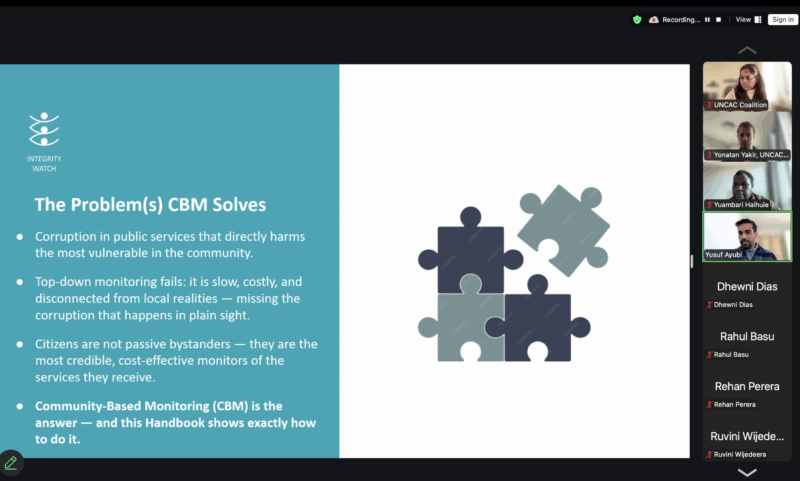
The handbook provides practical guidance for launching and managing CBM initiatives, including tools, templates, checklists, and real-world examples across health, education, infrastructure, extractives, and trials. It covers key steps such as context mapping, recruiting and training local monitors, establishing transparency mechanisms, and transitioning ownership of the monitoring process to communities. Integrity Watch has already successfully supported CBM initiatives in Zambia, and discussions are underway to launch similar initiatives in Chile, Nepal, and Bangladesh.
Ayubi also emphasised how community-based monitoring and this handbook contribute to the implementation of the UNCAC, particularly by operationalising prevention measures, enabling civil society participation, promoting public reporting, and supporting protection of reporting persons.
Organisations interested in partnering with Integrity Watch to adopt the approach can learn more or connect with them at www.integritywatch.org
Opportunities for engagement
- Join thematic working groups: Participate in working groups focused on asset recovery, victims of corruption, whistleblower protection, and grand corruption, among others.
- Contribute to the Coalition website: We invite members to write for the Global Civil Society Coalition for the UNCAC website, specifically sharing how your work advances the articles of the Convention. In this regard, revamped regional pages are being developed and will be launched as part of the new Coalition website.
- The Transparency Pledge: Only four countries in our region have signed the pledge. We must work together to brainstorm ways to encourage more states to commit to transparency in their review processes.