


24 October 2025 –
The 2025 Global Summit of the Open Government Partnership held in Vitoria (Spain) from 6 to 9 October highlighted many examples of collaboration between civil society and government showing that, when civil society is not just consulted but truly included, transparency and anti-corruption outcomes are stronger and more legitimate.
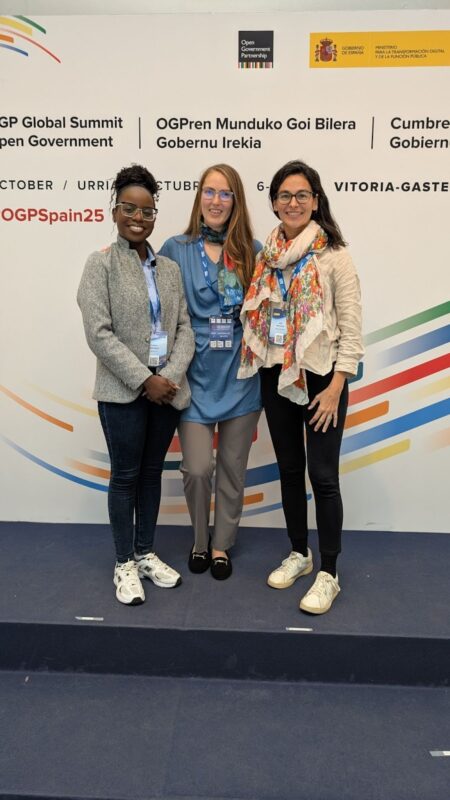
Collaborative approaches of open governance between civil society and government are well-established in the Open Government Partnership (OGP). In the UNCAC process, it’s still a work in progress. This is why enhancing synergies between the UNCAC and OGP fora can help ensure that OGP’s 75 Member States stay true to their commitments to meaningfully involve civil society in anti-corruption efforts, as outlined in Article 13 of the UNCAC.
One concrete example of this collaboration was the UK-government led IRM initiative, in partnership with the UNCAC Coalition and OGP. Through collective advocacy with governments and civil society, we succeeded in getting more than 60 States to commit to three key principles: transparency, inclusiveness, and participation of civil society in the UNCAC country reviews and their follow-up, and to include these commitments in their OGP action plans. This was a major milestone adopted at the 10th CoSP in late 2023, also including States that are not part of OGP.
The ongoing negotiations on the next phase of the UNCAC Implementation Review Mechanism (IRM) represent another key opportunity for OGP Member States to ensure civil society participation is an integral part thereof.
Call to action
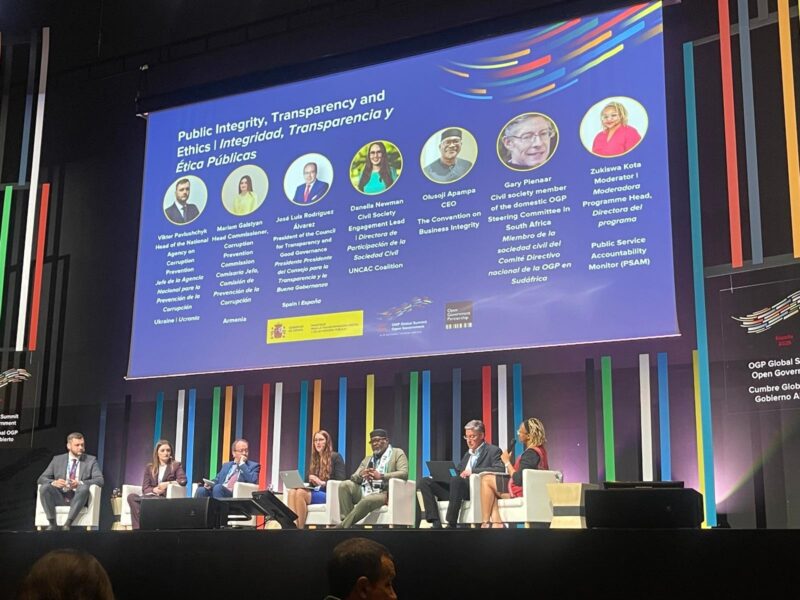
In her intervention at the OGP Summit on the high-level panel entitled “Public Integrity, Transparency and Ethics”, Civil Society Engagement Lead & Project Manager Danella Newman underscored the importance of civil society-government collaboration and of coalitions. When governments, civil society, and international partners align on a common goal, real commitments follow. But commitments on paper are not enough – we must ensure implementation in practice.
Danella called on OGP Member States to strengthen the linkages between the OGP and UNCAC platforms, by:
- Being present at the negotiations on the next phase of the IRM on 5-7 November and actively speaking out for a stronger, more transparent, inclusive, efficient and effective next phase of the IRM;
- Including civil society representatives in their official delegations attending CoSP11 in Doha in December; and
- Integrating ambitious commitments on the implementation of UNCAC CoSP resolutions into their OGP National Action Plans.
Several States have already been doing this, but more voices are needed to ensure a strengthened and truly effective next phase of the UNCAC IRM. Because the stronger the UNCAC process globally, the stronger our shared efforts to advance key anti-corruption reforms nationally, and locally. The UNCAC Coalition will continue to focus on promoting transparency and meaningful participation in UNCAC implementation – ensuring that civil society can engage constructively in identifying problems, proposing reforms, and following up on implementation.
Other key takeaways from the OGP Global Summit
- The Vitoria-Gasteiz Declaration, adopted ahead of the Summit and endorsed by many civil society organizations including the UNCAC Coalition and several of our members, highlighted openness, access to information and civil society participation in decision-making as vital to strengthening democracy in a context of rising threats such as the erosion of public trust in institutions, shrinking civic space, growing disregard for fundamental rights, and intensifying pressure against multilateralism.
- Being part of a coalition can provide a certain level of protection to civil society actors. With many CSOs facing aid-cuts, restrictions and intimidation, donors need to step up to ensure civil society can continue to operate and contribute to anti-corruption efforts.
- The increasing use of emerging technologies and Artificial Intelligence-based systems in support of public decision-making and in fighting corruption requires transparency and the strong involvement of civil society actors to safeguard human rights, prevent risks of discrimination and bias, and ensure that these technologies serve the interests of all citizens, especially the most vulnerable.