


16 July 2025 –
Asset and interest declarations of public officials are a critical tool for accountability. If well designed and implemented, they can help combat corruption by pointing to potential conflicts of interest or illicit enrichment of political representatives, members of Parliament or public servants. Unfortunately, these declarations are often not comprehensive or openly available. On Tuesday, 24 June, members of the UNCAC Coalition in Europe met to discuss how to improve the transparency of asset and interest declaration systems across the region, as part of a collaborative project that recently completed its data collection phase.
At the global level, the United Nations Convention against Corruption (UNCAC) calls on governments to promote transparency and prevent conflicts of interest. It provides that countries set up systems for public officials to report their assets, jobs and activities outside of government, and any major gifts or benefits that could interfere with their public duties. Finally, these systems must ensure “effective financial disclosure for appropriate public officials” (UNCAC Articles 7, 8 and 52).
A regional database to evidence diversity and lack of transparency
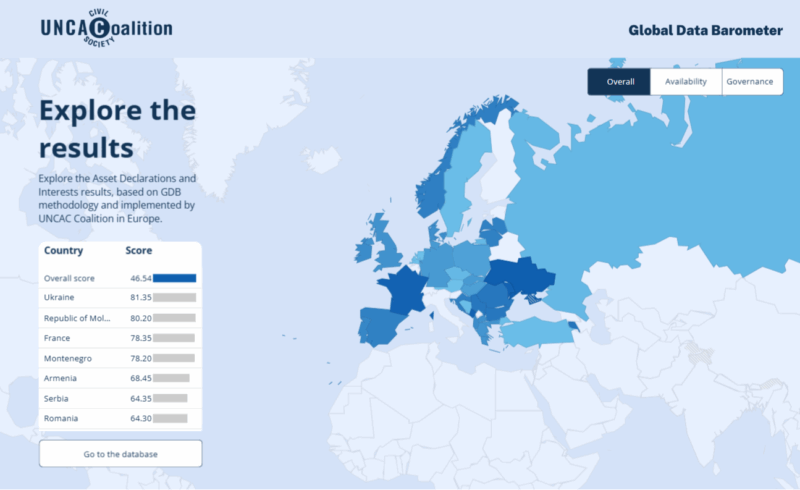
To better understand how these declarations are regulated and implemented at the national level in Europe, the UNCAC Coalition Regional Network in Europe partnered with the Global Data Barometer (GDB) to launch a collaborative project aimed at building a regional database on asset and interest declarations.
The project “Asset and Interest Disclosure Database” shows existing laws, regulations, and practices in 33 European countries, focusing on the transparency and accessibility of declarations. Our large-scale data collection effort involved 31 civil society organizations – members and partners of the UNCAC Coalition – and has resulted in a regional database and dashboard, which also includes links to relevant asset and interest declarations in each country.
A preliminary analysis of the findings, focusing on the transparency aspect, puts in evidence that no country in Europe meets the highest standard of fully open, reusable, and comparable online asset and interest declarations. Most navigate in low or medium levels of transparency, with only partial information being made available. The examples of Armenia and Portugal showcase common shortcomings in practice.
Armenia: A high performer in governance and availability of asset and interest declarations
The case of Armenia was presented by Anush Hakobyan, Legal Expert at Transparency International Anticorruption Center (TIAC). In Armenia, public officials, including high-corruption-risk officials and their close family members, are required by law to submit asset and income declarations. These declarations cover movable and immovable property, cash, bank accounts, stocks, and other forms of income or property interests. Public officials must also report potential conflicts of interest, including ownership or management roles in businesses, and refrain from participating in decision-making processes where such conflicts exist.
The framework in Armenia ensures the mandatory publication of asset and interest declarations online, through the Corruption Prevention Commission’s registry. The data allows public access to comprehensive information on declared interests, assets, and liabilities of public officials and their close associates, which is published annually and can be easily consulted. This level of accessibility promotes transparency and enables monitoring by the corresponding institutions, but also by journalists and civil society watchdogs.
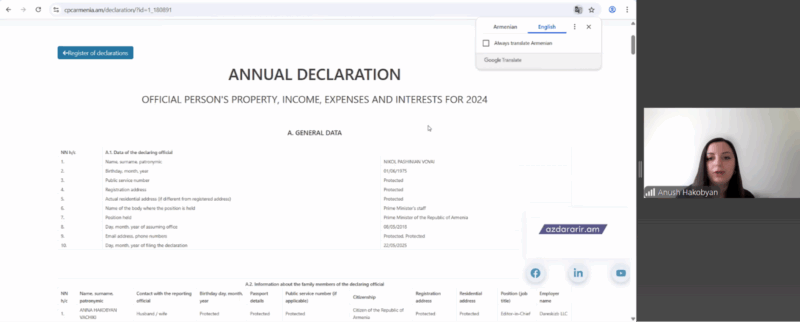
However, there are important gaps in the system. Among these:
- the registry lacks statistics and real-time overview of which declarations are missing;
- the profiles of family members are not linked to the corresponding public official, resulting in no aggregated overview of household declarations;
- while the platform allows access to and export of filtered or specific data extracts, there is no functionality for bulk downloads or APIs to access the entire dataset as a whole;
- the verification process of the information contained in the declarations remains opaque.
Portugal: The paradox of a new transparency website that limits access to declarations in practice
Susana Duarte Coroado, Post Doctoral Researcher at Dublin City University Business School and former Chair of Transparency International Portugal, presented the case of Portugal. The country has largely implemented the internationally-recommended anti-corruption framework, with legal requirements for asset declarations dating back to 1983, interest declarations to 1995, and rules on gifts and hospitality introduced for cabinet members in 2016, and for parliamentarians in 2019.
A turning point came in 2019, when a wave of political scandals and the findings of a parliamentary commission on transparency in public life prompted a major reform. While it fell short on key issues like conflict of interest regulation and lobbying, it introduced a more streamlined system for public declarations, centralizing them into a single form to be overseen by a new Entity for Transparency. This body became operational in 2023, and its online platform was launched in 2024.
In practice, however, an attempt to access income, assets and interests declarations in Portugal nowadays proves challenging. Not only personal, sensitive data is protected, but also other financial and professional details. A search for a member of parliament on the Transparency Entity’s platform results in the message “Data unavailable due to professional secrecy” for records from 2024 onward.
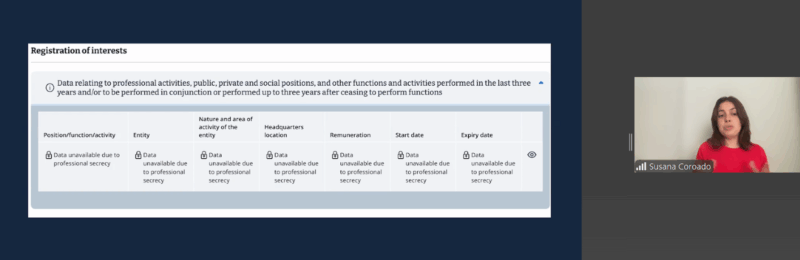
On the Parliament and ministry websites, transparency is not guaranteed either. For post-2024 declarations, the Parliament redirects users to the Transparency Entity’s platform, creating a loop that yields no concrete results. There are also other institutional gaps and technical and bureaucratic hurdles, such as the need to provide a “legitimate interest” or no searchable or downloadable dataset of the declarations in bulk. The current system provides the appearance of public availability of asset and interest declarations, without the substance, as data protection often outweighs the public’s right to know. As Susana pointed out, this is a step backward disguised as progress.
Which advocacy opportunities lie ahead to improve transparency of asset and interest declarations?
A recently presented thematic report by the UNCAC Secretariat highlighted that one of the most prevalent challenges in the implementation of UNCAC Chapter II (Preventive measures) concerns transparency of political finance, and asset and interest declarations. The report noted a frequent “lack of rules or inadequate measures to prevent, detect and verify conflicts of interest, including on outside activities, secondary employment, the regulation of post-resignation and post-employment restrictions, asset declarations and acceptance of gifts and hospitality”.
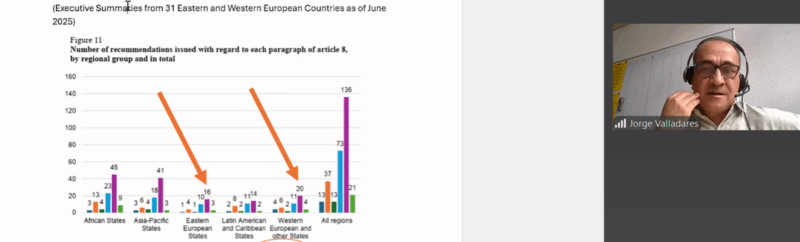
Against this backdrop, Jorge Valladares, Political Integrity Lead, and Flora Cresswell, Regional Coordinator for Western Europe, both at Transparency International, proposed to focus on two key processes to strengthen transparency in asset and interest declaration systems. Civil society organizations can leverage the following international and regional frameworks:
- Firstly, the UNCAC: it is crucial to urge governments to implement the recommendations they receive through the Convention’s implementation review mechanism and country review reports, and fully comply with UNCAC provisions.
- Secondly, organizations in Europe should also pay attention to the proposed EU Directive on combating corruption. Civil society can play a vital role in advocating for the explicit inclusion of asset and interest declaration systems within the scope of the directive.
In both global and regional contexts, continued engagement and awareness-raising initiatives are essential. For this, we hope that civil society organizations, journalists and other actors will use resources such as the new regional database on asset and interest disclosure.