
As States parties enter the final stretch of negotiations on the key documents that will shape the next phase of the UNCAC Implementation Review Mechanism (IRM), attention is increasingly shifting from what is soon to be agreed to how those commitments will work in practice.
At an informal event organized by the Global Civil Society Coalition for the UNCAC on the margins of the 17th first resumed session of the Implementation Review Group (IRG), representatives of Ghana and France joined Transparency International and the Coalition to discuss the latest drafts of the key review documents and how States and civil society can already prepare for the upcoming next phase country reviews, starting mid-2027.
The discussion built on an earlier Coalition event in June and came at a decisive moment. Following the adoption of Resolution 11/2 at the eleventh UNCAC Conference of the States Parties (CoSP 11) in Qatar, States parties gathered to finalize the Self-Assessment Checklist (SACL), country report and executive summary blueprints, as well as the review timeline, ahead of their expected adoption at a one-day CoSP special session in November 2026.
Resolution 11/2 provides important opportunities to make the next phase more impactful: examining implementation in practice, considering new developments since first-phase reviews, better identifying technical assistance (TA) needs and reflecting on past TA delivery, encouraging country follow-up reporting, and strengthening transparency and stakeholder participation. Yet many of its more ambitious calls to action remain voluntary. As the discussion emphasized, the success of the next phase will therefore depend not only on the documents States adopt, but on the practices they establish around them.
Moving from laws on paper to implementation in practice
A strong point of convergence among speakers was the need for the next phase to look beyond the existence of laws and institutions and examine whether anti-corruption measures actually work.
Opening the discussion, Joseph Whittal, Commissioner at Ghana’s Commission on Human Rights and Administrative Justice (CHRAJ), reflected on Ghana’s experience during both cycles of the first phase country review. While highlighting the value of the IRM in identifying gaps and strengthening national anti-corruption frameworks, he stressed that “a review should not be an end in itself.” Rather, reviews should contribute to tangible improvements in preventing and combating corruption. This requires greater attention to evidence of implementation. Passing legislation on asset declarations, access to information, whistleblower protection, or public procurement is one step; demonstrating that these measures are effectively implemented, monitored and enforced—and that they produce results—is another. Future reviews should therefore draw more systematically on implementation data, enforcement experience, practical examples and institutional challenges to answer a fundamental question: are anti-corruption measures working, and if not, what is needed to make them work?
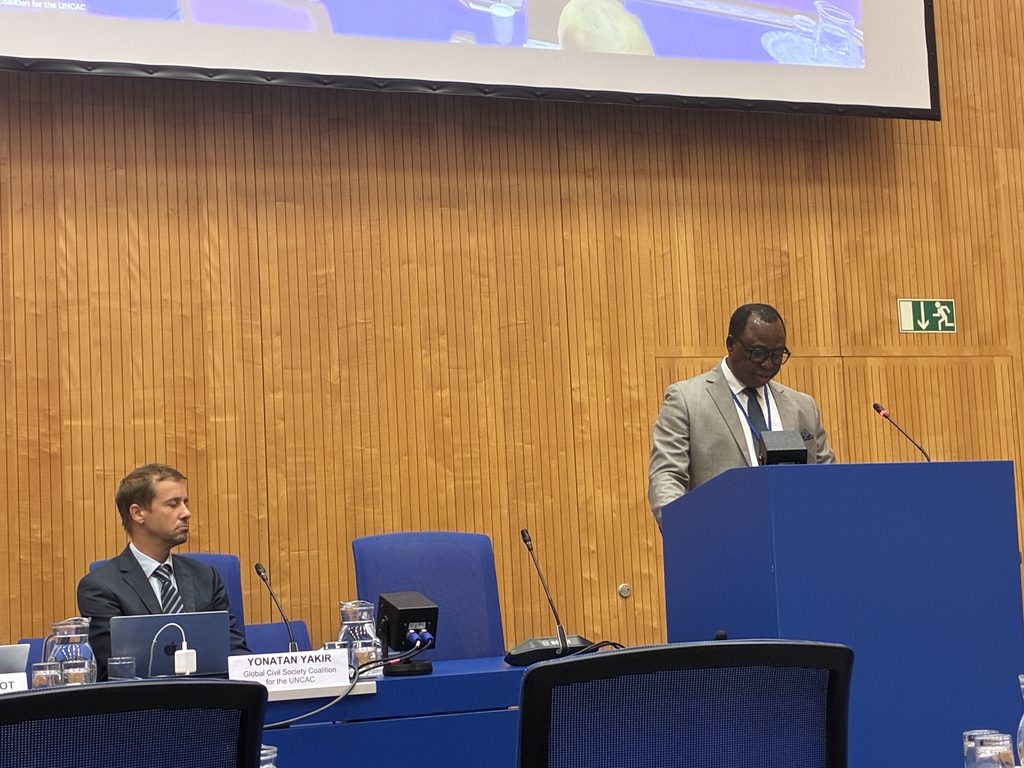
Drawing on Ghana’s experience, Commissioner Whittal highlighted the role TA plays in turning review recommendations into concrete reforms. Ghana has received UNODC assistance in areas including corruption risk assessments, whistleblower protection, legislative reforms and evaluation of its National Anti-Corruption Action Plan. The experience suggests that TA is most effective when it is specific, needs-based and directly linked to identified implementation gaps. Reviews should therefore help States articulate not only what assistance they need, but the institutional, operational, or resource constraints behind those needs. They should also examine what assistance has already been delivered, whether it addressed the identified gaps, what results it produced and what further support may be necessary. This would create a stronger connection between the review itself, TA delivery and measurable progress in implementing the Convention.
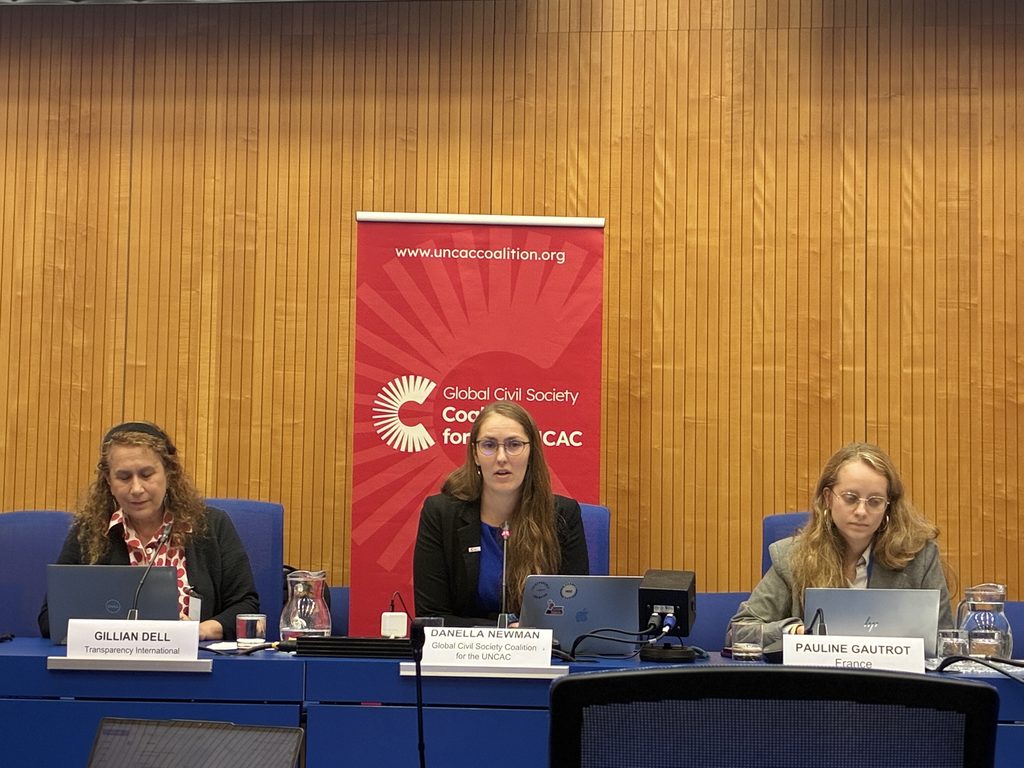
Gillian Dell, Global Advocacy Lead at Transparency International, described this shift as a logical progression for a mature review mechanism. While legal frameworks remain important, “actual practice should move to center stage.” For the upcoming reviews of UNCAC Chapters III and IV, this could mean providing more detailed statistics on investigations, prosecutions, convictions, acquittals and other case outcomes. Reviews should also consider the staffing, resources and professional autonomy of law enforcement and prosecution bodies, alongside the independence and resources of courts handling corruption cases. Where States cannot provide relevant data, the review should examine why, including obstacles to collecting it. Countries lacking the capacity to gather such information may require TA even before their review begins.
Ensuring the review documents deliver on Resolution 11/2
With the key documents nearing completion, speakers examined whether the latest drafts adequately translate Resolution 11/2 into practical questions and outputs.
Pauline Gautrot, Anti-Corruption Policy Advisor at France’s Ministry for Europe and Foreign Affairs, welcomed the overall direction of the documents, while stressing that they must be “readable, practical and accessible to the people who will ultimately use them —many of whom have not participated in the negotiations.” For government experts completing the SACL, questions should be sufficiently precise to make clear what information is required. France particularly supports ensuring that new developments since previous reviews are examined not merely as legislative or policy changes but also in terms of their implementation and impact in practice. Following the completion of the country review, the review findings should be usable by national decision-makers and capable of informing national strategies and indicators. Similarly, priority TA needs identified through the SACL should be clearly reflected in the executive summary so that assistance providers can identify priority sectors, beneficiaries and needs and act on them in cooperation with the requesting country.
Yonatan Yakir, the Coalition’s Programme Manager & UN Affairs Lead, welcomed several improvements already contained in the draft SACL, including questions on focal point information, how stakeholders were consulted, progress since previous reviews and more detailed identification of TA needs. He then highlighted areas that should still be strengthened. Questions on measures taken to address previous challenges and on new developments should explicitly ask about implementation in practice and results achieved. Broader developments could be clarified by drawing on UNCAC Article 61, including trends in corruption, emerging issues and cross-cutting challenges. The Coalition also encourages greater use of findings from other relevant international and regional mechanisms. Such information can complement evidence submitted by the country under review, help avoid duplication on one hand, while depicting a more honest assessment of country anti-corruption-related measures on the other. Where a measure is identified as a “good practice”, supporting documentation and links could also strengthen the evidence underpinning that assessment.
How to promote meaningful stakeholder participation in upcoming reviews?
The discussion also underscored that greater participation should not become another box-ticking exercise.
In Ghana, CSOs participated in a steering committee during its previous reviews, contributing to the assessment alongside government actors. Their role also continued after the reviews, through advocacy for national reforms and engagement with international anti-corruption policy processes. Commissioner Whittal argued that such participation can provide independent evidence, highlight issues not fully captured in government reporting, and support accountability and implementation after recommendations have been issued.
Looking ahead, Pauline Gautrot emphasized that States should start planning their approach to civil society engagement before the actual country review begins. Governments can prepare their experts, revisit gaps identified during previous reviews, raise awareness nationally about the upcoming process, and decide how the new transparency and participation opportunities in Resolution 11/2 will be embedded into their review practices.
Gillian Dell similarly called for an all-of-society approach in which governments and non-state actors approach the review as a shared exercise intended to strengthen national anti-corruption efforts. Multi-stakeholder dialogue before and after reviews could help create that sense of common purpose, while non-governmental stakeholders can prepare by gathering evidence and developing independent assessments of the country’s UNCAC implementation.
For the Coalition, meaningful participation also means thinking carefully about when and how stakeholders are involved. Civil society input during a country visit, for example, may be considerably more useful if it takes place early enough to inform subsequent discussions rather than at the very end of the country visit. In line with paragraph 28 of the IRM’s Terms of Reference, States can also consult civil society while preparing their SACL responses.
As for the reviewing States, they will also have an important role to play: Assessing information from different sources, considering relevant findings from other review mechanisms, and raising potentially difficult issues with the country under review. In this respect, future IRG’s and related discussions could include the perspectives and experiences of reviewing country officials on how to address sensitive issues that come up during country reviews.
Making use of the IRM next phase transparency modalities will be key in facilitating meaningful participation. Publishing focal point contact details, publishing up-to-date review timelines, and proactively informing stakeholders well in advance can give CSOs the time needed to gather evidence and participate meaningfully. The review documents can also help incentivize such practices by explicitly asking countries whether they wish to publish their SACL, focal point information, press releases, and full country reports. As more States opt in, these practices can gradually become the norm. Champions of transparent and participatory reviews can further reinforce this momentum by sharing their experiences at national, regional, and international levels.
Looking Ahead
The next few months will determine the formal architecture of the IRM’s next phase, but the discussion made clear that adopting strong documents is only the beginning. Resolution 11/2 has opened new possibilities for country reviews that look more closely at results, learn from developments since previous reviews, connect identified gaps to TA and bring civil society and other stakeholders more meaningfully into the process. Whether those possibilities translate into stronger reviews will depend on how States interpret and implement them.
There is no need to wait for the first reviews to begin. Governments can already prepare experts and institutions, revisit previous recommendations and implementation gaps, improve data collection and begin engaging national stakeholders. Civil society can identify relevant evidence, build relationships with focal points, coordinate nationally and prepare to contribute both to official processes and through independent reporting.
As the first reviews of the next phase approach, early country experiences will be particularly important, as they will set the tone for the next phase- to ensure that transparency, meaningful participation and the assessment of implementation in practice become standard features of the next decade of UNCAC country reviews.