
The judiciary is central to the fight against corruption. Prosecutors investigate and prosecute corruption-related offences, while judges adjudicate such cases. More broadly, they safeguard democratic governance by ensuring that the executive and legislative branches act in accordance with the rule of law. To fulfil this role effectively, however, judges and prosecutors must themselves uphold the highest standards of integrity and remain protected from corruption, political interference and other forms of undue influence. Article 11 of the United Nations Convention against Corruption (UNCAC) recognizes this pivotal role and calls on States Parties to take measures to strengthen integrity and prevent opportunities for corruption among members of the judiciary and of the prosecution services.
The European network of the Global Civil Society Coalition for the UNCAC convened its 23rd regional meeting on June 18, 2026 to discuss how independent monitoring, evidence-based advocacy and other strategies can strengthen judicial integrity, transparency and access to justice, bringing together civil society practitioners from across the region.
Judiciary under pressure and lack of global guidance to implement UNCAC Article 11
The three interrelated elements of an effective judicial system – equal access to justice; judicial and prosecutorial integrity; transparency and accountability – have gained renewed attention over the past years. In 2021, the Political Declaration of the UN General Assembly Special Session against corruption (UNGASS) recognized that an independent and transparent judicial system, aligned with principles of judicial ethics and integrity, is crucial to preventing and combating corruption, and underlined the need to protect investigative, prosecutorial and judicial institutions from undue influence. In June 2025, the 16th meeting of the UNCAC Working Group on Prevention discussed good practices on integrity and ethics in the criminal justice system. The UNCAC Secretariat highlighted positive measures such as codes of conduct, ethics training, accountability mechanisms, conflict-of-interest systems and safeguards in judicial careers, in a background paper drawing on State contributions including from Albania, Armenia, Austria, Belarus, Czechia, European Union, France, Georgia, Poland, Portugal, Republic of Moldova, Russian Federation, Serbia.
Yet the picture on the ground remains mixed. According to the 2025 Eurobarometer survey on the perceived independence of national justice systems, 36% of EU citizens rated the independence of courts and judges in their country as fairly or very bad, citing political and economic pressure among the main reasons. The 2025 EU Rule of Law Report, published in July 2025, found that many Member States have strengthened safeguards for judges’ appointments and autonomy of prosecutors, as well as improved the quality and efficiency of justice delivery, but that reforms are progressing slowly and serious concerns remain, including in enlargement and candidate countries. On the global level, although the Conference of the States Parties to the UNCAC has addressed judicial and prosecutorial integrity in several broader resolutions on corruption prevention, it has yet to adopt a dedicated resolution and provide more guidance for the effective implementation of UNCAC Article 11.
Kosovo: from court monitoring to institutional reform and awareness-raising

Arrita Rezniqi, Senior Legal Researcher at the Kosovo Law Institute (KLI), opened with an overview of how her organization combines a variety of activities – from court monitoring, legal research, free legal aid, to investigative journalism – to promote judicial accountability and access to justice. Over the past decade, KLI has become one of the principal contributors to rule of law reform in Kosovo and several laws the organization flagged as unconstitutional, including legislation on the prosecutorial council and the Bureau for Confiscation of Unjustified Assets, were later struck down by the Constitutional Court and criticized by the Venice Commission. They also covered UNCAC Article 11 in their parallel report on UNCAC implementation in Kosovo back in 2024.
Through its free legal aid centre, KLI defends journalists, whistleblowers and activists, including one recent case in which it successfully defended a civil society activist against what it argued was a SLAPP suit brought by a government minister. KLI also produces a weekly investigative television programme, now in its twelfth year, combining the work of journalists and lawyers in prime time. Citizen tips have led to major exposures, such as the arrest of an active prosecutor caught on video accepting a bribe, or the arrest of two senior police officers who had shielded a businessman with police connections. Underpinning all of this work is a model of constructive engagement through a Memorandum of Understanding with the Kosovo Judicial Council, which gives KLI direct access to court hearings and to Judicial and Prosecutorial Council meetings.
Moldova: two decades of independent monitoring
Lilia Ioniță, Program Director at the Centre for the Analysis and Prevention of Corruption (CAPC), shared lessons from more than 20 years of court monitoring in Moldova; which her organization began in 2004 as one of the first organizations in the country to do so. Good laws and good institutions, she argued, are not enough on their own; monitoring is what shows whether rules are actually applied in practice.
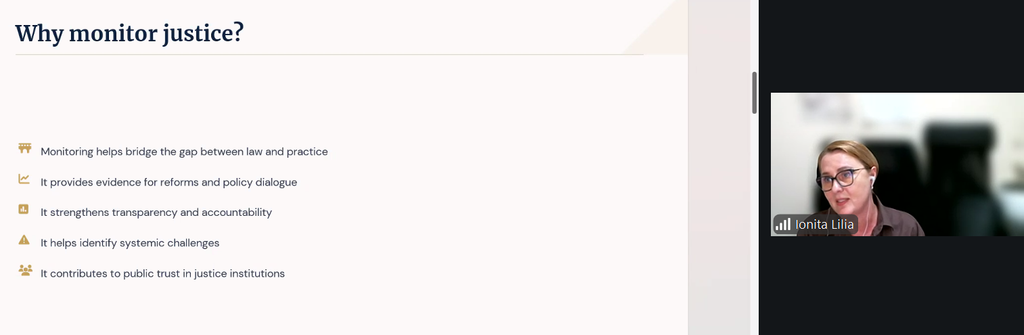
More recently, CAPC has turned to monitoring Moldova’s judicial vetting and pre-vetting process, a politically sensitive exercise using independent monitors and standardized templates. The findings have been striking: in CAPC’s most recent report, none of the members of the vetting commission – the body established to assess the ethical and financial integrity of judges and candidates – met the legal criteria set out in the vetting law; the rules governing the process changed several times while it was underway; and decisions showed inconsistent approaches across similar candidates. A related concern was the limited transparency of the commission’s own secretariat and the lack of consistency and clear justification for decisions. Overall, CAPC’s parallel monitoring of anti-corruption institutions found that legislation in Moldova often outpaces institutional capacity: new powers and mandates are adopted faster than institutions can be resourced and staffed to use them.
Drawing on this long experience, Ioniță distilled a set of lessons:
- transparency only becomes real when institutions practice it on a daily basis, not when it is merely written into law;
- monitoring only works when it is fact-based and methodologically rigorous, especially on sensitive topics; and
- communication between civil society, citizens and public authorities is essential to the credibility of processes like judicial vetting.
Asset declarations in the judiciary: current trends and advocacy opportunities
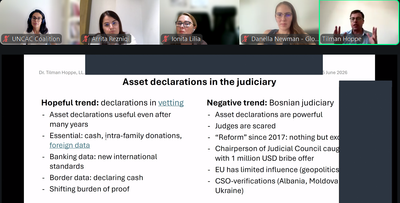
Anti-corruption expert and individual member of the Coalition Tilman Hoppe (publications) explained the value of asset declarations in the judiciary, presenting the example of the judicial vetting in Moldova as a hopeful case. After years of asset and interest declarations being filed with little verification, Moldova’s vetting process began digging into filings from a decade earlier, catching judges who had assumed the role beyond scrutiny. Measured by the number of candidates filtered out or officials who lost their positions, the exercise has been strikingly effective: today’s unverified declarations may become tomorrow’s accountability tool, as is now starting to happen in other countries.
On the other hand, Bosnia illustrates the opposite trajectory: for nearly a decade, judges successfully resisted any meaningful asset declaration reform, even amid corruption scandals. What has consistently pushed reform forward in Moldova, Albania, or Ukraine, has been civil society itself, including CAPC’s own investigations into judges’ luxury purchases, published well before state authorities acted.
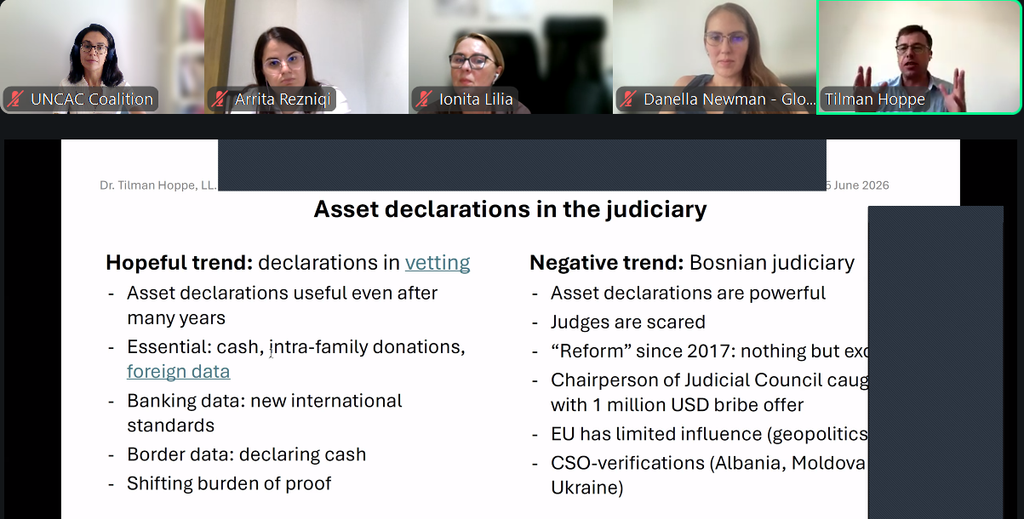
Hoppe highlighted several elements that make declaration systems effective: requiring disclosure of cash and intra-family donations, closing off vague claims about money from relatives; capturing foreign assets, since officials frequently hide wealth abroad in neighbouring countries; and cross-checking declarations against customs and border data. In this sense, a new international treaty aims to enable cross-border exchange of data to verify asset declarations, although only a handful of countries are party to it so far (signed in 2021 by Serbia, Montenegro, and North Macedonia, and by Moldova in 2023).
Two lines of case law, as Hoppe noted, open avenues for advocacy: the Court of Justice of the EU upheld the online publication of asset and interest declarations, rejecting the argument that data protection law prohibits disclosure (Case C-184/20 (2022)) and a judgment by the European Court of Human Rights concerning Romania, supported a shifted burden of proof and the use of older evidence in verifications.
Sustaining monitoring work and cross-border cooperation
The discussion that followed turned briefly to KLI’s investigative TV programme. Rezniqi described how KLI’s own show, produced in-house with a dedicated production team and a rotating cast of investigative journalists and legal advisors, evolved over twelve years into two formats: a Friday panel-debate programme and a Saturday prime-time investigative show driven largely by citizen tips. A quick search suggested similar formats exist in Austria, Germany, the UK, Croatia and Switzerland.
Participants also discussed the challenge of sustained monitoring work. Both KLI and CAPC rely on a mix of committed staff and trained volunteer monitors, particularly for hearings in specialized areas such as environmental or corruption cases. Recent funding cuts from the U.S. and other countries have forced organizations to dramatically reduce staff, prompting an ongoing effort to diversify funding.
Closing the meeting, participants weighed where advocacy energy is best spent. The consensus leaned toward complementarity: international cooperation is valuable, but must always account for national context which varies considerably from country to country. The Coalition’s ambition is to keep pushing for greater transparency and cross-border exchange of ownership and asset data for the judiciary, building on its dashboard tracking asset and interest disclosures across European countries.
If you are a civil society activist from Europe and would like to become involved, please contact our Regional Coordinator Ana Revuelta Alonso at ana.revuelta@uncaccoalition.org.