A joint initiative of the the Asia-Pacific Regional Community and the Working Group on Protection of Whistleblowers and Other Reporting Persons of the Global Civil Society Coalition for the UNCAC.
Speakers:
- Vladimir Radomirović, Editor-in-Chief of Pištaljka and Co-chair of the Coalition’s Working Group on the Protection of Whistleblowers and Other Reporting Persons
- Louise Portas, Crime Prevention and Criminal Justice Officer with Corruption and Economic Crimes Branch of the UNODC and the whistleblower protection focal point for the Corruption and Economic Crime Branch
- Cynthia Gabriel, Lawyer and founder of the Center to Combat Corruption and Cronyism (C4 Center) in Malaysia
- Erdenejargal Perenlei, Executive Director of Open Society Forum in Mongolia
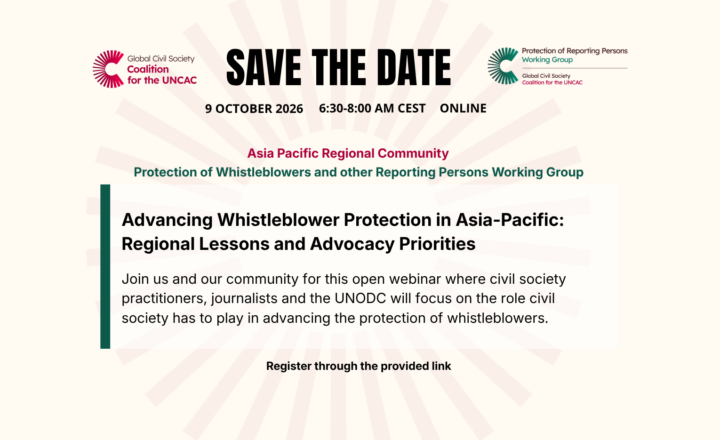
Event flyer
Introduction
A whistleblower is a person who reports or discloses information about wrongdoing encountered in a work-related or other relevant context, including corruption, fraud, abuse of authority or other conduct that threatens the public interest. Whistleblowers play a critical role in exposing misconduct that may otherwise remain hidden and in enabling authorities, organisations, journalists and the public to identify and address corruption. Yet speaking up can carry significant risks: whistleblowers may face dismissal or other workplace retaliation, legal action, harassment, threats, reputational damage and, in some contexts, risks to their personal safety. Effective legal and institutional frameworks are therefore essential to ensure that people can report wrongdoing safely and that their disclosures are appropriately addressed.
The importance of protecting those who report corruption has long been recognised under the United Nations Convention against Corruption (UNCAC), including through Article 33 on the protection of reporting persons. This recognition was significantly reinforced in December 2023, when the Conference of the States Parties to the UNCAC adopted Resolution 10/8, the first-ever UNCAC resolution dedicated specifically to the protection of reporting persons. This development comes amid growing international attention to whistleblower protection: an increasing number of States are adopting or strengthening relevant legal and policy frameworks, while UNODC has reported growing demand from countries for technical assistance in this area.
Whistleblowers and other reporting persons play a critical role in exposing corruption, yet comprehensive legal mechanisms to protect them remain the exception rather than the norm. Comprehensive whistleblower protection frameworks are still lacking in many countries globally, including across the Asia-Pacific region, with some notable exceptions such as Malaysia.
Against this backdrop, the Coalition’s Working Group on Protection of Whistleblowers and Other Reporting Persons and the Asia-Pacific regional community will jointly organise a webinar on Whistleblower Protection in Asia-Pacific. This webinar aims to bring together civil society practitioners, journalists and the UNODC to focus on the role that civil society can play in advancing the protection of whistleblowers and other reporting persons. Held as an open webinar, this session is designed to broaden the conversation on whistleblower protection, engaging participants and stakeholders beyond the Coalition’s existing membership.
The timing of this discussion is particularly relevant, with the next phase of the UNCAC Implementation Review Mechanism (IRM) commencing soon, offering an opportunity to follow up on recommendations from previous review cycles, including those relating to Article 33 on the protection of reporting persons. The Coalition’s Working Group on Whistleblower Protection has been advocating for stronger protection mechanisms and has contributed to the development of practical resources, including UNODC’s Practical Toolkit for Developing Whistleblower Protection Frameworks.
Objectives of the meeting
- Equip civil society with the knowledge and tools to use UNCAC Article 33 and Resolution 10/8 to assess existing national whistleblower protection frameworks (if any), identify gaps against key international standards, and develop advocacy priorities for stronger and more effective protection of whistleblowers.
- Take stock of developments and experiences across the Asia-Pacific region, including recent legislative and policy reforms and lessons from countries where whistleblower protection frameworks have been developed or strengthened. Particular attention will be given to civil society’s role in reform processes and the challenges that remain in translating legal protections into effective implementation.
- Identify practical entry points and strategies for civil society advocacy at the national and regional levels.
Expected outcomes
- Participants gain a clearer understanding of what stronger whistleblower protection frameworks can look like in practice, informed by concrete regional experiences, and identify entry points for civil society advocacy in their own countries.
- Assess the level of knowledge, interest, and capacity-building needs within the region, and identify possible next steps, including a more practical, hands-on training session for the regional community.
