
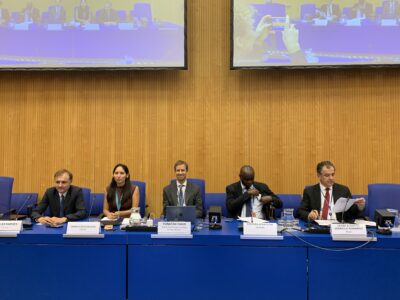
On 1 September 2026, on the sidelines of the UNCAC Implementation Review Group (IRG) meeting in Vienna, the Global Civil Society Coalition for the UNCAC’s Environmental Crime and Corruption Working Group (ECC WG) and the Wildlife Justice Commission, Chair of the ECC Working Group (chaired by Lisa Hartevelt), brought together government representatives, the United Nations Office on Drugs and Crime (UNODC) and civil society for a hybrid event on “Assessing the implementation of Resolution 11/9: Preventing and combating corruption as it relates to crimes that affect the environment.”
Adopted by consensus at the eleventh session of the UNCAC Conference of the States Parties (CoSP11) in December 2025, Resolution 11/9 is the most comprehensive set of UNCAC commitments to date on corruption linked to crimes that affect the environment. Brazil and Namibia tabled the resolution, co-sponsored by Burkina Faso, Chile, Colombia, Costa Rica, Côte d’Ivoire, the Dominican Republic, Ethiopia, Ghana, Honduras, Iraq, Japan, Kenya, Lesotho, Nigeria, Norway and Peru. The event discussed how to translate these provisions and commitments into national policy, law and practice, drawing on national experiences and good practices, and explored how to make use of upcoming UNCAC processes in 2027 to help advance effective implementation. The event also marked the launch of the ECC WG’s Civil Society Guide, “Promoting Implementation of Resolution 11/9: Preventing and combating corruption as it relates to crimes that affect the environment”.
From negotiations to implementation
The event was moderated by Yonatan Yakir of the Global Civil Society Coalition for the UNCAC and opened with remarks from government representatives before moving into a panel discussion.
César Augusto Vermiglio Bonamigo, Deputy Permanent Representative of Brazil to the UN in Vienna and Brazil’s lead negotiator on Resolution 11/9, opened the event by reflecting on the difficult negotiations that led to the adoption of the resolution. Among the issues that proved contentious were the concept of “crimes that affect the environment” itself, as well as new language addressing professional enablers and, for the first time in a CoSP resolution, recognizing Indigenous Peoples and local communities. He noted that negotiators had sought an ambitious outcome while working within the limits of what could achieve consensus. “It was a very tough negotiation… We had a lot of ambition, but we worked with the possibilities. We were really glad we managed to approve it by consensus, with all delegations on board, including those who had major concerns.”
Joanna Choblet, Policy Officer at the Wildlife Justice Commission, then outlined four broad areas of commitments in the resolution: prevention and integrity; enforcement and accountability; financial transparency; and reporting and civil society participation. These include measures on licensing and permitting, public procurement, beneficial ownership transparency, financial investigations, asset recovery, anti-money laundering, safe reporting mechanisms and public access to information. She emphasized that Resolution 11/9 moves beyond simply acknowledging the problem: “The resolution moves the conversation from recognizing the link between corruption and environmental crime towards identifying concrete measures to prevent, investigate and address that link. And it’s also not just declaratory—it includes follow-up mechanisms that civil society and States can actually use.”
Perspectives from the national level: prevention, reporting and accountability
Speakers from Brazil, Kenya, France and Ghana – countries that co-sponsored Resolution 11/9 or have been at the forefront of these issues internationally – shared concrete examples of how its commitments can translate into practice.
César Augusto Vermiglio Bonamigo highlighted Brazil’s experience in translating anti-corruption commitments into a range of prevention, integrity and enforcement tools, including mechanisms that assess and promote corporate integrity standards, complemented by monitoring systems and the use of artificial intelligence to identify risks of irregularities. He also noted the potential for these tools to address corruption risks linked to broader Environmental, Social and Governance (ESG) criteria.
Stephen Azantilow, Director of Anti-Corruption at Ghana’s Commission on Human Rights and Administrative Justice, presented Ghana’s corruption risk management work in the fisheries sector. A sector-specific assessment identified corruption risks in areas including licensing, inspections, procurement, human resources and fisheries observers, and led to a mitigation plan and concrete reforms. One key change addressed conflicts of interest by moving payment of fisheries observers from industry actors to the Fisheries Commission. Azantilow stressed that identifying risks is only the beginning: “Implementation must be continuous. A mitigation measure should not be considered successful just because an activity occurred once. Training, monitoring, supervision and integrity measures must be institutionalised and periodically reviewed. …monitoring matters”.
John Mugendi, Senior Assistant Director at the Kenya Wildlife Service, described reforms undertaken with UNODC support to strengthen corruption prevention across Kenya’s parks and conservation areas. These include a corruption prevention policy and the establishment of committees across eight conservation areas, a code of conduct signed by staff, strengthened reporting mechanisms and an integrity office. In the 2025–2026 financial year, the integrity office received 46 cases, most of which were investigated, audited and followed by action. Kenya Wildlife Service is also developing a whistleblowing policy. These efforts sit within its broader strategic plan, which identifies accountability and integrity as key priority areas. Looking ahead, Mugendi emphasized the institution’s commitment to implementation: “We’ve realized the impact corruption will have not just in the country, but on the environment… As an organization, Kenya Wildlife Service, we are committed to the resolutions, and we’re looking forward to the implementation as we continue to combat corruption in our parks.”
Nicolas Karges, Counsellor at the Permanent Mission of France to the UN in Vienna and Co-chair of the Member States’ Group of Friends on Crimes that Affect the Environment, drew lessons from a major waste-trafficking and money-laundering case in Southern France. The investigation began with an anonymous corruption report and relied on close cooperation among prosecutors, financial investigators, customs, tax authorities and environmental experts. The case also exposed practical barriers to international cooperation in complex transnational investigations, including the time required to establish a joint investigation team, which was ultimately not pursued despite its potential to improve efficiency of the cross-border investigation. Alongside Brazil’s representative, Karges expressed support for an additional protocol to the United Nations Convention against Transnational Organized Crime (UNTOC) on crimes that affect the environment, which he argued could provide a common framework and accelerate international cooperation in complex cases. Reflecting on the lessons, Karges said: “These findings have reinforced our belief that corruption is a major driver of environmental crime, but that it can also help to detect this type of crime. They have also strengthened our conviction that it is necessary to work in multidisciplinary teams and that we need to facilitate international cooperation.”
Picking up on these challenges, Yonatan Yakir highlighted the importance of looking beyond commitments on paper to the practical barriers to implementation. Referring to the resolution’s provisions on international cooperation, he noted: “It’s interesting to hear the actual challenges, the actual problems behind such kind of diplomatic wording that we see across many CoSP resolutions.”
Launching a practical guide to promote implementation of Resolution 11/9
A central part of the event was the launch of the new Civil Society Guide, “Promoting implementation of Resolution 11/9: Preventing and combating corruption as it relates to crimes that affect the environment”.
Presenting the guide, Corinna Gilfillan, Policy Lead of the Global Civil Society Coalition for the UNCAC, demonstrated how this tool could help turn the commitments of Resolution 11/9 into results: “We spent a lot of time, governments as well as civil society, negotiating or supporting the negotiation of these resolutions. We don’t want them to sit on a shelf. We want them to have an impact.”
The guide is designed primarily as an advocacy tool for civil society organizations and other non-state actors and is also relevant to government officials, parliamentarians and technical assistance providers. It explains the commitments in Resolution 11/9, why they matter, and what meaningful implementation can look like. It identifies practical ways to integrate commitments into national policy, law and practice; protect whistleblowers and others exposing corruption; monitor implementation and outcomes; contribute evidence and expertise to government reporting; and bring national experience into regional and global discussions. Moreover, it addresses environmental defenders as important stakeholders in efforts to address corruption linked to crimes that affect the environment. They should be meaningfully engaged in relevant processes and able to expose corruption and environmental harm, participate in decision-making and carry out their work safely and without fear of retaliation.
The guide also highlights the second phase of the UNCAC Implementation Review Mechanism (IRM) as an important opportunity to examine how relevant UNCAC provisions are being implemented in practice and to bring relevant aspects of Resolution 11/9 into country reviews. Civil society can use the review process to provide evidence on implementation, good practices, challenges and new developments related to corruption and crimes that affect the environment, and to advocate for stronger implementation where gaps remain.
The guide also includes examples of emerging good practice and is intended to be a living resource, which can be strengthened over time as additional evidence and experience from different countries is collected.
Next steps: implementation and UNCAC follow-up in 2027
Daniela Sota Valdivia, Crime Prevention and Criminal Justice Officer at UNODC, clarified the resolution’s formal follow-up process. UNODC plans to send a questionnaire to States Parties in March or April 2027, ahead of a dedicated panel at the UNCAC Working Group on the Prevention of Corruption in May. The information submitted in response to the questionnaire, together with the Working Group discussion, will inform UNODC’s report to CoSP12 later in 2027.
She also emphasized that effective technical assistance requires sustained engagement. Experiences in Kenya, Ghana and elsewhere show that corruption risk management can identify further needs, from stronger whistleblower protection to codes of conduct and institutional reforms. “It’s not like you go [and] do one intervention and then suddenly things have changed. It’s rather a more long-term intervention that is needed in the countries. And that’s why resources are needed, and also resources that are sustained in the long run.”
The discussion underscored that the period before the 2027 UNCAC meetings is an important window for action. Governments can assess where Resolution 11/9 is already being implemented, identify gaps and technical assistance needs, consult civil society and document results. Civil society can monitor progress, contribute evidence, propose solutions, and use the new guide to support implementation and accountability.
The Environmental Crime and Corruption Working Group will continue to support civil society engagement on these issues, including by promoting the exchange of experiences, good practices, challenges and lessons learned among civil society organizations working at the national, regional and global levels. The Working Group will draw on these experiences to strengthen collective learning and advocacy, identify implementation gaps and solutions, and bring civil society perspectives into relevant UNCAC processes.
Watch the full recording from the event
We encourage States, civil society organizations and other actors to share how they are implementing Resolution 11/9 and using the guide, as well as updates on relevant developments, challenges and good practices in their countries and on other environmental crime and corruption issues. Please share these experiences with the Environmental Crime and Corruption Working Group at ecc@uncaccoalition.org.