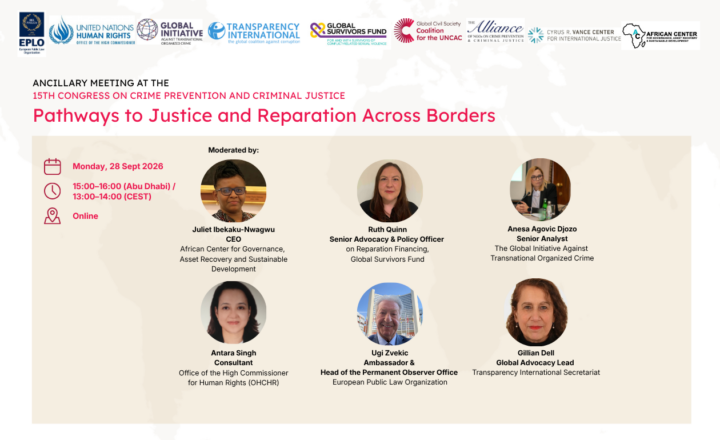
Ancillary meeting at 15th Congress on Crime Prevention and Criminal Justice
Co-organizers: OHCHR, Global Civil Society Coalition for the UNCAC, The Global Initiative Against Transnational Organized Crime, The Alliance of NGOs on Crime Prevention and Criminal Justice, European Public Law Organization, Transparency International, African Center for Governance, Asset Recovery and Sustainable Development, Cyrus R. Vance Center for International Justice.
Corruption and transnational crime deprive millions of people of their human rights, security, and access to essential public services. They fuel inequality, weaken governance, and entrench impunity across borders. Yet despite these profound harms, the people harmed aka “victims” remain largely invisible within many criminal justice systems. Their losses, financial, social, psychological, and collective, are rarely acknowledged, and effective pathways to truth, participation, and reparation remain limited or inaccessible.
A human-rights-based approach is essential for building people-centred, inclusive, and responsive criminal justice systems. This approach recognises victims as rights-holders whose participation is central to justice, accountability, and prevention. A justice system that overlooks victims cannot fully uphold the rule of law, ensure non-discrimination, or achieve safe and secure societies.
The UN Convention against Corruption (UNCAC) provides a strong normative basis for such an approach. Articles 13, 32, 34, and 35 call on States Parties to promote public participation, protect victims and witnesses, address the consequences of corruption, and ensure opportunities for compensation. However, implementation remains weak. In many jurisdictions, victims cannot report wrongdoing safely and lack mechanisms to seek reparation.
Corruption is increasingly intertwined with transnational organised crime, including money laundering, trafficking, illicit financial flows, and cross-border bribery schemes. These crimes often involve complex networks operating across jurisdictions, leaving victims without clarity on where or how they can seek justice or recover stolen assets. The cross-border nature of these crimes can also fragment investigations, create different legal and evidentiary requirements, and impose significant barriers to victims’ participation and access to remedies. Strengthening victims’ access to remedies therefore requires cross-border cooperation, coordinated institutions, and meaningful engagement with civil society.
Recent developments in Latin America, including the use of amicus curiae briefs, strategic litigation, and human-rights-based arguments, show how legal tools can amplify victims’ voices and advance accountability. These experiences offer valuable lessons for strengthening the implementation of UNCAC and UNTOC and for designing criminal justice systems that genuinely respond to people’s needs. They also demonstrate the potential for legal and civil society actors to create new pathways for victims to participate in proceedings and seek justice and reparation, including where corruption and its impacts extend across borders.
The workshop will explore how criminal justice systems and human rights mechanisms can become more responsive to victims when corruption and transnational crime cross borders. It will consider both the legal pathways available to victims and the institutional and practical conditions required to make those pathways meaningful.
Objectives
- Highlight the negative impacts of corruption and transnational crime on human rights and demonstrate why victims’ rights and participation must be central to justice processes.
- Discuss practical pathways to strengthen victims’ legal standing and access to reparation, including through domestic reforms, strategic litigation, and international mechanisms.
- Identify common challenges and opportunities for integrating human rights approaches into the implementation of UNCAC and broader criminal justice reforms.
- Promote dialogue and cooperation among States, justice institutions, and civil society to advance people-centred, inclusive, and responsive criminal justice systems.
- Explore how criminal justice cooperation, asset recovery, human rights mechanisms and civil society engagement can work together to strengthen victims’ access to justice and reparation across borders.
Speakers
The session will be moderated by Juliet Ibekaku, CEO of the African Center for Governance, Asset Recovery and Sustainable Development, and the Co-Chair of the Victims of Corruption Working Group of the Global Civil Society Coalition for the UNCAC.
Joining the discussion as speakers will be:
Anesa Agovic Djozo, Senior Analyst, The Global Initiative Against Transnational Organized Crime
Antara Singh, Consultant, Office of the High Commissioner for Human Rights (OHCHR)
Gillian Dell, Global Advocacy Lead, Transparency International Secretariat
Ruth Quinn, Senior Advocacy & Policy Officer on Reparation Financing, Global Survivors Fund
Uglješa Ugi Zvekic, Ambassador & Head of the Permanent Observer Office, European Public Law Organization
