

Context in which this group operates
Human rights and anti-corruption work are deeply interconnected, yet the two fields have often operated in silos, with limited collaboration between civil society, academics and institutions working on each. This disconnect weakens efforts to address corruption as a driver and enabler of human rights violations, and limits the use of human rights mechanisms and anti-corruption tools in a complementary and mutually reinforcing way.
Corruption can undermine the enjoyment of human rights by diverting public resources, weakening institutions, restricting access to essential services, facilitating discrimination and abuse of power, and limiting civic participation and accountability. At the same time, human rights standards and mechanisms can provide important tools to prevent and address corruption, strengthen accountability, ensure participation, and advance remedies for people and communities affected by corruption. A stronger connection between the two fields can therefore contribute to more effective and people-centred responses to corruption and its impacts.
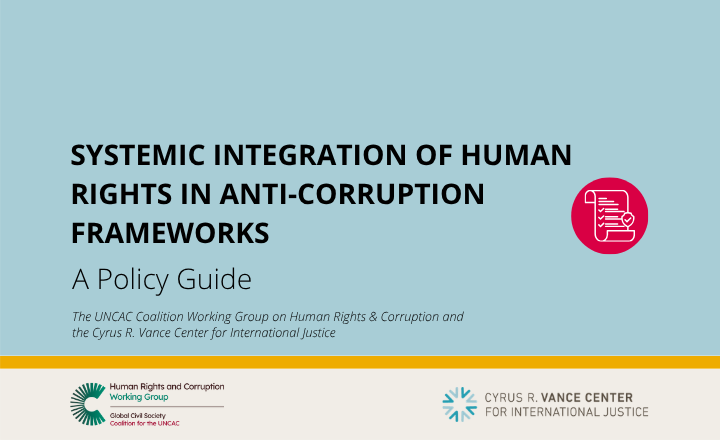
The Human Rights and Corruption Working Group brings together civil society, academics and institutions to bridge this gap, advance a people-centred approach that recognises corruption’s impact on human rights, and strengthen the complementary use of human rights and anti-corruption frameworks and mechanisms. The Working Group seeks to strengthen engagement across relevant UN fora and mechanisms, including the Human Rights Council and its Universal Periodic Review, the UNCAC Conference of the States Parties, and UNODC and OHCHR, fostering greater integration between human rights and anti-corruption policy and practice. It provides a space for exchange, joint learning and advocacy, supporting members to connect developments across the two fields and identify opportunities for collective action.
Objectives
The objectives of the Human Rights and Corruption Working Group are to:
- Break down silos between human rights and anti-corruption civil society, academics and institutions
- Provide updates on policy developments in anti-corruption and human rights
- Advance anti-corruption efforts with a victims-centred approach
- Equip anti-corruption civil society with the tools to use human rights mechanisms, and vice versa
- Increase the prevention and recognition of corruption as a human rights violation
- Advocate for changes in international law, policy and practice
Coalition Mailing List Guidelines
Please have a look at our Mailing List Guidelines, which apply to all conversations and exchanges of information across the Coalition. By being a part of our core community and Working Groups, you agree that you have read and will follow these guidelines.