Transparency and civil society participation are essential for an effective UNCAC Implementation Review Mechanism, ensuring legitimacy, accountability, and compliance with international human rights and anti-corruption standards.
The Coalition’s Guide to Transparency and Participation in the UNCAC implementation review process (IRM) draws on global good practices since 2009, outlining concrete steps States Parties can take to make each stage of the review process more open, inclusive, and ultimately more robust and effective.
The guide is available in English, French, Spanish. You can see the different stages of the review process, including best practice examples we have collected over the years in the accordion below.
Please send your comments or questions on this guide to danella.newman@uncaccoalition.org.
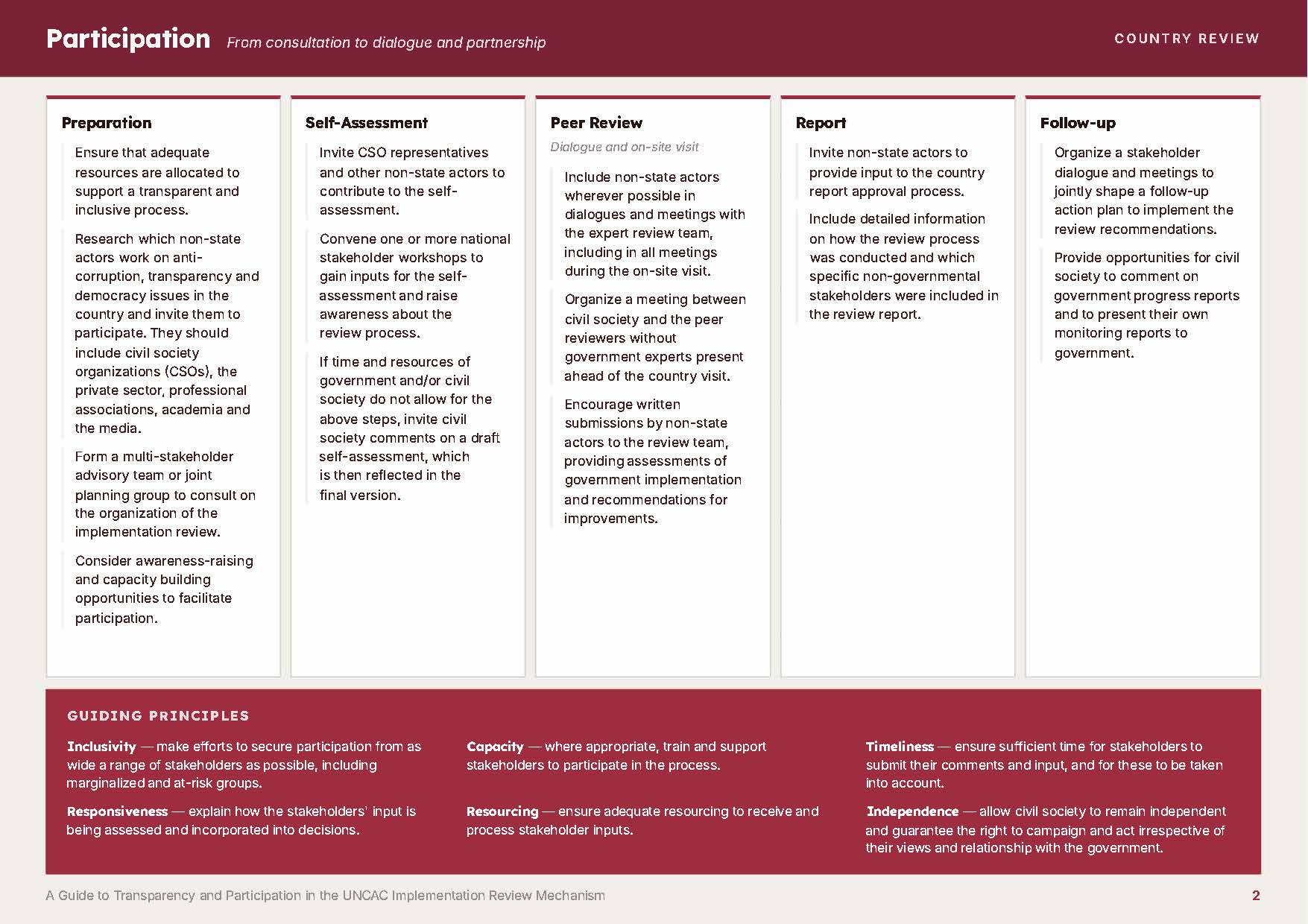
Participation
- Ensure that adequate resources are allocated to support a transparent and inclusive process.
- Research which non-state actors work on anticorruption, transparency and democracy issues in the country and invite them to participate in the review process. The nonstate actors involved should include representatives of civil society organizations (CSO), the private sector, professional associations, academia and the media.
- Form a multi-stakeholder advisory team or joint planning group to consult on the organization of the implementation review.
- Consider awareness-raising and capacity building opportunities to facilitate participation.
Transparency
- Publish and maintain comprehensive information on the upcoming review (e.g., in a section of the competent ministry’s website) including:
- The UNCAC review process, its methodology and schedule;
- The contact details of the government’s coordinator of the process (focal point);
- Qualification criteria for non-state actor participation and key entry points for contributions.
- Allow interested stakeholders to stay informed throughout the review process, e.g., through an email newsletter.
Best practices around the world
- Sweden, Armenia, Switzerland, and Chile published updated focal point and review schedule information on a government website.
- In Jordan and Rwanda, civil society representatives are part of the experts team for the UNCAC review and meet regularly.
- More than 45 States have signed the Coalition’s Transparency Pledge, committing to higher standards of transparency and participation of civil society in their UNCAC reviews. Find out more about the Pledge and States’ level of compliance here.
Best practices in UNCAC fora
- Include a civil society representative in your State delegation to the IRG meetings in Vienna, or to the CoSP.
Participation
- Invite CSO representatives and other non-state actors to contribute to the self-assessment.
- Convene one or more national stakeholder workshops to gain inputs for the self-assessment and raise awareness about the review process.
- If time and resources of government and/or civil society do not allow for the above steps, invite civil society comments on a draft self-assessment, which is then reflected in the final version.
Transparency
- Publish the completed self-assessment checklist on the government’s website as soon as it is available and before the beginning of the peer-review phase.
- Proactively agree to prompt publication of the self-assessment on the UNODC website.
- Communicate the completion of the self-assessment through relevant channels to the public and inform the stakeholders who have contributed or otherwise expressed interest in the process.
Best practices around the world
- Denmark asked UNODC to publish its completed self-assessment checklist on its UNODC country profile page as soon as it is available, before the beginning of the peer-review phase.
- In Togo, the government invited a leading Togolese CSO to coordinate the active participation of other CSOs in a multi-stakeholder workshop to fill out the self-assessment checklist.
Participation
- Include non-state actors wherever possible in dialogues and meetings with the expert review team, including in all meetings during the on-site visit.
- Organize a meeting between civil society and the peer reviewers without government experts present ahead of the country visit.
- Encourage written submissions by non-state actors to the review team, providing assessments of government implementation and recommendations for improvements.
Transparency
- Encourage the expert review teams to visit the country under review.
- Schedule the visit in a way that provides stakeholders with sufficient time to prepare.
- Publicize the visit, along with a schedule of events and the composition of the review team on the government’s website.
- Seek the reviewers’ permission to publicize their contact information, or create a mechanism that allows stakeholders to submit written input to them.
Best practices around the world
Before the country visit
- In Nigeria, the UNODC and the Technical Unit on Governance and Anti-Corruption Reforms held a briefing for CSOs two weeks before the review meeting.
- In Zimbabwe, the government sent an invitation via a prominent CSO to other CSOs in the country to attend the country visit with the external review team and invited CSOs to comment on guiding questions.
- In Switzerland, CSOs invited to the meeting received in advance the same documents as public officials from the federal administration who participated in the country visit. These documents included the agenda of the whole country visit, a complete list of participants, and Switzerland’s self-assessment checklist, in a version that included comments and questions by the reviewers. CSOs were also invited to the federal agencies’ internal preparation and coordination meeting before the country visit.
- In Kenya, CSOs received the meeting notification in March for the meeting held in June, giving civil society adequate time to prepare.
- In the United Kingdom, the government shared the self-assessment checklist ahead of the country visit. The Bond Anti-Corruption Group, a coalition of British NGOs, prepared a joint response to the self-assessment checklist, which was published by the government, and shared their findings in a meeting with the peer-reviewers.
- The invitations the governments of Paraguay and Argentina sent to CSOs included a detailed agenda of the entire country visit proceedings, including a list of participating state and NGOs actors and information on time slots allocated to civil society.
- In Togo, the government provided civil society with a draft document of the self-assessment, and encouraged CSOs to widely distribute the document amongst other CSOs in anticipation of the country visit.
During the country visit
- In Austria, a meeting between civil society representatives and the peer reviewers was organized with the support of UNODC ahead of the official country visit and the self-assessment checklist.
- Albania, Togo and Zimbabwe ensured that a wide range of CSOs was invited to and participating in the country visit.
- Many States under review followed best practice in leaving the room during the meeting between civil society and the peer reviewers, allowing them to speak openly. Some examples include: Austria, Namibia, Togo, Burundi, Mozambique, Uganda and Zimbabwe, Burundi, Bosnia and Herzegovina, Portugal, Switzerland and Bulgaria, Switzerland, Bulgaria, North Macedonia, Spain.
- In Brazil and Chile, CSOs were allowed to present documents and were given ample time to share their perspectives. In Honduras, the government relayed a CSO’s UNCAC implementation parallel report to peer reviewers before the country visit, thus providing space for informed follow-up questions related to the CSO on the parallel report as well as more time for interventions by other CSOs.
- In Portugal, each CSO had one full hour to meet with the reviewers on their own.
- In Bosnia and Herzegovina, reportedly, a whole civil society day was organized as part of the country visit where civil society was able to provide input to the peer reviewers without government representatives present. In addition to a number of CSOs present, business representatives were there too.
Participation
- Invite non-state actors to provide input to the country report approval process.
- Include detailed information on how the review process was conducted and which specific non-governmental stakeholders were included in the review report.
Transparency
- Make sure to publish the country review findings, including the full country report, in the original and local languages on the government’s website.
- Proactively agree to the publication of the full country report on the UNODC’s website.
- Actively communicate the release of the report to stakeholders and the public. Provide the report to Parliament and the media.
Best practices around the world
- CSOs in Togo, Bosnia and Herzegovina, Bulgaria, Germany, North Macedonia, Poland, Romania, Spain, Germany, North Macedonia and Papua New Guinea and Nigeria were asked to provide written input after the country visit.
- A timeline of next steps after the country visit was provided in Togo, North Macedonia and in Germany.
- The following 13 countries have published both the self-assessment checklist and the full country report: Mauritius, Nigeria, Chile, Mongolia, Slovakia, Switzerland, Sweden, USA, Germany, Italy, Portugal, Slovenia, UK.
- Kenya includes detailed information on which specific non-governmental stakeholder were included in the review in its full country report.
Participation
- Organize a stakeholder dialogue and meetings to jointly shape a follow-up action plan to implement the review recommendations.
- Provide opportunities for civil society to comment on government progress reports and to present their own monitoring reports to the government.
Transparency
- Report regularly on progress in relation to the country review recommendations, uploading reports on a designated government website and by submitting progress reports on follow-up measures taken to the UNODC.
- Publish information about opportunities for non-state actors to provide input to and feedback on the progress reports.
Best practices around the world
- In Kenya, North Macedonia, Slovenia, Australia, Chile, Italy, Switzerland, and Mauritius (mostly Transparency Pledge signatories), the government organized a meeting with civil society to discuss the outcomes and recommendations of the review report. In Switzerland, the government shares periodic updates with CSOs on the status of the review and the timeline for the upcoming report. Beyond these updates, a Swiss CSO has had frequent exchanges with a governmental working group on combating corruption and several governmental agencies.
- In several countries, the State is involving civil society in follow-up of their UNCAC review recommendations:
-
- In Nigeria, CSOs have been integrated into the Inter-Agency Task Team working groups, including on safe reporting and asset recovery.
- In Chile, a multi-stakeholder body focusing on the UNCAC and its reviews called Alianza Anticorrupción UNCAC was established, with civil society as a partner. Its different Working Groups meet regularly to exchange about UNCAC implementation., which civil society is a part of, both in Working Groups as well as at the General Assembly, see Alianza Anticorrupción UNCAC.
- In Bosnia and Herzegovina, a committee is being set up with civil society as an equal partner to government institutions involved in the 2nd cycle UNCAC review, to monitor and follow-up on the recommendations that came out of the review and following an established schedule.
- Several States, including Australia, Mauritius, Greece, Malta, Slovenia, North Macedonia and Germany, have already voluntarily published information about follow-up measures taken since the completion of their report on their UNODC country profile page.
You can find more information on best practices and not so good practices of transparency and civil society participation in UNCAC reviews in our 20 years of UNCAC blog post.
Now that the follow-up phase of the UNCAC IRM has been decided upon, we will be developing new tools and a guide on how to best engage soon. Stay tuned!