
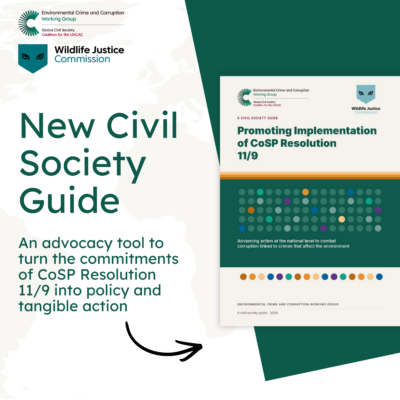
The Global Civil Society Coalition for the UNCAC’s Environmental Crime and Corruption Working Group and its Chair, the Wildlife Justice Commission, have recently released a civil society guide, “Promoting implementation of Resolution 11/9: Preventing and combating corruption as it relates to crimes that affect the environment.”
This guide serves as an advocacy tool for civil society to use at the national, regional and global levels to turn the commitments of CoSP Resolution 11/9 into policy and tangible action. It aims to make these commitments more accessible to civil society organisations working on environmental crime and corruption, including those not yet familiar with the UN Convention Against Corruption or Resolution 11/9.
The guide breaks down the commitments in Resolution 11/9 and looks at what implementation can mean in practice. These commitments relate to many issues our community work on, including:
- Strengthening legal, integrity and regulatory frameworks
- Improving transparency, accountability and access to information
- Following the money through financial investigations and asset recovery
- Strengthening oversight of businesses, financial institutions and professional service providers
- Strengthening international cooperation and enforcement
- Using technology and investigative tools
- Whistleblower reporting and protection
- Promoting active civil society participation, recognizing the vital role of local communities and indigenous peoples (first time reference in a CoSP resolution)
We encourage civil society organizations, experts and other members of civil society to:
- use the guide to raise awareness and help advance their national priorities on these issues,
- bring evidence and on-the-ground expertise into discussions on implementation; and
- engage with policymakers and other government authorities to help turn the commitments in Resolution 11/9 into concrete action.
We aim for it to be a living resource that reflects developments and experiences from civil society in countries around the world to inform and support advocacy and implementation efforts.
We encourage you to use and share the guide, and also to let us know how you are using it. You can send information on good practices, implementation efforts, and other relevant developments in your country on environmental crime and corruption by reaching out to us at ecc@uncaccoalition.org.
Watch below the discussion held at the 17th session of the Implementation Review Group, where panelists looked at what implementation of UNCAC Resolution 11/9 can look like in practice.
The event was moderated by Yonatan Yakir, Programme Manager & UN Affairs Lead, Global Civil Society Coalition for the UNCAC.
Speakers included representatives from Brazil, France, Kenya, Ghana, UNODC and civil society, including:
🔺 César Augusto Vermiglio Bonamigo – Deputy Permanent Representative of Brazil to the United Nations in Vienna
🔺 John Mugendi – Senior Assistant Director, Kenya Wildlife Service
🔺 Nicolas Karges – Counsellor, Permanent Mission of France to the UN in Vienna; Co-chair, Member States’ Group of Friends on Crimes that Affect the Environment
🔺 Corinna Gilfillan – Policy Lead, Global Civil Society Coalition for the UNCAC
🔺 Daniela Sota Valdivia – Crime Prevention and Criminal Justice Officer (anti-corruption), UNODC
🔺 Stephen Azantilow – Director, Anti-Corruption, Commission on Human Rights and Administrative Justice, Ghana
🔺 Joanna Choblet – Policy officer, Wildlife Justice Commission
This new civil society guide to Resolution 11/9 was launched during the event.
Read Wildlife Justice Commission’s news article on the guide here: https://wildlifejustice.org/turning-anti-corruption-commitments-into-action-to-tackle-environmental-crime-a-new-civil-society-guide/