
A corrupt act may take place in one country, involve companies or public officials in another, and move the resulting proceeds through several jurisdictions. Addressing the harm caused by corruption therefore requires cooperation across borders, not only to investigate and prosecute wrongdoing, but also to ensure access to justice for those affected. Yet national justice systems often operate in isolation, making it difficult to provide effective remedies and address the harm suffered.
“The victims of corruption remain invisible in the criminal justice system. Their losses; financial, social and psychological, are never mentioned or ever acknowledged.”
– Juliet Ibekaku-Nwagwu, CEO of the African Center for Governance, Asset Recovery and Sustainable Development and co-chair of the Victims of Corruption Working Group of the Global Civil Society Coalition for the UNCAC.
Where can they report the harm? Who can participate in proceedings? Where can they seek compensation? And what happens when the assets that could contribute to reparations are located in another country?
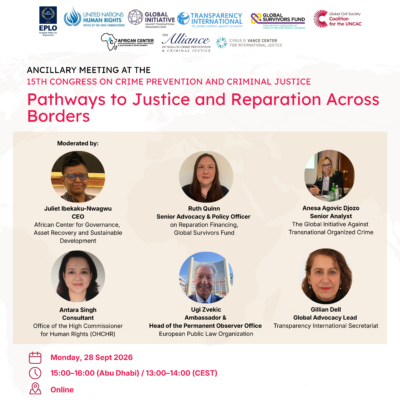
These questions were at the heart of the ancillary meeting “Pathways to Justice and Reparation Across Borders,” held on September 28 2026 in the margins of the 15th UN Congress on Crime Prevention and Criminal Justice in Abu Dhabi. The session brought together experts to examine how justice and reparation systems can better respond to people harmed by corruption and other forms of transnational crime.
The meeting was co-organized by the Global Initiative Against Transnational Organized Crime, the Alliance of NGOs on Crime Prevention and Criminal Justice, the European Public Law Organization, Transparency International, Global Survivors Fund, the African Center for Governance, Asset Recovery and Sustainable Development, the Cyrus R. Vance Center for International Justice, OHCHR, and Global Civil Society Coalition for the UNCAC. The Coalition’s event page provides the full program and list of speakers.
The discussion was particularly timely following the 15th UN Congress on Crime Prevention and Criminal Justice, held in Abu Dhabi in September 2026. The Congress placed people-centered, inclusive and responsive criminal justice systems and equal access to justice among its central themes. But one message from the discussion was clear: the existence of laws and institutions does not automatically translate into meaningful access to justice for people harmed by corruption. Victims often remain invisible, face practical and legal barriers to seeking remedies, and struggle to obtain reparation. Addressing these gaps requires more than established legal frameworks: it calls for stronger coordination across criminal justice and human rights systems, meaningful participation of people harmed, and effective mechanisms to recognise harm and deliver reparation. (see concept note for more context around the objectives of this meeting).
Survivor participation must be at the center of reparation
“Policy makers are missing a trick if they don’t involve survivors and victims [in policy-making]”
– Ruth Quinn, Senior Advocacy & Policy Officer on Reparation Financing at Global Survivors Fund
Ruth Quinn of the Global Survivors Fund highlighted the importance of ensuring that survivors are not simply recipients of reparation but active participants in determining what meaningful reparation looks like.
The Global Survivors Fund’s work demonstrates the value of survivor-centered approaches. In Ukraine, for example, GSF has worked with the Ukrainian government and civil society partners on an urgent interim reparations program. More than 1,200 survivors came forward through the pilot, with hundreds receiving interim compensation alongside psychosocial and legal support.
GSF has also explored how frozen and confiscated assets can potentially contribute to financing reparations for survivors, including through its work on Syria and Ukraine. Recovered proceeds of corruption being used for reparations is particularly beneficial for people harmed by corruption who may otherwise face significant barriers to pursuing individual claims through courts.
These experiences offer an important lesson for corruption cases: participation is not an additional step in the reparation process. It is part of justice itself.
Research on foreign bribery has identified persistent challenges in determining who qualifies as a victim and how compensation should reach people and communities affected by corruption. In many cases, monetary sanctions are paid into government treasuries rather than reaching those who suffered the consequences of the corrupt conduct.
Cross-border harm requires cross-border solutions
Antara Singh of OHCHR emphasized that the right to an effective remedy is a fundamental human rights principle. The UN human rights framework recognizes the importance of accessible and effective mechanisms through which people can seek redress and reparation.
For people harmed by corruption, this means that justice cannot stop at the point where a corrupt act is identified. The harm, the people affected, and the remedies available must also be considered.
“The analysis should go beyond documenting the corrupt transaction itself to what happened to people as a consequence.”
– Antara Singh, Human Rights Consultant, OHCHR
This requires examining how corruption and the diversion or misuse of public resources affect people’s enjoyment of human rights, including their access to essential public services. It also means identifying the communities and vulnerable groups that bear these harms disproportionately, so that their experiences are recognised and appropriate remedies can be provided.
This is particularly important in cross-border cases, where the proceeds of corruption, evidence and people harmed may be located in different jurisdictions. While asset recovery can have a reparative dimension, doing so effectively requires identifying the harm caused, the rights affected and the people or communities entitled to a remedy.
Anesa Agovic Djozo of the Global Initiative Against Transnational Organized Crime further highlighted the practical difficulties created when victims, perpetrators, assets and evidence are located in different countries. Research on illicit financial flows and organized crime in the Western Balkans illustrates the increasingly transnational nature of criminal networks, money laundering and corruption.
“There may be no border crossing whatsoever, but the crime is transnational from the moment it occurs.”
– Anesa Agovic Djozo, Senior Analyst, The Global Initiative Against Transnational Organized Crime
Cross-border corruption cases can also be hampered by different legal requirements, institutional barriers, limited resources and insufficient coordination between authorities.
Legal systems still struggle to recognize collective and indirect harm
“Corruption harm is frequently institutionally mediated. There may be several steps between the corrupt act and the eventual harm.”
– Gillian Dell, Global Advocacy Lead, Transparency International
Gillian Dell of Transparency International examined the challenges faced by people seeking civil remedies for corruption. A civil claim must establish a corrupt act, legally cognizable harm and a sufficient causal connection between the two. In grand corruption cases, establishing these becomes more difficult when conduct, defendants, assets and harm extend across jurisdictions.
Access to remedies for corruption harm also raises difficult questions about liability, causation and availability of collective forms of reparation, particularly where the people harmed are communities rather than easily identifiable individual claimants. There are also special issues relating to official immunity, corporate responsibility and liability of financial institutions and professional enablers. And then there are the practical barriers of cost, distance, access to evidence and legal representation. Across legal systems there are differences in their ability to provide remedies for people harmed by corruption with gradual advances in many jurisdictions over recent decades.
These issues are especially relevant to foreign bribery cases, where there is thus far very little account taken of non-state victims in relevant proceedings.
Several steps at international level would help to advance the objective of stronger civil remedies frameworks for people harmed by corruption. First, the next round of UNCAC reviews will cover UNCAC Article 35 on compensation as well as articles on rights of victims and measures to address consequences of corruption – it is crucial that this process is effective and sheds more light on national systems and practices. Second, a valuable by-product of the UNCAC review process would be the creation of a public database of cases involving corruption-related civil claims, to expand understanding in this area. Third, the Council of Europe GRECO should finally initiate a robust country review round for its Civil Law Convention on Corruption. Finally, UNODC or another international body should consider developing a model law for the use of countries seeking support to improve their legal frameworks for civil remedies for corruption.
Moving beyond institutional silos
The discussion also recalled the historical separation between criminal justice and human rights approaches to people harmed by crime.
Drawing on his experience at the 1985 Milan Crime Congress, Uglješa Ugi Zvekic of the European Public Law Organization explained that the two were never meant to diverge, but did so because of institutional divisions within the UN. He noted that instruments such as UNTOC, UNCAC and the forthcoming Cybercrime Convention have begun to bridge the gap, but argued that fragmentation between international frameworks addressing transnational organized crime, corruption and related issues can leave people without meaningful opportunities to participate in justice processes.
“Together, human rights and criminal justice provisions “can really help towards victims’ recognition, identity, protection of the rights which are today uneven and fragmented.”
– Uglješa Ugi Zvekic, Ambassador & Head of the Permanent Observer Office, European Public Law Organization
A person harmed by corruption does not experience their harm as belonging neatly to separate categories of criminal law, human rights law, asset recovery or civil litigation. Yet these are often the systems they must navigate to obtain justice.
The UN Basic Principles and Guidelines on the Right to a Remedy and Reparation provide an important human rights framework for addressing these gaps. They emphasize access to justice, adequate and effective remedies, and measures to ensure that victims can exercise their rights to a remedy.
What needs to change?
The discussion pointed to several areas where action is needed:
- Ensure that people harmed by corruption are identified and recognized within justice and asset recovery processes.
- Place meaningful participation at the center of reparation processes.
- Strengthen access to civil claims and collective forms of reparation for corruption-related harm.
- Ensure that asset recovery considers not only where assets came from, but how their return can contribute to justice and reparation.
- Strengthen cooperation between criminal justice, human rights and asset recovery systems across jurisdictions.
- Address the legal and practical barriers that prevent people from participating in proceedings or accessing remedies across borders.
One proposal raised during the discussion was the development of a new international instrument on justice for victims of crime that could help bridge existing gaps between criminal justice and human rights frameworks.
This proposal builds on a longer-standing international discussion about strengthening the rights of people harmed by crime and their access to justice. The UN has previously adopted the Declaration of Basic Principles of Justice for Victims of Crime and Abuse of Power, while human rights law has developed complementary standards on effective remedies and reparation.
Whether through a new instrument or through strengthening existing frameworks, the central objective should be the same: ensuring that people harmed by corruption and transnational crime are not left without a meaningful pathway to justice.
The path forward
The conversation does not end with the Crime Congress. The 15th UN Congress on Crime Prevention and Criminal Justice placed people-centered, inclusive and responsive criminal justice systems and equal access to justice among its central themes.
The 12th Conference of the States Parties to UNCAC, to be held in Uzbekistan in 2027, will provide another important opportunity to advance these discussions.
The takeaways from this meeting will feed into a forthcoming policy brief bringing together the perspectives shared and exploring pathways toward stronger justice and reparation for people harmed by corruption and transnational crime.
The path forward is about ensuring that the people harmed by corruption are seen, identified and meaningfully included in the justice and reparation processes intended to serve them.
Watch the meeting recording below.