
by Danella Newman, Global Civil Society Coalition for the UNCAC, and Maheshi Herat, Transparency International Sri Lanka
With support from the Coalition, Transparency International Sri Lanka turned its parallel report findings into practical tools for public authorities, opened technical dialogue with oversight institutions on enforcing the Right to Information Act, and set out a reform agenda for participatory lawmaking and secured CoSP resolution sponsorship on a key topic.
Following the publication of its civil society parallel report on Sri Lanka’s implementation of UNCAC Chapters II and V in June 2025, the Coalition continued supporting Transparency International Sri Lanka (TISL) to carry forward the report’s key recommendations. The report found Sri Lanka’s Right to Information (RTI) framework – legally one of the more robust in the region – undermined in practice by inconsistent enforcement, a chronically under-resourced Right to Information Commission, weak record management, and public authorities that routinely fail to publish information proactively as the law requires.
Between October 2025 and July 2026, TISL conducted follow-up activities to address those findings with practical resources that institutions can use, opened dialogue with the bodies responsible for RTI oversight, and pressed Sri Lanka to engage more actively in international discussions on the next phase of the UNCAC Implementation Review Mechanism (IRM) and other key matters.
Turning proactive disclosure duties into a tool authorities can use
Sections 8 to 10 of Sri Lanka’s Right to Information Act require public authorities to publish core information about their mandate, structure, spending and major projects without waiting for a request. Compliance has been patchy, and the parallel report identified proactive disclosure as a clear gap between law and practice.
TISL set out to find out why they were not being met, beginning with confidential interviews with officials from institutions including the Department of National Budget and the Department of Government Information. These surfaced operational realities – internal approval processes, record management systems, staffing and capacity constraints – that officials rarely describe publicly, and shaped the first draft of a practical checklist.
In May 2026, TISL then convened a multi-stakeholder roundtable with representatives of the Right to Information Commission, the Presidential Secretariat and the Ministry of Energy. Instead of a usual advocacy event, the session functioned as a technical validation exercise: participants worked through the draft, identified common compliance problems, and gave concrete feedback on its structure, language and usability.
The result is a trilingual Proactive Disclosure Checklist for public authorities to assess their own compliance, covering institutional information, RTI contact points and fee schedules, rules and services, budgets and spending, major projects and public funds, complaints and integrity reporting, accessibility, redaction practice, and internal review responsibility. Its value lies in the operational detail: whether documents are searchable rather than scanned, whether key information can be found within three clicks of the homepage, whether only the sensitive part of a document was redacted rather than the whole file withheld, and whether one named senior officer is accountable for keeping disclosures current. Quarterly questions make it a recurring review, not a one-off audit. Importantly, the Government of Sri Lanka has now initiated the process for reforms of the Right to Information framework, creating space for advocacy surrounding the usage of this checklist in practice.
Clarifying what happens when authorities do not comply
The parallel report also found that sanctions under the RTI Act are almost never applied, with little transparency around how and when the Commission uses them. TISL therefore examined Section 38 of the Act, which governs institutional accountability for non-compliance.
A second roundtable brought together the Right to Information Commission, the Public Service Commission and the Ministry of Mass Media in June 2026. Discussion focused on the practical barriers: what counts as wilful non-compliance, how RTI obligations interact with existing disciplinary processes, and how oversight bodies coordinate – or fail to – in following up.
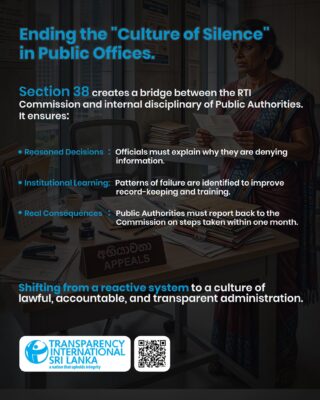
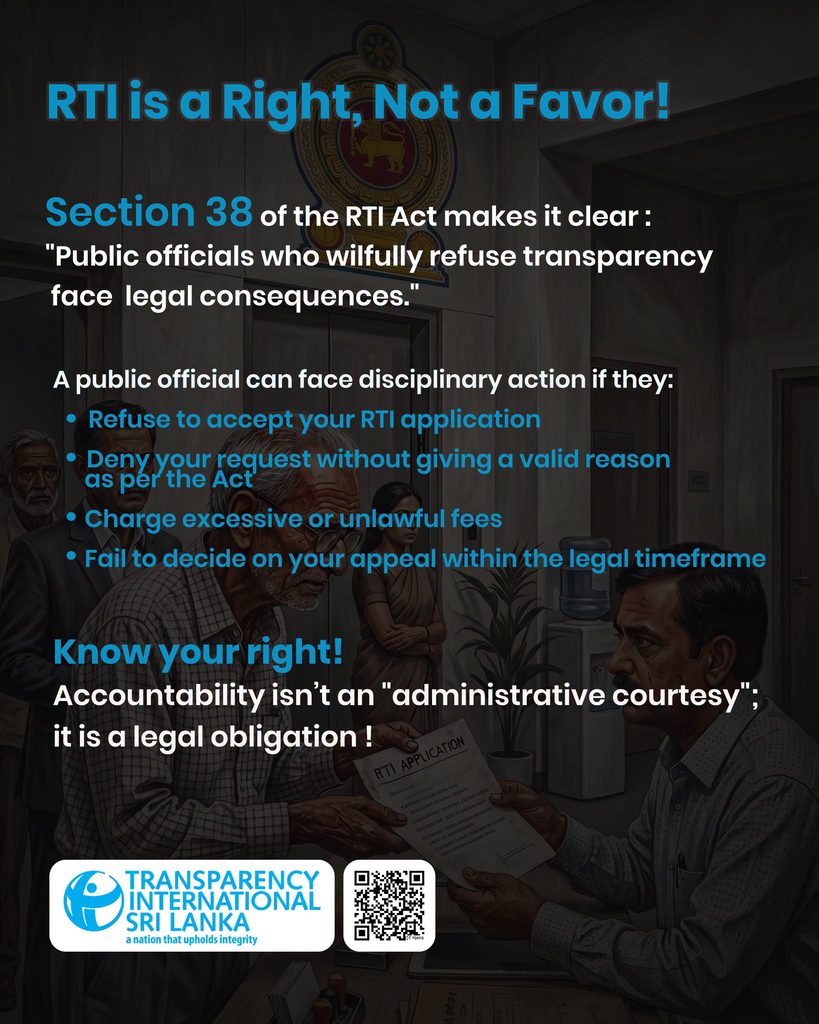
Rather than demanding immediate enforcement, TISL used the discussion to map the accountability architecture and understand why it is not being used. The resulting policy brief on Section 38 sets out institutional responsibilities under the Act, analyses the obstacles to applying them, and offers recommendations intended to inform future policy dialogue on RTI accountability. A tri-lingual Facebook post in English, Sinhala and Tamil, with visuals breaking down Section 38, raised awareness of this little-known provision.
Making the case for opening up the lawmaking process
Another objective addressed a broader problem: Sri Lanka has no formal framework requiring public consultation before laws are made, though public participation sits at the heart of UNCAC Articles 10 and 13. TISL’s ongoing mapping of the legislative process fed a policy brief that sets out a practical reform agenda for making lawmaking more participatory, transparent and accountable.
The policy brief Towards Participatory Lawmaking in Sri Lanka describes an executive-centred process that is difficult for citizens to follow. Cabinet decisions approving new laws often disclose little about the problem being solved or the evidence behind it. Consultation, where it happens, is discretionary, poorly publicized, frequently confined to invited capital-based stakeholders, and usually takes place once a draft Bill already exists – by which point the substantive policy choices are settled. Draft texts are often prepared in English first, leaving Sinhala and Tamil speakers commenting on translations. And with no post-enactment review, citizens have limited recourse once the Speaker certifies a law.
Weak participation is not only a democratic deficit but an integrity risk: narrow interests shape legislation unscrutinized, leaving loopholes hardest to correct later. TISL proposes six principles – early, informed, inclusive, accessible, transparent and accountable participation – and twelve recommendations, including a Cabinet Circular mandating consultation before Bills are finalized, a public tracker of every proposed law, trilingual summaries and response matrices, automatic referral of rights-sensitive Bills to the Human Rights Commission, and safeguards on committee stage amendments. The brief will feed into a larger institutional study.
Carrying the agenda to Doha
Ahead of the eleventh session of the Conference of the States Parties (CoSP11), TISL met the Commission to Investigate Allegations of Bribery or Corruption (CIABOC) in its capacity as Sri Lanka’s UNCAC focal point. They discussed the state of negotiations on the draft resolution on the next phase of the IRM, the Coalition’s recommendations on transparency, civil society participation and access to country review documentation, and the case for Sri Lanka aligning with the Transparency Pledge.
At CoSP11 in Doha in December 2025, TISL briefed their country delegation on the substance and dynamics of the IRM draft decision, ensured its members were in the informal consultations where language is settled, and acted as a technical resource throughout.
Despite this engagement, Sri Lanka has not signed the Transparency Pledge yet and the delegation did not intervene in the IRM negotiations at CoSP11. While the focal point was receptive and indicated willingness to include TISL in Sri Lanka’s official delegation, procedural and administrative challenges ultimately prevented TISL’s inclusion. However, TISL’s did persuade the delegation to co-sponsor resolution 11/7 on transparency in the funding of political parties, candidatures and electoral campaigns – the first dedicated political finance resolution, adopted by consensus with a record number of co-sponsors. Political financing had been flagged in TISL’s own parallel report as a persistent weakness in Sri Lanka’s Chapter II implementation, despite the recent Election Expenditure Act.
Successes
TISL’s follow-up activities produced resources and relationships that outlast the project:
- A trilingual self-assessment tool for public authorities, validated by the officials who have to apply it.
- An evidence base on why RTI sanctions go unused, consolidated in a policy brief that oversight bodies can use.
- A concrete reform agenda for participatory lawmaking, its first steps achievable without constitutional reform.
- Working relationships built on credibility with the Right to Information Commission, the Public Service Commission, the Presidential Secretariat and the Ministry of Mass Media.
- Sri Lanka’s co-sponsorship of the first-ever UNCAC resolution on political finance transparency, and a previously-identified gap carried into an international commitment.
- A briefed national delegation at CoSP11, present where outcomes are shaped.
Lessons learned
TISL brought draft documents rather than open questions into its consultations, giving officials something specific to react to and produced far sharper feedback than a general discussion would have. Confidential interviews elicited candour about institutional shortcomings no roundtable would have surfaced. Framing the outputs as tools that help institutions meet obligations they already have, rather than as criticism of their failure to meet them, kept the door for dialogue open throughout.
This approach proved resilient. When Cyclone Ditwah disrupted stakeholders availability in late 2025 and early 2026, TISL shifted towards smaller targeted sessions rather than postponing, and found that the more intimate format generated better material than the events it replaced.
Outlook and next steps
Maheshi Herat, Executive Director of Transparency International Sri Lanka (TISL), explained that “This year, Sri Lanka marks ten years of the Right to Information. While the RTI Act has had a positive impact, we must strengthen its implementation to fully realize its potential. This includes enforcing the accountability mechanisms under Section 38 for wilful non-compliance and ensuring effective proactive disclosure. These steps are essential to building more transparent and accountable governance.”
TISL began their follow-up activities knowing legislative change would take longer than the project period. What they built instead is a publicly-available evidence base and institutional relationships to draw on, which will be integrated into TISL’s broader governance, anti-corruption and access to information programming. Future work will focus on promoting the proactive use of the Proactive Disclosure Checklist, advocacy on implementing Section 38 of the RTI Act, and documenting institutional experiences, as the RTI framework evolves. TISL has already started integrating the RTI-related resources into its RTI awareness raising and training activities for different stakeholder groups. TISL will also continue advocating for participatory lawmaking and legislative transparency. They are seeking funding to sustain these efforts.
It remains unclear when Sri Lanka will be reviewed under the IRM next phase, but TI Sri Lanka will keep advocating for a transparent, inclusive and effective review, and for full implementation of the Convention and its resolutions nationally. The country’s co-sponsorship of UNCAC Resolution 11/7 opens the door to continued advocacy on political finance transparency, building on the gaps its parallel report identified.


