What does the fight against corruption have to do with transnational organized crime? For crimes that affect the environment, the answer is: a great deal.
Wildlife trafficking, illegal logging, illegal fishing, illegal mining, and waste trafficking are often discussed as environmental offences. But many of these crimes are also highly organized, profitable, and transnational.
The international community has an important role to play in linking corruption and the organized criminal networks behind these crimes that affect the environment (CAE). But what tools do they have to tackle these overlapping areas?
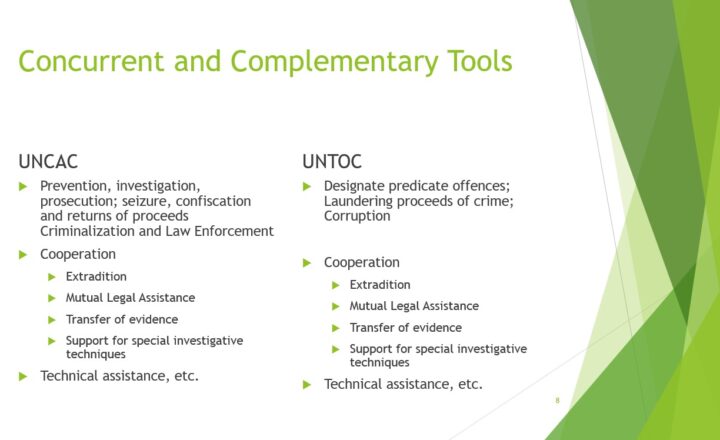
On 16 June 2026, the Coalition’s Working Group on Environmental Crime and Corruption held its 23rd meeting, Bridging United Nations Convention against Transnational Organized Crime (UNTOC) and UNCAC: Advancing the corruption and environmental crime agenda. The meeting brought together experts including Sheldon Jordan, Co-founder of the Canadian Environmental Crime Research Network; Laura Waisbich of Instituto Igarapé; and was moderated by Lisa Hartevelt, Director of Policy at the Wildlife Justice Commission and Chair of the Working Group. Together, they explored how these global mechanisms are complementary together: the UNCAC addresses corruption and strengthens international cooperation in tackling it, whilst the other provides a framework for countries to cooperate against transnational organized crimes.
For Working Group members familiar with the UNCAC but less familiar with the UNTOC, the discussion highlighted how using both frameworks together is to make them more effective in tackling CAE and transnational organized crime. But there are steps to take before these can be made operational side-by-side.
Environmental crime is more than an environmental issue
The networks involved in CAE can operate across multiple countries, with different actors responsible for sourcing, transporting, laundering, and selling illicit goods. They may also be involved in other forms of organised crime, including drug trafficking and money laundering. Corruption enables these illicit activities at multiple points along the supply chain, while illicit financial flows allow criminal profits to be concealed, transferred, and reinvested.
Sheldon Jordan illustrated this with an example from his own experience: in 2016, an assessment of wood imports into Canada found that 10-12% were at high risk of coming from corrupted origins, representing an estimated CAD 1.5 billion in trade and affecting the equivalent of 12,000-13,000 Canadian jobs. As he noted, “corruption that’s happening elsewhere in the world isn’t an elsewhere problem, it’s an everywhere problem”, creating unfair competition for legitimate, highly regulated industries.
This means that CAE are simultaneously environmental crimes, organized crimes, corruption crimes, and financial crimes.
This is where the UNCAC is essential. Its provisions and mechanisms provide countries with important tools to prevent and address corruption, strengthen international cooperation, pursue illicit financial flows, and recover assets. The adoption of UNCAC CoSP Resolution 11/9 on preventing and combating corruption as it relates to crimes that affect the environment in 2025 further strengthened international commitment to addressing corruption as it relates to CAE.
However, if we focus only on corruption, we risk addressing the enablers while leaving the criminal networks themselves insufficiently targeted.
The missing piece: organized crime tools
The UNTOC was created to provide a framework for countries to cooperate against transnational organized crime. It contains powerful criminal justice tools, including mutual legal assistance, extradition, joint investigations, special investigative techniques, financial investigations, confiscation, and asset recovery, as well as measures to address money laundering and corruption. These are the tools needed to disrupt the networks behind CAE.
The challenge is that the UNTOC does not automatically apply to environmental offences. The Convention applies to “serious crime”, defined as conduct punishable by a maximum deprivation of liberty of at least four years. This creates a significant gap. Environmental offences are defined and penalised differently from one country to another. A UNODC analysis of national laws, cited by Sheldon Jordan during the meeting, found that only a third of environmental offences in UNTOC Member States meet the “serious crime” threshold. And even within a single country, this picture might be uneven: wildlife trafficking may meet the threshold, while offences involving fisheries or pollution may not – this is the case in Canada, for example.
Where offences are not consistently recognized as “serious crimes”, countries may not be able to make full use of the criminal justice tools and international cooperation mechanisms available under the UNTOC – tools that are crucial in pursuing transnational criminal networks.
The global nature of environmental crime makes this fragmentation particularly difficult to overcome. For example, a Wildlife Justice Commission analysis found that the rhino horn trade supply chain spans at least 50 countries. A criminal investigation crossing multiple jurisdictions can quickly encounter differences in criminal definitions, penalties, investigative powers, and institutional responsibilities.
Laura Waisbich illustrated how this plays out even within one region: the Amazon basin is one ecological biome, but it spans eight countries and one overseas territory, each with its own legal and institutional context, governance structures, and approaches to environmental crime.
These differences also exist within countries, at national, sub-national, and local levels. Sheldon Jordan noted that in Canada – and most jurisdictions globally – environmental crime spans wildlife, waste, minerals, fisheries, and forestry, with regulation split across multiple authorities at national, regional, and municipal level. Many of these authorities lack the mandate, powers, specialized capacity, and coordination mechanisms needed to address CAE and associated corruption. This fragmentation weakens operational responses and hinders coordinated and effective enforcement efforts.
This illustrates why CAE cannot be addressed through a one-size-fits all approach. At the same time, the transnational nature of these crimes means that national and local responses need to be connected through effective international cooperation.
Existing environmental agreements cannot fill the gap alone
There are existing environmental agreements addressing specific forms of environmental crime and illicit trade, such as the Convention on International Trade in Endangered Species of Wild Fauna and Flora (CITES), the Basel Convention on the Control of Transboundary Movements of Hazardous Wastes and their Disposal, and the Minamata Convention on Mercury, among others. These provide essential frameworks for protecting the environment and regulating environmental activity.
However, these agreements were not designed to address environmental crime as a form of transnational organized crime. They do not provide the same criminal justice framework as the UNTOC for systematically investigating transnational criminal networks.
This is not a criticism of these instruments. They each have an important role to play. Rather, it highlights why different international frameworks need to work together more effectively. At present, there is still no comprehensive global legal framework specifically addressing organised environmental crime.
An UNTOC Protocol on CAE could close the gap
In 2024, the Conference of the Parties to the UNTOC established an Intergovernmental Expert Group on CAE, with a mandate to examine gaps in the international legal framework and in the implementation of the UNTOC in relation to these crimes. The discussions of the Expert Group helped build a shared understanding that environmental crime is a core form of transnational organized crime, highlighted important challenges and gaps between environmental regulation and criminal enforcement, and created a unique opportunity for States to consider strengthening the international legal framework to address these crimes more effectively.
Building on these discussions, at the 13th Conference of Parties to the UNTOC (UNTOC COP13) in October 2026, States are expected to consider a resolution proposing to initiate a negotiating process for a new Protocol to the UNTOC on CAE.
There are already three existing UNTOC Protocols on trafficking in persons (TiP), migrant smuggling, and firearms trafficking, which serve as examples of how international legal frameworks can encourage legislative harmonization, create common standards across jurisdictions, strengthen international cooperation, and effectively support national implementation. A Protocol on CAE would do the same for the organised criminal dimension of environmental crime. It could help to:
- expand the application of UNTOC tools to CAE that currently fall outside of the Convention’s scope;
- facilitate international cooperation through harmonised offenses, legal definitions, improved information sharing, and coordinated action against transnational organised criminal networks;
- tackle corruption, illicit financial flows, and money laundering as key enablers of environmental crime;
- address legal loopholes and drive national legal reforms;
- encourage proportionate and effective sentencing approaches; and
- elevate CAE as a priority on national criminal justice and regional and international cooperation agendas.
Why this matters for the UNCAC Community
The UNTOC and UNCAC are complementary rather than competing, as they address different parts of the issue. Corruption enables environmental crime, through bribed officials, falsified permits, and weak oversight. Organized criminal networks exploit these vulnerabilities to run trafficking operations at scale. The UNCAC tackles the enabling environment: corruption, bribery, weak governance, illicit financial flows, and the vulnerabilities that allow environmental crime to flourish. A strengthened UNTOC framework would provide tools to investigate and disrupt the organized criminal networks that exploit these weaknesses more effectively.
Progress against corruption removes the protection that criminal networks rely on. Better tools against those networks, in turn, expose the corrupt actors who facilitate them.
The difference between a political resolution and a legally binding protocol also matters here. UNCAC Resolution 11/9 is an important political commitment by States to strengthen action against corruption linked to CAE, and it calls for measures including financial investigations and asset recovery. A stronger UNTOC framework could help turn these objectives into more effective criminal justice cooperation by providing additional legally binding tools to address the organized criminal dimension of CAE.
This complementarity is especially clear on the financial dimension. Environmental crime is driven by profit, and criminal networks rely on financial systems to move, conceal, and reinvest the proceeds. Following these financial flows can help investigators move beyond individual seizures or arrests to identify the wider networks and beneficiaries behind environmental crime.
An UNTOC Protocol could strengthen this response by helping ensure that environmental crimes are more systematically treated as predicate offences for money laundering investigations. It could also strengthen the use of financial investigations and the tracing, seizure, and recovery of criminal assets. The aim is therefore not simply to identify individual acts of corruption or intercept individual shipments, but to follow the money and target the criminal structures that profit from environmental crime — an area where UNCAC and UNTOC can reinforce one another directly.
What can you do?
Whether a new UNTOC Protocol moves forward will depend on States’ willingness to support and advance the process, in particular by supporting the adoption of the anticipated resolution initiating the negotiation of a Protocol on CAE at UNTOC COP13.
For members of the anti-corruption community, supporting this process is a complementary next step in advancing the commitments already made under the UNCAC.
Working Group members can help build that momentum by encouraging their governments to support the development of a dedicated UNTOC Protocol on CAE.
If you would like to support the Working Group’s efforts, get in touch with the Working Group on Environmental Crime and Corruption. Those interested in advancing discussions on a potential additional Protocol on CAE can also reach out to the Alliance of NGOs on Crime Prevention and Criminal Justice’s Working Group on Crimes that Affect the Environment.
