The importance of protection for whistleblowers and reporting persons has been embedded in Article 33 of the United Nations Convention Against Corruption (UNCAC), which underscores the need to protect those who report corrupt practices. The adoption of Resolution 10/8 in 2023 marked a significant advancement: the first-ever UNCAC resolution dedicated specifically to the protection of reporting persons, signaling a global acknowledgement of the risks faced by whistleblowers and the need for robust protective measures.
However, reality falls far short of what is needed. Against this backdrop, the Asia-Pacific regional community and the Working Group on Protection of Whistleblowers and Other Reporting Persons of the Coalition jointly organized a webinar on October 9, 2026, focused on rallying efforts to enhance protections for whistleblowers in the region. A primary objective of this joint initiative was to foster dialogue and identify actionable strategies or actions that civil society can undertake to enhance whistleblower protections across the region.
Recognizing gaps in reporting and protection mechanisms across Asia-Pacific
While more States are adopting or improving relevant legal and policy frameworks, the UNODC has reported growing demand from countries for technical assistance in this area. However, it is observed that comprehensive legal frameworks for whistleblower protection remain critically lacking in many Asia-Pacific countries. In response to a question in preparation for this session registration most webinar registrants identified gaps in legal frameworks and weak implementation and enforcement of existing laws as the biggest challenges to effective whistleblower protection. Fear of retaliation also emerged as a major concern, alongside limited awareness of and trust in reporting mechanisms. They further highlighted the lack of safe, accessible, and confidential reporting channels.
Vladimir Radomirović, Editor-in-Chief of Pištaljka and Co-chair of the Coalition Working Group, opened the session as the moderator by reflecting on his direct experience as a past whistleblower who suffered from retaliation, as well as in supporting the deliberations from 2023 when the milestone Resolution 10/8 was negotiated and adopted at the 10th session of the Conference of the States Parties to the UNCAC.
Initiatives and support by the UNODC to States Parties and civil society
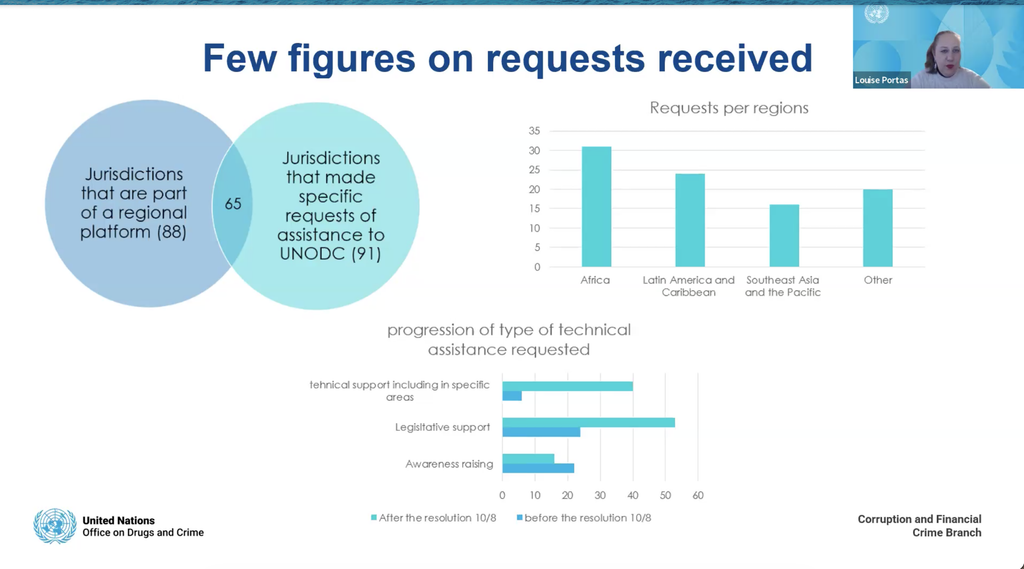
Louise Portas, Crime Prevention and Criminal Justice Officer with the Corruption and Economic Crimes Branch of the UNODC and the whistleblower protection focal point, provided an overview of international standards and recent developments in whistleblower protection. She noted that approximately 70% of countries reviewed under the first cycle of the UNCAC Implementation Review Mechanism received recommendations to strengthen implementation of Article 33, demonstrating persistent gaps in protecting reporting persons.
She highlighted the need for systems with:
- broad coverage of work-related wrongdoing,
- multiple reporting channels,
- protection based on reasonable grounds to believe information is true rather than the whistleblower’s motives, and
- measures to prevent, stop, and remedy retaliation.
She emphasized that employers have a responsibility to prevent retaliation, while independent authorities and effective remedies are essential when workplace protections fail.
Turning to implementation, Portas highlighted the growing demand for UNODC technical assistance, with more than 52 requests received since the adoption of Resolution 10/8. UNODC has recently developed an international study informed by responses from 82 States Parties (including 12 from the Asia-Pacific), alongside a practical toolkit containing model legislative provisions and guidance for developing whistleblower protection frameworks. Using this methodology, they supported legislative drafting in four countries in 2026, with two draft laws already submitted to Parliament. She also outlined UNODC’s expanding work on the relationship between whistleblowers, investigative journalists, civil society, and law enforcement, especially in Southeast Asia and the Pacific, emphasizing the need for a broader anti-corruption ecosystem that enables these actors to cooperate safely. Responding to a question concerning fragile and conflict-affected contexts, such as Myanmar, she stressed that meaningful protection can still be advanced in the absence of comprehensive national legislation and limited resources, particularly through understanding the specific context and putting in place institutional safeguards tailored to local risks.
Tools for civil society to support whistleblowers and advance protection
Cynthia Gabriel, a lawyer and the founding director of the Center to Combat Corruption and Cronyism (C4 Center) in Malaysia, provided an overview of Malaysia’s experience with whistleblower protection, highlighting the gap between legal provisions and their effective implementation.
She noted that while Malaysia has had a standalone Whistleblower Protection Act since 2010, its effectiveness has been undermined by political interference, conflicts of interest, limited reporting channels, and a lack of public trust in law enforcement institutions. She noted that, according to Malaysian Anti-Corruption Commission statistics, less than 1% of complaints handled by the Commission were submitted through official whistleblowing channels, illustrating the significant trust deficit in formal reporting channels. Gabriel also highlighted positive developments, including corporate liability provisions encouraging companies to establish internal reporting mechanisms and a recent court ruling awarding monetary compensation for damages to a whistleblower whose identity had been disclosed by authorities. She emphasized the need for a narrative on the importance of protecting whistleblowers and shifting the focus to how whistleblowers can save, in many cases, millions of public funds for a country.
Responding to a question about tools for civil society to advance whistleblower protection and support individual whistleblowers, she noted:
- the potential of secure digital reporting platforms and open-source tools to make reporting safer and more accessible,
- the need to expand technical assistance and expertise to local civil society organizations to strengthen their capacity to support whistleblowers effectively.
Opportunities for civil society to shape legislative frameworks on whistleblower protection
Erdenejargal Perenlei, the Executive Director of Open Society Forum in Mongolia, outlined Mongolia’s efforts to establish a comprehensive whistleblower protection framework as part of its broader national anti-corruption strategy. Although the 2016 National Anti-Corruption Programme in Mongolia recognised the need for dedicated whistleblower protection legislation, progress has been slow due to limited political will and repeated delays in the legislative process. A revised Whistleblower Protection Bill has now been submitted to Parliament, incorporating important safeguards aligned with international standards, including broad protection covering public and private sector wrongdoing, secure and anonymous reporting channels, a reversed burden of proof in retaliation cases, and provisions for compensation and support. She also highlighted several remaining concerns with the draft legislation, including the independence of the proposed whistleblower protection authority.
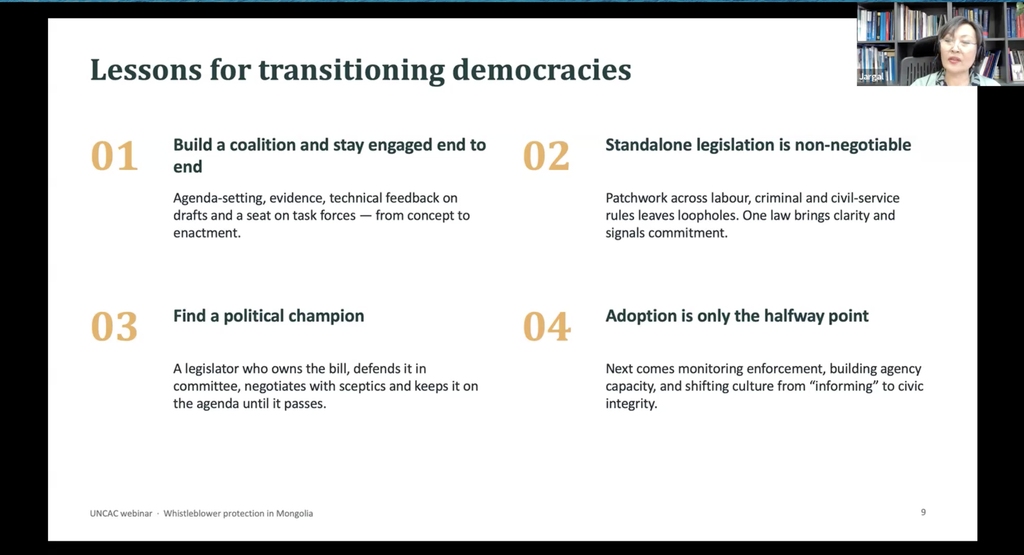
Drawing on Mongolia’s experience, she emphasized the critical role of civil society in advancing legislative reform, including:
- conducting research,
- building coalitions,
- using international anti-corruption commitments to advocate for stronger protections,
- providing technical input on draft legislation, and
- participating in government working groups.
Perenlei identified the importance of sustained civil society engagement throughout the legislative process, the need for standalone legislation rather than fragmented legal provisions, and the value of finding political champions to move reforms forward.
During the open discussion, concerns were raised about the financial burden of whistleblower protection mechanisms on developing countries, given the need to set up the infrastructure, such as reporting platforms and the financial resources to maintain such mechanisms. Portas emphasized that limited resources should not prevent their adoption, as affordable preventive measures, particularly requiring employers to address retaliation early, can reduce the need for costly state interventions and compensation. On civil society engagement, Perenlei stressed the importance of monitoring legislative processes, building capacity, and training those responsible for implementing whistleblower protection laws. Gabriel highlighted the need for civil society to actively participate in legislative reforms, defend essential safeguards, and collaborate with academia, investigative journalists, and the private sector to strengthen advocacy and share expertise. Addressing gender-specific risks, she also noted that intersecting discrimination based on gender, ethnicity, and religion can increase the vulnerability of women and minority whistleblowers, underscoring the need to challenge stereotypes and recognize their contributions to exposing wrongdoing.
Key takeaways and strategies
The discussions highlighted three priority areas to guide future advocacy and capacity-building efforts across the Asia-Pacific region:
- Strengthening civil society capacity: There is a need for tailored training to strengthen civil society capacity to advocate for stronger legal frameworks, improve implementation and enforcement, and ensure effective protection against retaliation. In the webinar’s closing poll, participants expressed particular interest in further training on these topics.
- Promoting cross-country learning and exchange: Sharing experiences and lessons learned from countries that have developed or strengthened whistleblower protection frameworks can inform advocacy efforts elsewhere in the region. Connecting civil society organizations across countries can facilitate peer learning, technical feedback on proposed reforms, the exchange of good practices, and monitoring of implementation.
- Developing strategic advocacy approaches: Civil society organizations need coordinated advocacy strategies at national and regional levels, including identifying political champions, securing participation in legislative reform processes and government task forces, and building broader coalitions with relevant stakeholders. Effective communication and public awareness efforts are also essential to build support for whistleblower protection and promote recognition of whistleblowing as an act in the public interest.