Table of Contents
With 193 States parties, the UNCAC is the most comprehensive global anti-corruption treaty, with near-universal coverage. Its main decision-making body, the Conference of the States parties (CoSP), brings together countries facing diverse corruption-related challenges and institutional frameworks, and has become a space for constructive dialogue between them. Because the CoSP decides by consensus, every resolution must be agreed by all parties.
In recent years, civil society’s engagement in the CoSP has become more coordinated, with a stronger focus on advocacy towards the adoption of meaningful resolutions. The objective is to ensure that States adopt resolutions that “set necessary global standards by including relevant, ambitious, elaborated, and concrete calls to action that address the most pressing implementation gaps and challenges related to the convention”, as stated by Yonatan Yakir of the Global Civil Society Coalition for the UNCAC in the opening of the event.
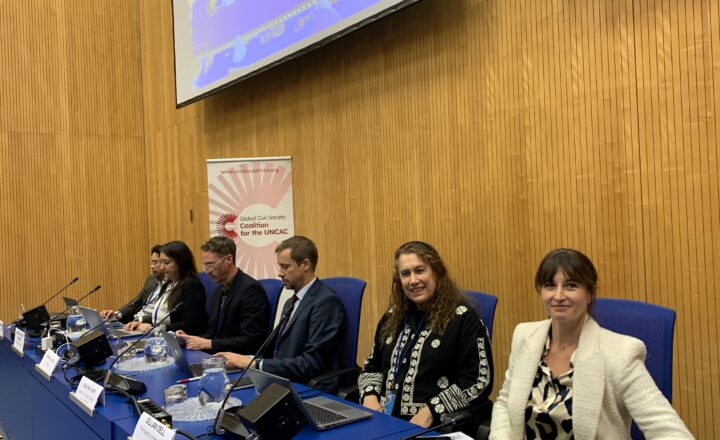
To provide insights on current anti-corruption priorities from a civil society perspective, the Global Civil Society Coalition for the UNCAC, with the Dominican Republic and Denmark, convened an event in the margins of the second resumed 17th session of the Implementation Review Group (IRG) on the 5th of November 2026, in Vienna. Following wide consultations with our network, the Coalition had identified eight priority issues that need greater attention from States parties in the lead-up to CoSP12, which will take place in Uzbekistan next year:
- Professional enablers of corruption
- Access to information
- Debt and corruption
- Asset and interest disclosure
- Effective and transparent asset recovery
- Protecting corruption detectors and those who report or investigate corruption
- Synergies between UNCAC and other fora
- Harm caused by corruption
Civil society experts from different organizations came together to share why these issues need to be addressed now, and raised recommendations for specific calls to action that could be reflected in CoSP12 resolutions.
The session was opened with remarks from Ambassador Gilka Meléndez of the Dominican Republic, and Frederick Due Rabenschlag, Political Affairs Officer at the Permanent Mission of Denmark to the United Nations. Ambassador Meléndez highlighted that listening to civil society helps States arrive at CoSP12 with identified “common ground” and better-informed positions. Frederick Due Rabenschlag emphasized that resolutions should drive tangible progress, and drew on civil society’s expertise in turning commitments into effective action.
Professional enablers of corruption
(in recording from 0:17:00)
Presented by: Hugh Jorgensen, Program Lead for Corruption Money Flows at Transparency International
Why this topic?
“Put simply, corruption at scale does not happen without professional help. And behind most grand corruption schemes and the hiding of corruption proceeds, stands a professional…” stated Hugh Jorgensen in introducing this topic.
He highlighted the importance of better regulating service providers with findings from Transparency International (TI) research. In the report “Loophole Masters: How Enablers Facilitate Illicit Financial Flows from Africa”, TI found that out of 33 African countries examined, 46% imposed no obligation to screen politically exposed persons or check the source of suspicious wealth of corporate service providers. In a more recent study investigating 20 financial intelligence units, reporting obligations for non-financial sectors were incomplete in nearly half of the countries assessed. In some major financial centres, lawyers, real estate agents and company service providers had no obligations to provide suspicious transaction reports at all.
Hugh argued that a resolution would give States a way to supervise and monitor these professionals. The Convention already offers some groundwork – albeit with caveats:
- Article 14 extends regulation beyond financial institutions but only where appropriate.
- Article 52 applies beneficial ownership and politically exposed person checks to financial institutions only
While this sets a useful framework, the Convention leaves to the discretion of States parties the implementation of these general provisions, which creates opportunities for exploitation.
In emphasizing that CoSP12 presents an optimal moment for a resolution on this topic, Hugh pointed to similar developments taking place in other fora: the General Assembly in 2024 called on States to investigate and prosecute professionals who enable illicit financial flows; in the Sevilla Commitment from FfD4, member states made a commitment to effectively regulate professional service providers and UNODC is leading a Sevilla initiative platform on accountable service providers.
To conclude he states, “the corrupt will always look for help. Such a resolution would be one step to making that help a little bit harder to find.”
Proposed measures/recommendations
To close the gap on enablers of corruption, he called for a dedicated resolution to cover five elements:
- Coverage: Regulate by activity, not just sector, and name high-risk professions.
- Regulation: Require due diligence, beneficial-ownership checks, suspicious-transaction reporting, and enhanced scrutiny of politically exposed persons; ensure professional privilege does not shield financial or administrative activities.
- Supervision: Establish independent national supervisors with government oversight where self-regulatory bodies are used.
- Accountability: Provide for dissuasive sanctions.
- Knowledge: Task agencies with assessing national frameworks and offering technical assistance on request.
Access to information
(in recording from 0:23:04)
Presented by: David Banisar, Co-Chair of the Coalition
Why this topic?
Reminding how “publicity deters corruption”, David Banisar pointed out that there is improved public trust when people can see that those who have done wrongdoings get prosecuted. For civil society, information enables civil journalists and civil society actors to effectively partner with governments in corruption detection and prevention.
He drew attention to the provisions already in the Convention that oblige States to take measures on access to information. Articles 10 and 13 require States to make information available to the public, to engage with civil society and to ensure that civil society has access to it. Two thirds of UNCAC States have adopted comprehensive access to information laws, although their effectiveness varies. He also noted that regional anti-corruption instruments in Latin America, Africa, the Arab region and Europe all include provisions on access to information, stressing that the practice is well established and not unique to the UNCAC. Other international frameworks point the same way. The Sustainable Development Goals (SDG’s) include provisions to enhance transparency, and human rights law contains important elements of access to information. These include Article 19 of the Universal Declaration and the International Covenant, documents issued by the Human Rights Committee and the Human Rights Council, and decisions of the European Court of Human Rights and the Inter-American Court of Human Rights under regional human rights conventions.
Despite this, no CoSP resolution has ever set out standards on access to information. Many resolutions stress its importance, but none say what States should actually do. A third of States still lack comprehensive laws, and existing laws are not always effectively used or implemented. States have also asked for technical assistance, as the second review cycle showed. David argued that a resolution could meet that demand by setting standards, sharing good practice and advancing a common agenda. He also stressed that access to information is essential for making other provisions work, including asset recovery and enforcement.
David concluded that “you can’t have engagement with civil society if they’re kept in the dark”.
Proposed measures/recommendations
His recommendations to a resolution on this topic include:
- Set out what corruption-related information states should make available, how to provide it, what to publish proactively, and who should have access.
- Build on existing frameworks, including the SDGs and international environmental and human-rights law, rather than create new infrastructure.
- Provide standards, good-practice guidance, and technical assistance to help states adopt, implement, or update access-to-information laws, in collaboration with civil society.
- Make UNCAC review-cycle documents public so people can see how their country is doing, what gaps it has identified, and how it plans to address them.
- Improve transparency across UNCAC and other relevant review mechanisms to support public engagement and anti-corruption efforts.
Debt and corruption
(in recording from 0:33:46)
Presented by: Daniela Patiño, Program Lead on the Protection of Public Resources at Transparency International
Why this topic?
Daniela Patiño opened by describing the unprecedented debt crisis facing countries worldwide and asked what role the Convention could play in addressing it. She placed corruption at the centre of the problem, arguing that it hinders the mobilization of domestic resources and enables an unsustainable debt burden.
Daniela states that “nothing shows better the impact of corruption on people’s lives than when corruption is embedded on the way lending agreements are negotiated, debt is managed and in which loans enter the budgets of different countries”. When resources from loans are embezzled or lost, the risk of unsustainable debt and fiscal increases, with a burden placed on the shoulders of future generations. According to UNCTAD, more than 3.4 billion people are living in countries that pay more on interest payments than on health and education.
She identifies ways in which corruption is embedded in debt:
- Opaque lending and borrowing: When debt information is hidden, and parliaments, supreme audit institutions, civil society, and other stakeholders are excluded from decisions and oversight, lending negotiations are vulnerable to corruption and capture.
- Growing use of extra-budgetary loans: When loan funds are not clearly incorporated into national budgets, disclosure and oversight become harder, increasing the risk of embezzlement and misallocation.
She identified two types of gaps that allow corruption to become embedded in debt:
- Gaps in laws and regulations: Many countries lack requirements to disclose public debt and loan terms, use confidentiality clauses that can conceal loans, and do not require parliamentary approval of new borrowing.
- Gaps in implementation and oversight: Even where oversight is mandated, parliaments and other institutions may not monitor borrowing and debt management effectively due to low prioritization, insufficient resources, or integrity concerns.
Whilst the topic of debt is already in conversation in other fora, Daniela points out that the “spirit and principles of the Convention already capture and include some provisions to close some of these gaps […] in terms of lack of transparency, of oversight, but also practices that enable direct corruption in the way in which debt is being acquired and is being managed”. Specific relevant provisions within the convention include:
- Article 9(2): Management of public finances, including preventing corruption in revenue mobilization and management of public funds.
- Article 10: Public reporting and access to information of public interest, including information about debt.
- Article 13: Civil society participation, including monitoring public decisions and funds and accessing information.
- Bribery and embezzlement provisions: Relevant to corruption in the access to and negotiation of loans.
- Article 34: Criminalization and consequences of corruption.
Proposed measures/recommendations
Looking to key advocacy milestones on the horizon, such as the International Anti-Corruption Conference (IACC) this December, the Financing for Development (FFD) forum in New York next year and CoSP12, Daniela calls on states to consider the following:
- Develop updated global standards to guide implementation of UNCAC Article 9(2) on public-finance management, with specific attention to public debt.
- Strengthen disclosure and transparency of debt-related decisions, consistent with Article 10, and enable civil society to access information and monitor them.
- Close opportunities for corruption in debt management and oversight.
- Build the capacity of oversight institutions to scrutinize how borrowed resources are managed.
- Improve cooperation among the UNCAC, FFD forum, and UNCTAD to address corruption risks in debt negotiations and management.
Asset and interest disclosure
(in recording from 0:44:36)
Presented by: Ana Revuelta Alonso, Analyst and Regional Coordinator for Europe at the Coalition
Why this topic?
“Even when they are required by law, asset and interest declarations are often incomplete, rarely verified, hard for the public to access and use, and blind to assets held abroad,” said Ana Revuelta Alonso in explaining why the next CoSP should provide guidance to States parties on strengthening their asset and interest declaration frameworks.
There is broad consensus, backed by research and evidence, that declarations of assets and interests by those holding public office are a useful anti-corruption tool. Well-designed and well-functioning, they can help prevent conflicts of interest, detect illicit enrichment, and give investigators a starting point to trace and recover stolen assets.
The problem lies in the gap between law and practice. The Coalition’s research on public disclosure, carried out last year in collaboration with the Global Data Barometer, in 76 countries across Europe, Latin America, and Africa, shows how much systems and implementation differ. A UNODC report based on UNCAC country review reports points in the same direction: up to 108 States parties have received a total of 324 recommendations on Article 8 alone, and the report found that “robust systems are rare”.
The Convention already contains several relevant provisions, including:
- Article 7(4) on conflicts of interest.
- Article 8(5) calling for the declaration of outside activities, employment, investments, assets, and substantial gifts or benefits.
- Article 52 on financial disclosure and sanctions.
However, there are no global standards on the reporting, management, or disclosure of declarations, and too little information is exchanged between jurisdictions in practice. The CoSP has never adopted a dedicated resolution on the topic or given guidance on what an effective declaration system looks like. UNODC’s last compilation on financial disclosure dates from 2018, and since then, digitalization and AI have been reshaping the field, bringing both new challenges and new opportunities.
There is also momentum to build on. At the last CoSP, about 20 States reported reforms on asset and interest declarations, including wider coverage, electronic systems, stronger oversight, and coverage of high-risk officials. Because declarations only reach their potential when connected to other data sets, a resolution could build links with those already adopted on political finance, beneficial ownership, and procurement. The coming launch of the next phase of the IRM offers a further opportunity, as it will focus on implementation. And although no single system in the world lives up to best practice, good practices already exist in different countries, and tools such as the Treaty on Exchange of Data for the Verification of Asset Declarations, which lets authorities exchange data to verify declarations and is in force and open for signature.
Ana concluded by echoing the Ambassador’s call to “identify common ground”, adding that civil society stands ready to support States parties at the IACC in the Dominican Republic next month and in the months ahead of CoSP12.
Proposed measures/recommendations
Ana outlined what a CoSP resolution could call for:
- Scope: Clarify both who has to declare and what has to be declared.
- Verification: Ensure declarations provide reliable and timely information.
- Transparency: Make declarations public, so that not only authorities but also civil society and other actors can use them to contribute to anti-corruption efforts.
- Interoperability: Enable systems to work together, for example through the use of unique identifiers.
- Sanctions: Provide for sanctions in cases of non-compliance and reinforce the links between declarations and asset recovery.
- Follow-up: Mandate UNODC and the Working Group on Prevention to compile and share good practices, challenges, and lessons learned, and to work towards a common open data standard for declarations.
Effective and transparent asset recovery
(in recording from 0:53:56)
Presented by: Jackson Oldfield, Director of Research and Policy at the Civil Forum for Asset Recovery (CiFAR), speaking also on behalf of Sarah Brimbeuf of Transparency International France, with whom he co-chairs the Coalition’s Asset Recovery Working Group
Why this topic?
Jackson Oldfield opened by noting that asset recovery has been “high on the agenda for many States parties”, with significant legislative and policy developments in recent years. In his view, these developments could be better reflected at the UNCAC level, and he encouraged States parties to use the CoSP to identify and promote best practice.
Rather than a single ask, the Working Group’s recommendations highlight three complementary areas for further action. These could be advanced through a future CoSP resolution, but also through discussions on technical cooperation and the implementation of existing commitments in the UNCAC process.
Proposed measures/recommendations
The recommendations are divided into three complimentary areas:
- Strengthening international cooperation, transparency, and accountability: Strengthen cooperation and timely information sharing between requesting and requested States, and strengthen accountability and oversight through clear institutional responsibilities, independent oversight, and transparent decision-making. Promote transparency throughout the asset recovery process, including public access to information on frozen, seized, confiscated, and returned assets, as well as costs, return agreements, and the final use of recovered assets, alongside public reporting and the exchange of good practices.
- Effective asset management: Strengthen implementation of the commitments set out in the non-binding guidelines on asset management by establishing or strengthening adequately resourced asset management systems with clear institutional mandates and responsibilities. Promote safeguards throughout the asset lifecycle, such as risk-based management, preservation of value, transparent accounting of costs, and oversight of asset management systems, as well as international cooperation, technical assistance, and the exchange of good practices.
- Ensuring recovery and return benefits people and communities: Promote consideration of human rights and corruption-based harm in asset recovery and return, including the situation of victims and affected communities. Strengthen cooperation between anti-corruption authorities and with national human rights institutions and other mechanisms, promote the participation of affected communities and civil society in asset return processes, and encourage appropriate remedies for victims and accountability in the use of returned assets.
Protecting corruption detectors and those who report or investigate corruption
(in recording from 0:58:07)
Presented by: Samantha Feinstein, Staff Attorney and Director of the International Program at the Government Accountability Project, and Co-Chair of the Coalition’s Working Group on the Protection of Whistleblowers and Other Reporting Persons
Why this topic?
As Samantha Feinstein explained, “there are significant gaps in the protection of all forms of corruption detectors, corruption is something that’s often deliberately concealed because the people involved or implicated have every reason to keep it hidden”. That is why those who uncover it matter so much. She described “corruption detectors” as a broader ecosystem of people who identify, uncover, and expose corrupt activity, including journalists and whistleblowers. Whistleblowers can expose wrongdoing from inside institutions, while journalists investigate allegations, verify information, and bring corruption to the public’s attention.
Doing so can come at a tremendous personal cost. Whistleblowers and journalists alike risk losing their jobs, and may face threats, violence, or abusive lawsuits, which can even be used to reveal the identity of confidential sources. They may also face digital surveillance and retaliation that extends beyond the reporting person to colleagues, family members, and those who assist them. Samantha added that she has already heard reports from whistleblower lawyers of employers using AI to work out the identity of confidential whistleblowers.
The two groups are also closely linked. Whistleblowers often turn to journalists when the official reporting channel fails to respond or is unsafe, and journalists rely on being able to protect their confidential sources. Yet legal protections remain fragmented: someone may be protected when reporting to an authority but not when speaking to a journalist, and a journalist may be protected while their source remains exposed. These gaps discourage people from speaking up.
The Convention already provides an important foundation:
- Article 33: Protection of reporting persons.
- Article 13: Public participation and access to information concerning corruption.
- Article 32: Protection of witnesses, experts, and victims.
- Resolution 10/8: Protection of reporting persons.
Gaps remain, however, where whistleblower protection, investigative journalism, and source confidentiality intersect. A new resolution would recognize how these issues are connected and encourage States to address the gaps in their laws and practices, building on the work already undertaken by States parties with support from UNODC, civil society, and other experts.
Samantha closed with a reminder of what is at stake: “We definitely can’t expose corruption effectively if the broader ecosystem of people who expose it are left unprotected.”
Proposed measures/recommendations
Samantha called for a resolution that would:
- Recognize and protect the different people involved in exposing corruption, including whistleblowers, journalists, civil society actors, and others who may face retaliation.
- Address retaliation in all its forms, not just workplace reprisals but also threats, violence, intimidation, digital attacks, and abusive legal proceedings, including strategic lawsuits against public participation (SLAPPs).
- Strengthen confidentiality and source protection, with meaningful safeguards against identification or exposure, including through surveillance and digital technologies.
- Close gaps in protection for disclosures outside official channels, with States considering safeguards for people who report to journalists or civil society organizations, or who speak publicly, particularly where institutional channels are unsafe or ineffective.
- Ensure access to effective protection and remedies, including timely protection measures, practical assistance, international cooperation, and the sharing of good practices and technical support.
Synergies between UNCAC and other fora
(in recording from 1:05:20)
Presented by: Betina Pasteknik, Deputy Director of the Coalition and Co-Chair of the Coalition’s Working Group on Human Rights and Corruption
Why this topic?
Betina Pasteknik began by outlining that the topic of synergies between UNCAC and other fora had an impact across all the topics during the session and stressed that it has two dimensions: cooperation between national institutions, and synergies at the international level.
Because corruption affects the rule of law, access to public services, and the integrity of institutions, it is increasingly addressed in fora beyond the UNCAC, such as the Human Rights Council and the Universal Periodic Review. UNODC and OHCHR are also working more closely together. A 2025 report by the two bodies examined the overlapping recommendations issued under the IRM and human rights mechanisms and identified six areas of convergence: protection of whistleblowers and witnesses, freedom of expression and the right to information, judicial integrity, business integrity, institutional integrity, and corruption and the death penalty. At the Human Rights Council, resolution 59/6 on the negative impact of corruption on human rights calls for coordination between Vienna, Geneva, and New York, and requests the Advisory Committee to prepare a study with concrete guidelines on implementing States’ existing procedural and substantive human rights obligations in the context of preventing and combating corruption, to be presented to UNODC.
There is already a foundation within the UNCAC framework for cooperation with other mechanisms:
- UNGASS Declaration: Addresses the links between corruption and human rights.
- Article 63(4)(c) and the IRM terms of reference: Provide a basis for cooperation and for avoiding duplication with other mechanisms.
- Second phase of the IRM: Section 3 of the revised self-assessment provides entry points for recommendations from other review mechanisms.
- Resolution 11/4: Calls for cooperation between national institutions.
Betina argued that this approach brings practical benefits to States. When institutions work together, reforms can be more holistic and have a bigger impact on society, and States can reduce their reporting burden. She noted that in conversations with delegates, many are not aware that their country may have received the same recommendation at the Human Rights Council as under the IRM. In her view, greater international coherence creates stronger national institutions and more effective results on the ground, and as the leading framework on anti-corruption, the UNCAC should take a leading role in coordinating these efforts.
Betina closed by warning that “we move ahead, or we will stay behind”, and invited delegates to share their views on the question, including at an event the Coalition will hold at the IACC in Punta Cana on 1 December.
Proposed measures/recommendations
Rather than presenting a fixed list of asks, Betina put a question to the room: “should a resolution be able to enhance coordination?”
She points to the following directions:
- Encourage coordination between national institutions, so that States look at all the recommendations they receive from international mechanisms together.
- Use the second phase of the IRM to take the recommendations of other review mechanisms into account and avoid duplicating them.
- Strengthen coordination between the UNCAC and other fora, with the UNCAC taking a leading role.
- Share practical national approaches that bring human rights and anti-corruption work together.
Harm caused by corruption
(in recording from 1:12:16)
Presented by: Gillian Dell, Global Advocacy Lead at Transparency International and Chair of the Coalition’s Working Group on Grand Corruption and State Capture
Why this topic?
Gillian Dell takes the final word during this session to address the harm to people caused by corruption, bringing it back to the victims and reminding us that corruption causes concrete and often physical damage. She highlights cases where corrupt “procurement of school meals has meant children were served contaminated food”. She pointed to countless cases where infrastructure inspectors were bribed and buildings, bridges, and dams collapsed, killing and injuring people – and, as she put it, “the victims could be any of us”. Corruption harms not only States but also individuals, communities, and businesses, and it can arise in any government function, from inspections and oversight to procurement and registration.
Drawing on the 1985 UN Declaration on Victims, which describes harm as physical or mental injury, emotional suffering, economic loss, or substantial impairment of fundamental rights, she outlined several forms the harm from corruption can take:
- Physical harm: Contaminated food and collapsing infrastructure.
- Loss of property and livelihoods: A bribe in a land registry can change a title overnight and dispossess a family that has farmed the same land for generations, while a payment to a forestry official can let illegal loggers clear a forest that a community depends on for food, income, and clean water.
- Emotional and moral harm: The grief of a family that has lost someone, and the moral injury to a whole community when public institutions are corrupted and trust drains away.
- Human rights harm: Harm to life, health, and access to food, water, and education, both individually and collectively.
The Convention already recognizes this:
- Article 35: Anyone who suffers damage as a result of corruption should be able to go to court for compensation, whatever the type of proceedings.
- Article 32(5): Gives victims procedural rights.
- Article 34: Asks States to address the consequences of corruption, for example by annulling contracts or concessions.
Yet, she argued, UNCAC discussions pay too little attention to the harm done to people and the avenues available to repair it. The issue has surfaced in the Asset Recovery Working Group in 2016, in a panel at the 2023 CoSP, and in StAR’s 2023 paper on victims of corruption, but it is usually only addressed in the context of asset recovery discussions. Althoug remedies for people harmed depend on whether they have access to justice in ordinary civil and criminal proceedings. In practice, corruption victims are too often absent from criminal proceedings, their claims are not considered, and settlements (non-trial resolutions) are negotiated without them. Successful civil claims based on corruption are also rare: “the promise of Article 35 is seldom kept”.
Proposed measures/recommendations
Gillian called on States parties to make room for the people harmed by corruption in UNCAC discussions, including through resolution language at CoSP12 where appropriate:
- Put the harm corruption does to people, and how to remedy it, on the agenda of the CoSP and its working groups.
- Share national experiences of what works, so that the promise of Article 35 becomes practice, and develop guidance on good practices.
- Conduct thorough UNCAC reviews of the relevant provisions.
- Share information on cases, to see where people harmed have obtained redress and where they have not.
As Gillian concluded, the Convention gives States the tools but “what’s missing is the attention to the harm caused”.

