
Corruption is not merely a failure of governance; it can undermine fundamental rights, weaken public institutions, and deepen inequalities. Yet, anti-corruption and human rights frameworks often operate in parallel, with limited coordination between the institutions responsible for their implementation.
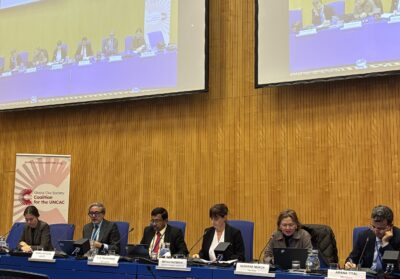
This disconnect was the focus of “From National Coordination to International Coherence” an event co-organised by the Global Civil Society Coalition for the UNCAC on the margins of the second resumed 17th session of the UNCAC Implementation Review Group (IRG) in Vienna. Bringing together representatives of governments, international organisations, and civil society, the discussion explored how stronger coordination can translate international commitments into meaningful action at the national level.
Moderated by Betina Pasteknik, Deputy Director of the Global Civil Society Coalition for the UNCAC and Co-Chair of its Human Rights and Corruption Working Group, the session opened with a call for greater coherence between anti-corruption and human rights frameworks. Referring to the 822 recommendations that include the term “corruption”, issued through the Universal Periodic Review (UPR), she highlighted the growing recognition stressing corruption as a cross-cutting issue with significant human rights implications. She stressed that corruption cannot be effectively addressed through the United Nations Convention against Corruption (UNCAC) framework alone, underscoring the Convention’s central role in fostering greater coherence across relevant international mechanisms. She called for moving beyond theoretical discussions of synergies towards concrete examples of how national-level coordination and collaboration can translate this convergence into practice.
Connecting frameworks through national action
Drawing on Germany’s value-driven development strategy, Susanne Münch, Head of Division at the Germany’s Federal Ministry of Justice and Consumer Protection highlighted how human rights and good governance serve as core principles with both human rights and anti-corruption being quality criteria in their work and are mainstreamed across all technical assistance.
Citing examples from Kenya and Indonesia, she illustrated how initiatives such as digital public complaint mechanisms, sustainable forest management, and transparent procedures for granting land rights to Indigenous communities can advance anti-corruption efforts while strengthening human rights protections. She stressed that technical assistance must strengthen accountable institutions while safeguarding the rights of those most affected, concluding that “when corruption and human rights harms are interconnected, our technical assistance should be interconnected too”.
Commissioner K. B. Rajapakse of Sri Lanka’s Commission to Investigate Allegations of Bribery or Corruption (CIABOC) outlined key institutional reforms introduced under the Anti-Corruption Act No. 9 of 2023, including an expanded mandate, the ability to receive anonymous complaints, digital asset declarations, and strengthened victim protection mechanisms.
He further highlighted the partnership between CIABOC and the Human Rights Commission of Sri Lanka, showcasing how joint awareness-raising and prevention initiatives can bridge the anti-corruption and human rights agendas. These efforts seek to deepen public understanding of how corruption affects citizens’ rights and reinforce the role of institutional collaborations in ensuring that the fight against corruption goes hand in hand with human rights protection.
From Guatemala, Commissioner Julio Flores of the National Commission against Corruption highlighted the possibility to explore a greater convergence, coordinated action, and tangible results in international review processes. He emphasised the value of identifying overlapping and complementary recommendations across the UNCAC Implementation Review Mechanism (IRM), the Inter-American Follow-up Mechanism (MESICIC), and human rights mechanisms to avoid duplication, prioritise reforms, and strengthen follow-up.
Drawing on Guatemala’s experience, he presented an inter-institutional mechanism involving more than 15 public institutions, which assesses implementation gaps, identifies responsible entities, and informs action plans with concrete, verifiable measures and clear timelines.
Deputy Commissioner Tina Divjak of Slovenia’s Commission for the Prevention of Corruption, highlighted the relationship between transparency and data protection. Referring to Slovenia’s ERAR transparency platform and its cooperation with the Information Commissioner, she highlighted how transparency and data protection must work hand in hand, ensuring that greater public access to information does not come at the expense of individuals’ privacy.
Reflecting on the challenges balancing transparency with data protection, she stressed the need to distinguish between information available to oversight institutions and what can be made public, emphasising that while transparency is essential to prevent corruption risks, it must be accompanied by appropriate safeguards to protect personal data.
Building international coherence
Amane Tiyal, Counsellor at the Permanent Mission of the Kingdom of Morocco in Vienna, highlighted a 2026 cooperation agreement between Morocco’s Interministerial Delegation for Human Rights and National Authority for Probity, Prevention and Fight Against Corruption, which establishes a structured cooperation between the two institutions, recognising the mutually reinforcing nature of the human rights and anti-corruption agendas.
He highlighted that the areas of cooperation include exchange of data and expertise, joint training, thematic studies, follow-up to recommendations, and tools for assessing corruption’s impact on the enjoyment of rights.
He outlined five priorities for effective collaboration – establishing a shared understanding; connecting recommendations with clearly identified responsibilities; assessing results by its impact on people; creating opportunities for regular review and informed participation; and connecting national implementation with international learning. He further emphasised the importance of a two-way exchange, whereby national experiences inform international discussions, while global best practices help strengthen domestic policies.
María José Veramendi Villa, Human Rights and Anti-Corruption Officer at the Office of the UN High Commissioner for Human Rights (OHCHR), highlighted the significant overlap between recommendations under the UNCAC IRM and UN human rights mechanisms. Drawing on OHCHR-UNODC joint mapping exercises, she identified areas of convergence across anti-corruption and human rights frameworks, including whistleblower and human rights defender protection, access to information, judicial integrity, business integrity, and asset recovery.
She emphasized that these synergies allow States to address multiple recommendations through coordinated reforms, supported by aligned reporting, consolidating recommendations into national implementation plans, permanent coordination mechanisms, joint technical assistance, and coordinated national follow-up.
Building on this discussion, Shervin Majlessi, Chief of the Convention Support Section at the UN Office on Drugs and Crime (UNODC), outlined efforts to integrate human rights considerations into UNODC’s technical assistance to States, in line with its Human Rights 75 pledge. Referring to resources UNODC has developed to mainstream human rights considerations across its work, he highlighted that these efforts focus on assessing national contexts, identifying human rights risks, engaging relevant stakeholders, and incorporating appropriate safeguards into anti-corruption assistance.
He also identified four opportunities to strengthen coherence between the IRM and other review mechanisms: incorporating UPR recommendations into UNCAC self-assessments, improving national coordination, using human rights findings to inform UNCAC implementation, and integrating them into the design of technical assistance.
Laura Notess, Civic Space Thematic Lead at Transparency International, called for more systematic, sustained, and inclusive cooperation between anti-corruption and human rights institutions, supported by long-term institutional arrangements and meaningful civil society participation. Looking ahead to the next UNCAC Conference of the States Parties in Tashkent, she urged States Parties to develop a resolution establishing a clearer framework, mandate, and resources for cooperation between the human rights and anti-corruption frameworks in Vienna and Geneva, including ongoing OHCHR–UNODC collaboration.
From coordination to meaningful change
The discussion demonstrated that stronger cooperation between anti-corruption and human rights institutions is not simply an administrative exercise. As States Parties look toward the 12th Conference of the States Parties to the UNCAC (CoSP12), there is an important opportunity to turn this discussion into concrete commitments. This includes strengthening coordination between the Vienna and Geneva frameworks, establishing joint national implementation approaches, and ensuring meaningful civil society participation.

