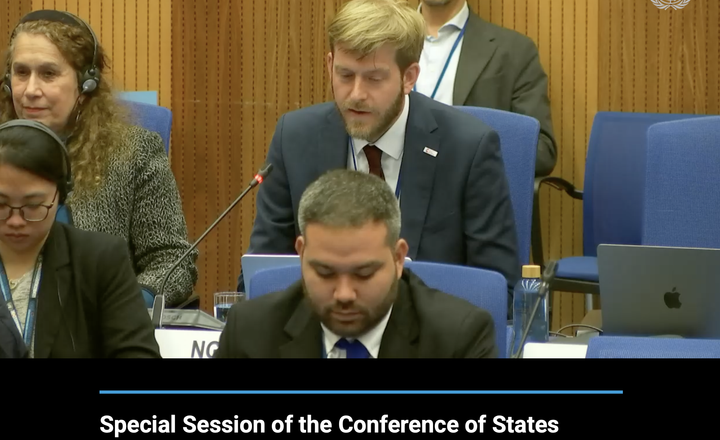
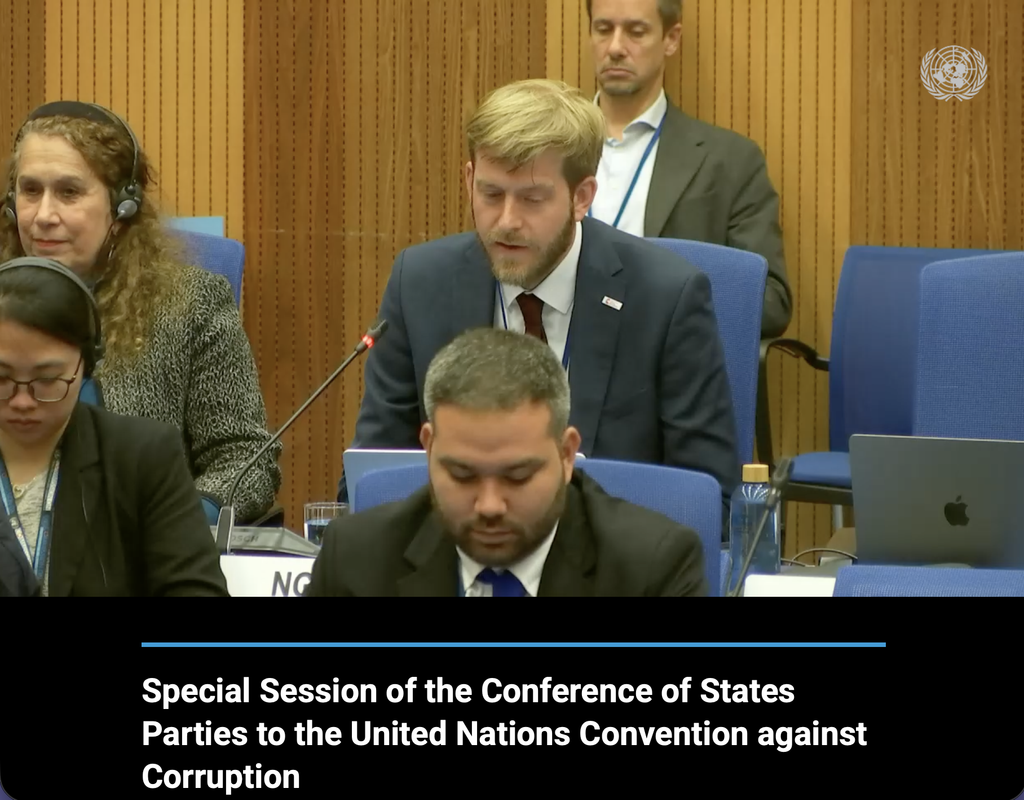
In a UNCAC CoSP Special Session that took place on 6 November in Vienna, State Parties agreed on the key documents of the Implementation Review Mechanism’s (IRM) next phase, following more than two years of deliberations. These include:
- the self-assessment checklist (SACL),
- the revised model review schedule,
- and the blueprint for the full country report and executive summary.
A last attempt made by one State Party to introduce changes to the documents that were agreed by the Implementation Review Group in September, met an overwhelming objection by numerous States parties from all regional groups. These proposals, if accepted, might have slightly weakened country review outcomes. As a result, no substantial changes were made to the earlier agreed documents, and those were adopted by consensus. This decision marks the conclusion of all necessary steps, as set out in CoSP resolution 11/2, to formally launch the IRM follow-up phase.
The next steps ahead: The drawing of lots of reviewed and reviewing countries in May 2027, and the official start of approximately 40 country reviews in July 2027.
New opportunities
The Global Civil Society Coalition has been closely following the process of deliberations from the outset, making recommendations to strengthen the key documents through direct outreach to States parties as well as through mobilizing national CSOs to advocate for more effective, inclusive and transparent country reviews. These efforts culminated in an open letter, signed by almost 400 CSOs and experts from 118 countries, calling to adopt the IRM documents without further delays. The next phase introduces significant opportunities for a more effective, participatory and transparent review process that should lead to more impactful outcomes, including:
A wider review scope which includes:
- Questions on implementation of the UNCAC provisions throughout the SACL include a stronger focus on implementation in practice and results achieved.
- Reporting on “other measures”, such as new developments related to UNCAC implementation, beyond merely reporting on progress in relation to the implementation of the 1st phase country reviews’ recommendations, some of them more than 15 years old.
- A more precise identification of technical assistance needs by the country under review, including the objectives and the beneficiaries of the requested assistance. Countries are also invited to report on the impact of past technical assistance delivery in response to first phase findings.
- An invitation to countries to address relevant CoSP resolutions and broader developments related to their UNCAC implementation.
- An invitation to countries to address findings from other international review mechanisms that have an anti-corrution related mandate. For example, regional mechanisms, the Open Government Partnership Independent Reporting Mechanism, as well as findings from human rights mechanisms such as the Universal Periodic Reviews.
Enhanced transparency:
Countries under review are invited to publish:
- The country review focal point details and contact information, which will make the process more accessible for non-governmental stakeholders.
- Dates of the upcoming country visit and estimated review completion on their UNODC country profile page.
- A press release when completing the country review: The established practice is to consider a country review “completed” when the review executive summary is published.
- Periodic follow-up information on progress in implementing review recommendations ahead of each CoSP, on the respective CoSP session webpage.
Increased participation:
- Non-governmental stakeholders are invited to contribute at all stages of the review: provide input to SACL; during the country visit of the reviewing countries; in the preparation of the country report.
- The country report blueprint includes a section inviting the country under review to provide information on stakeholders’ involvement, including on “the nature and content of their contributions”.
- The country under review may include an annex in the full country report with information provided by non-governmental stakeholders on UNCAC implementation. A similar question inviting such findings appears also in the SACL.
- The Executive Summary includes a section for concise reflection on the process and information about engagement with all relevant stakeholders.
Country review milestones & entry points for civil society
Building on the experience from the 1st phase, a provisional review timeframe of 14 months will be allocated and approximately 5 months of a “preparatory phase” (which includes the stages from the nomination of review focal points until the submission of the responses to the SACL by the country under review). The “desk review”, which is the stage where the reviewing countries begin assessing the SACL responses provided to them, will signal the official start of the tentative 14 months of the country review until its completion.
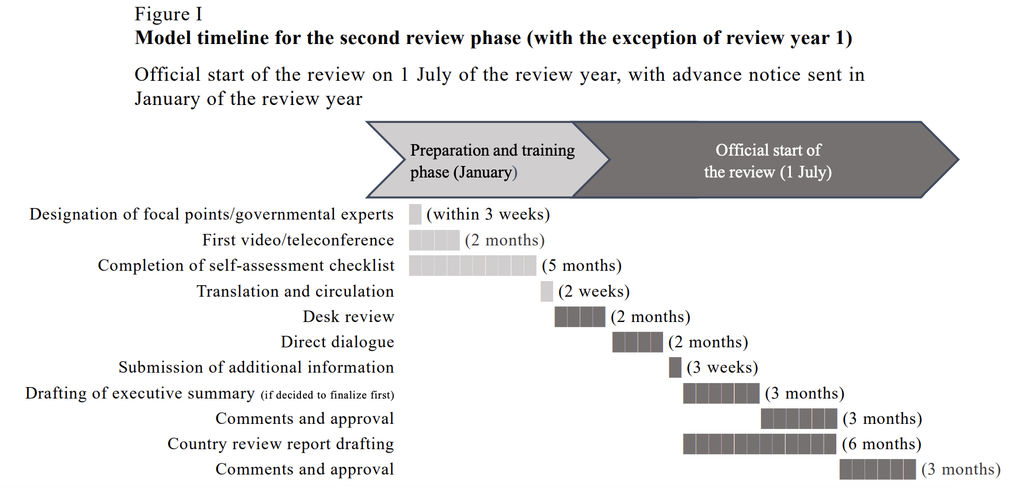
Under the first phase, country reviews were supposed to last only six months, but in fact, took much longer to complete, with an average of 36 months. Civil society stakeholders at the national level are strongly encouraged to engage in the country review from the outset, meaning the preparation phase and before, to make sure they take advantage of the earlier entry points. These include engaging with the review focal point, and providing input to the SACL to inform the reviewed country responses. As in the first phase, the Global Civil Society Coalition will accompany interested CSOs with tools to meaningfully engage in the country reviews. Naturally, the next phase’s new scope and modalities will require fresh tools and guidance documents for civil society, which are in the pipeline: an updated guide for transparency and participation in reviews, a renewed transparency pledge, guidance documents on how to produce a civil society assessment in parallel to the official country review, as well as trainings for CSOs that wish to engage in their country review.
May 2027 is an important milestone – the drawing of lots for the reviewed countries should be followed by quick action from civil society interested in engaging in the first-year country reviews, as approximately 40 country reviews will begin already in July 2027. As for the rest of the country reviews in years 2-5 of the 1st cycle, which will focus on implementation of chapters III (Criminalization and Law Enforcement) and IV (International Cooperation), national CSOs will know when to expect their country review to begin, and could plan ahead their engagement.
Recommendations for countries moving forward
As States parties can already begin preparing for their upcoming 2nd phase reviews of chapters III and IV, they are strongly encouraged to make full use of the opportunities to increase levels of transparency, non-governmental participation, and the assessment of the Convention’s implementation in practice. Such efforts should include:
1. Enhancing transparency:
a. Requesting UNODC to publish the 1st cycle review documents on the country’s UNODC Country Profile – these include the self-assessment checklist and the full country report.
b. Publishing the country review focal point contact details when nominated, as well as a provisional and regularly updated country review timeline.
c. Deciding to publish the country review’s main inputs and outcomes, including the response to the SACL and the full country report on your UNODC country profile page and a governmental website.
2. Strengthening inclusiveness:
a. Informing well in advance all relevant non-governmental stakeholders about how they can engage in key stages of the country review, including by contributing to the SACL, participating in the on-site country visit, and in developing and implementing follow-up measures to the country review recommendations.
b. Soliciting and considering the input from a broad range of independent non-governmental stakeholders with relevant expertise and experience, publishing their findings in the SACL and in the country report annex, and reflecting how this input was taken into account.
c. Ensuring that stakeholders can participate in country reviews safely and without fear of reprisal.
3. Increasing review effectiveness:
a. Going beyond descriptions of laws, policies and institutions to demonstrate implementation in practice, the impact of measures, and the results achieved.
b. Examining aspects such as compliance, investigative and enforcement actions, including through the collection and publication of comprehensive data and relevant statistics, and providing sufficient information on data quality, methodology and limitations to allow for the evidence to be meaningfully assessed. Where quality and relevant data do not exist, it should be seen as a need for technical assistance that will help such countries to assess the impact of their measures in a sustainable manner.
c. Taking stock of new developments since the completion of the 1st phase reviews, such as progress made, developments that have strengthened or weakened implementation, trends and circumstances of corruption offences (such as corruption and environmental crimes), cross-cutting issues (such as gender & corruption) and the implementation of relevant CoSP resolutions.
d. Considering relevant findings from other corruption-related international or regional review mechanisms that should inform the upcoming country review.
Reviewing countries will have a crucial role to play in contributing to a meaningful review process and outcome, in particular through raising sensitive questions during the process, requesting data and statistics to demonstrate reported progress, taking into account relevant findings from other related review mechanisms, and meaningfully engaging with other stakeholders such as during the country visits, and in considering non-governmental stakeholders’ findings.
Summary
As the process of deliberations on the next phase unfolded, up until the successful adoption of the review key documents at the CoSP special session, it became evident that a majority of States parties from all regional groups would like to see a more effective review process that assesses the impact and results achieved, that will develop actionable recommendations for governments to follow up on, and that will lead to the delivery of sustainable and impactful technical assistance.
The UNCAC fora should also keep in mind that during the 1st phase reviews, countries already had the opportunity to assess the practical implementation of the Convention. That opportunity, however, was largely missed, as most country reviews focused on the existence of legal frameworks and policies rather than on their actual impact to prevent and combat corruption effectively. Another stark reminder of an ineffective review mechanism is that of the UNTOC, the “sister convention”, deliberated in the same UN building, and governed by quite similar rules of procedure. These should remind us that including more progressive calls to action always risks remaining on paper if these calls to action do not become the established practice from the outset of the next country reviews.
The original UNCAC IRM Terms of Reference still apply, emphasizing the intergovernmental nature of the process, keeping the calls to action for more transparency and stakeholder participation voluntary, and avoiding any form of country ranking. However, to truly review the impact of anti-corruption measures, States should perceive the UNCAC fora as a community of practice that bases its conclusions on evidence and shares the responsibility to achieve the goals of the Convention. To do this, governments cannot review themselves alone. The IRM next phase holds a promise for more accountability in combating corruption, and could help us understand what kind of measures really have an impact. In the words of UNODC’s Executive Director, Monica Juma, at the opening of the CoSP special session: “The first phase asked whether State Parties had the laws and institutions that the Convention requires. The second phase asks an even more fundamental question: are these working?”

