
Whistleblowers play an essential role in exposing corruption, yet they rarely act alone. Journalists, lawyers, civil society organizations and investigators help verify, amplify and act on their disclosures, and often face the same retaliation. Safeguarding this wider ecosystem requires strong laws, practical support and sustained cooperation among governments, international organizations and civil society.
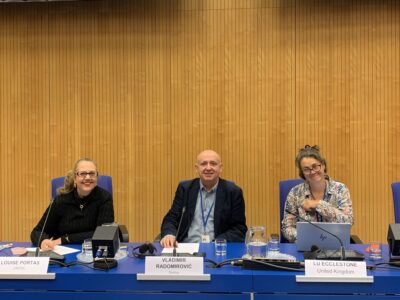
These themes anchored the side event on Protecting Those Who Expose Corruption: Building on Resolution 10/8 to Safeguard the Wider Ecosystem, co-organised by the Global Civil Society Coalition for the UNCAC on the margins of the second resumed 17th session of the UNCAC Implementation Review Group (IRG) in Vienna last week, where representatives of governments, international organizations and civil society explored how States can build on Resolution 10/8.
The session, moderated by Vladimir Radomirović, Editor-in-Chief of Pištaljka in Serbia, reviewed progress since the adoption of Resolution 10/8 at the tenth Conference of the States Parties (CoSP10), the risks shared by whistleblowers and journalists, and practical measures to protect everyone who helps bring corruption to light. Recalling that civil society drafted the resolution and that Serbia and the State of Palestine tabled it, he described it as a breakthrough and urged participants to build on it.
What Resolution 10/8 has set in motion
Louise Portas, Crime Prevention and Criminal Justice Officer and Whistleblower Protection Focal Point in the Corruption and Economic Crime Branch of the United Nations Office on Drugs and Crime (UNODC), explained that the resolution, the first dedicated to protecting reporting persons, has created important momentum for implementing Article 33 of the UNCAC. Since then, the demand for technical assistance has surged. Since 2019, UNODC has received requests from 91 States Parties and has provided support at national level to 52 States, out of which 36 have been since the adoption of the resolution. Requests have also shifted from awareness-raising and training toward drafting whistleblower legislation, often from a blank page, as well as establishing internal reporting and protection mechanisms at the institutional level.
In 2025, UNODC developed an international study drawing on input from 82 States Parties and the European Union, which demonstrated a significant progress and increase in the adoption of dedicated whistleblower protection laws. 36 States Parties and the EU have reported having adopted comprehensive “whistleblower” protection laws, and 11 more reported being in the process of drafting or adopting. Building on these findings, UNODC and the Government Accountability Project with the contribution of the European Union, launched a practical toolkit for developing whistleblower protection frameworks in December 2025. Using the toolkit, UNODC has initiated working with countries to draft tailor-made laws which they can take ownership of. UNODC has run the exercise in four countries this year, and two draft laws have reached the Parliament or the Council of Ministers.
Why protection must also follow the information
Drawing on the experiences of the Platform to Protect Whistleblowers in Africa (PPLAAF), its Director of Programs Gemma-Maé Hartley noted that most whistleblowers do not see themselves as whistleblowers – they are often people who simply do their jobs, noticed a wrongdoing and felt the need to act. In Africa especially, intermediaries like journalists and civil society organizations are often the only realistic channel for whistleblowers, either because those are the means which can ensure disclosures lead to investigations or prosecution, or because they can protect whistleblowers when internal and external channels are compromised.
Across Africa, only 12 countries currently have whistleblower laws, and many fail to recognize public reporting to the media or civil society, leaving those whistleblowers outside of the scope of protection that laws may be able to offer them.
Citing PPLAAF’s policy brief on investigative journalism and whistleblowing, she highlighted the overlapping risks that journalists and civil society also face. These include legal retaliation including strategic lawsuits against public participation (SLAPPs), pressure to reveal confidential sources within newsrooms, the use of cybercrime and national security laws, surveillance and digital exposure, and corss-border retaliation. She stressed that risk does not stay with one actor but travels with the information, so protection must travel with it too.
From whistleblowers to “corruption detectors”
As UNODC expands its work beyond whistleblowers to what it calls the “corruption detectors”, Louise Portas explained that other actors such as journalists, civil society groups, lawyers, play a different but complementary role and risk retaliation. The UNODC workstream therefore aims to deepen its expertise on the nexus between whistleblowers and investigative journalists, recognize and protect facilitators within whistleblower frameworks, and build a whole-of-society ecosystem against corruption in which these actors cooperate effectively and receive better protection.
Complementing Louise Portas’s points, Lu Ecclestone, Deputy Head of the Illicit Finance Department at the UK Foreign at the Commonwealth and Development Office, outlined how the UK supports this agenda, including as co-chair of the Media Freedom Coalition. A public consultation on reforming the UK’s 25-year-old whistleblower protection framework, open until early January, seeks to identify the areas which requires updating: who should receive protection, including whether to extend it to other groups such as employees; how public interest should be defined and applied; whether the types of wrongdoing are sufficient; which disclosure routes and thresholds to recognize; and whether the Serious Fraud Office, which handles bribery, fraud, and corruption cases, should offer financial incentives to protect or encourage whistleblowers.
Moving toward stronger protection for everyone who exposes corruption
The session underscored that protecting whistleblowers requires more than a law. States must also recognize and protect the journalists, lawyers and civil society organizations and other actors who help bring disclosures to light, because they are as important and face the same threats as whistleblowers.
The 12th Conference of the States Parties (CoSP12) offers an important opportunity to act. Speaking on behalf of the Coalition’s Working Group on the Protection of Whistleblowers, Vladimir Radomirović said the discussion made a strong case for a new resolution supporting the ecosystem around whistleblowers. States Parties should back such a resolution at CoSP12 and write protection for public disclosures into national law, while civil society and media organizations should join the Working Group and help shape it.

