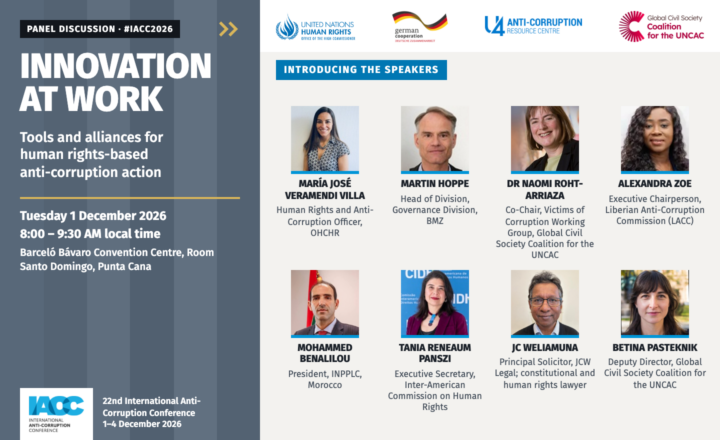
Organizers: OHCHR, GIZ, Global Civil Society Coalition for the UNCAC
Background
Corruption and human rights abuses reinforce each other. The misuse of entrusted power for personal gain benefits a few while harming the most vulnerable in society. Simultaneously, human rights violations create conditions where corruption can thrive.
A human rights-based approach to anti-corruption action helps enhance accountability, reveal abuses of power, empower affected communities, and rebuild trust in institutions. It mobilises governments, donors, courts, and civil society to achieve tangible, people-centred integrity outcomes.
An increasing number of innovative approaches aim to integrate both agendas and ensure progress on rights, justice, and democratic accountability. Across regions, national institutions are beginning to implement new approaches. Courts are recognising corruption as a human rights harm and expanding victims’ standing. National human rights institutions (NHRIs) are engaging more directly with anti-corruption bodies. Executive agencies are linking integrity strategies, asset recovery, and public ethics frameworks to human rights outcomes. These experiences offer valuable lessons on what works, what does not, and how institutions can cooperate more effectively.
At the 22nd International Anti-Corruption Conference (IACC), the United Nations Office of the High Commissioner for Human Rights (OHCHR), the Bundesministerium für wirtschaftliche Zusammenarbeit und Entwicklung (BMZ)/Deutsche Gesellschaft für Internationale Zusammenarbeit GmbH (GIZ), the U4 Anti-Corruption Resource Centre, and the Global Civil Society Coalition for the UNCAC are joining efforts to organise a session focused on innovative tools and alliances for human rights–based anti-corruption action.
The workshop will provide a safe, interactive space for dialogue on integrating human rights into anti-corruption practices, drawing on innovative experiences from governments, donors, courts, and civil society. It aims to be acaction anded, connecting committed actors, laying the groundwork for a group of like-minded partners interested on supporting human rights–based anti-corruption action, and fostering discussions on the issue at the next Conference of States Parties (CoSP) and its subsidiary bodies.
Session Objectives
This panel discussion seeks to:
- Examine concrete practices through which human rights principles are being integrated into anti-corruption work at the national level, including approaches taken by courts, NHRIs, executive agencies, specialised anti-corruption bodies, civil society, and with the support of international cooperation agencies and institutions.
- Highlight innovative legal and policy approaches that strengthen victims’ participation, access to justice, and remedies in corruption cases.
- Explore institutional cooperation models, including between anti-corruption bodies, NHRIs, prosecutors, and development actors, that enable human rights–based approaches in practice.
- Facilitate peer exchange on practical entry points for governments, development cooperation, academia, and civil society to support institutional reform and operationalise a human rights-based approach to anti-corruption strategies, policies and practices.
- Identify priorities for sustained collaboration and follow-up, including pathways to elevate national experiences into international policy discussions, such as at the next Conference of States Parties (CoSP).
Expected Results
With this session, all organising partners expect to increase awareness amongst participants on how a human rights-based approach can further legitimise and strengthen anti-corruption efforts; showcase concrete tools, practices, and alliances that help achieve this goal; facilitate connections and dialogue amongst government officials, international organisations, donors, courts, civil society and academia; identify practical entry points and priorities for joint action; and contribute to building momentum for collective follow-up, including continued support to human rights based anti-coruption action at the next CoSP.
Moderator
-
- María José Veramendi Villa
Human Rights and Anti-Corruption Officer, Office of the United Nations High Commissioner for Human Rights
Opening Remarks
-
- Martin Hoppe
Head of Division, Governance Division, Ministry for Economic Cooperation and Development (BMZ)
Mr Hoppe will set the scene for the session and share a global perspective on advancing integrity and accountability through development cooperation, whilst advancing human rights.
Panellists
-
- Dr. Naomi Roht-Arriaza (TBC)
Co-Chair of the Victims of Corruption Working Group of the Global Civil Society Coalition for the UNCAC and author of “Fighting grand corruption. Transnational and human rights approaches in Latin America and beyond”.
Dr Roht-Arriaza will discuss the jurisprudential advances at global, regional and national levels that strengthen the rights of victims of corruption, expand access to justice, and recognise the impact of corruption on human rights. She will share findings from her recent U4 publication examining how courts in several jurisdictions have recognised corruption as a direct human rights violation, thereby enabling broader legal standing, integrating international law, and placing victims at the centre of proceedings.
-
- Cllr. Alexandra Zoe
Executive Chairperson of the Liberian Anti-Corruption Commission (LACC)
As the establishment of the National Anti-Corruption Court (NACC) progresses, a representative of the LACC, the national anti-corruption body responsible for investigating and prosecuting corruption cases, will discuss the opportunities and challenges to strengthen the establishment of a victim-centred judicial response to corruption-related offences aligned with international human rights norms and standards.
-
- Mr. Mohammed Benalilou
President, L’Instance nationale de la probité, de la prévention et de la lutte contre la corruption (INPPLC), Morocco
Mr. Benalilou will discuss Morocco’s initiatives to increase collaboration between national human rights institutions, anti-corruption bodies, and implementation mechanisms. He will share best practices to strengthen technical cooperation to address the real-life impacts of corruption on development and livelihoods, while advancing human rights protection as a central pillar of prevention efforts.
-
- Ms. Tania Reneaum Panszi
Executive Secretary of the Inter-American Commission on Human Rights
Ms. Reneaum will discuss how emerging tools—like strategic litigation—are being used to expose corruption as a structural driver of human rights violations, particularly affecting marginalized communities. Drawing on the Inter-American system’s case law and precautionary measures, the Commission can show how framing corruption as a human rights issue strengthens accountability, expands access to justice, and encourages states to adopt preventive, victim-centred anti-corruption policies rather than relying only on punitive approaches.
-
- JC Weliamuna
Principal Solicitor, JCW Legal, Sri Lankan barrister (SILK) and Australian legal practitioner, constitutional and human rights lawyer, and anti-corruption expert.
Mr. Weliamuna will discuss the importance of strengthening the capacity on a human rights-based approach to anti-corruption of anti-corruption authorities and of formalizing cooperation between anti-corruption authorities and national human rights institutions.
-
- Ms. Betina Pasteknik
Deputy Director and Co-Chair of the Human Rights and Corruption of the Global Civil society Coalition for the UNCAC.
Will discuss the critical role of civil society in advancing the integration of human rights into anti-corruption policies and practices, and share lessons learned from multilateral advocacy efforts.
Closing takeaways by the moderator
Rapporteur
-
- Ms. Daniela Cepeda Cuadrado
Senior Anti-Corruption Adviser, U4 Anti-Corruption Resource Centre
