About the UNCAC Review Status Tracker
The Status Tracker provides a comprehensive overview of the status of the UNCAC review in all States Parties to the Convention. The interactive map showcases a snapshot of the status of the 2nd ongoing review cycle. In the tables below, you can find more information on both cycles, including links to all relevant documents and the name and institution of the focal point, where known.
Information shown is continuously compiled through outreach and engagement with UNCAC review focal points and civil society organizations around the world. It is regularly updated – as shown by the date at the bottom of the tables.
All relevant IRM tools and resources are available here.
The UNCAC Implementation Review Mechanism (IRM)
The UNCAC IRM combines a self-assessment by the country under review with a governmental peer review by two peer reviewing States. The involvement of civil society in the review process is encouraged, but unfortunately optional.
The ongoing UNCAC review process comprises two five-year cycles:
- The first cycle (2010–2015) covers chapter III on criminalization and law enforcement and chapter IV on international cooperation;
- The second cycle (initially 2015–2020, extended to June 2026 due to significant delays) covers chapter II on preventive measures and chapter V on asset recovery. Several States are still finalizing their reviews in late 2026 and 2027.
The outputs of each country review are a self-assessment checklist by the country under review, a full country review report prepared by the peer reviewers and approved by the country under review, and an executive summary of this report. The publication of the self-assessments checklists and the full country review reports are optional. However, an increasing number of countries are agreeing to publishing these two key documents. The executive summaries are automatically published on the UNODC’s website.
The next phase of the UNCAC IRM
States Parties will adopt the review documents and model schedule for the next phase of the UNCAC IRM at a CoSP Special Session in November 2026. The next phase of the UNCAC IRM will officially launch in May 2027, with the first reviews starting in July 2027.
Overview tables
Learn more about the tables below.
To view a larger version of the table and filter columns click here. To see how to filter a column, see here.
Second Cycle UNCAC review (ongoing)
First Cycle UNCAC review (2010-2015)
The above tables provide an overview of the status of the UNCAC review in all States Parties to the Convention for both the 2nd and ongoing review cycle, and further below, for the 1st review cycle, grouped by region and year of review, and includes information on:
- The UNCAC review itself:
- Scheduled year of review;
- Status of review (ongoing, completed or unknown);
- Details on the status of review (information obtained through UNCAC focal points, Permanent Missions in Vienna, UNODC or CSOs);
- Name and job title of the governmental UNCAC focal point (if known) – contact us for their contact information;
- Peer reviewing countries;
- Available UNCAC review documents (governmental expert list, self-assessment checklist, executive summary, full country report);
- Information on measures taken after the completion of the country review.
- Additional information:
- Whether a country is an Official Development Assistance (ODA) recipient country;
- Whether a country has signed our Transparency Pledge;
- The country’s compliance status with the Transparency Pledge;
- Whether a review document was obtained through our Access to Information campaign;
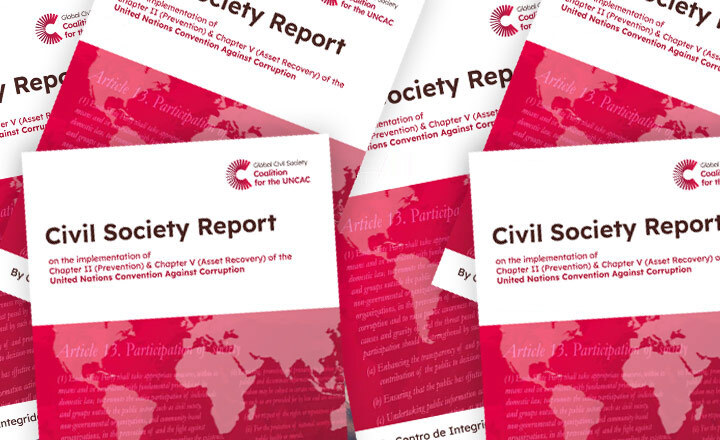
- Whether a civil society organization from this country has written a parallel report on UNCAC implementation (link to the report).
The table is continuously updated. If you are your government’s UNCAC focal point or otherwise have reliable information on the status of the UNCAC review in a particular country and would like us to update this table, please write an email to danella.newman@uncaccoalition.org and CC info@uncaccoalition.org.
How can civil society use the UNCAC Review Status Tracker?
Check your country’s review status, and become involved. If your country’s review is:
Unknown: Try to find out who your country’s UNCAC focal point is from the govern-mental expert list on your country’s UNODC’s country profile or on our status tracker above and contact them. According to the review status, follow the other steps.
Ongoing:
Pre-country visit:
- Contact your focal point, saying how you can contribute to the review, e.g.;
- provide comments on a draft of the self-assessment checklist;
- give input to the peer reviewers before or during the country visit;
- or other ideas based on the Coalition’s Guide to Transparency and Participation in the UNCAC Implementation Review Mechanism.
Post-country visit:
- Contact your focal point, saying how you can contribute to the review, e.g.,
- provide comments on a draft of the country report;
- advocate for the inclusion of civil society recommendations in it;
- ask for the names of CSOs included in the review to be listed in it;
- ask for the government to present its findings to civil society and other stakeholders once the review is completed;
- or other ideas based on the Coalition’s Guide to Transparency and Participation in the UNCAC Implementation Review Mechanism.
Completed: Contact your focal point and advocate for
- the implementation of the review recommendations included in their full country report and executive summary, which, if published, can be found on your country’s UNODC’s country profile or on our status tracker above;
- periodic reporting on follow-up measures the country has taken in this regard.
- If the full country report has not been published yet, participate in our Access to Information Campaign to obtain the document, and monitor the government’s implementation of the recommendations.
If you are looking to contact your government focal point, please contact us at danella.newman@uncaccoalition.org.
How can States Parties make their UNCAC reviews more transparent and inclusive of civil society?
Our updated Guide to Transparency and Participation in the UNCAC Implementation Review Mechanism (also available in Spanish and French) includes best practice examples, including:
- Publishing information on the review proactively and in a timely manner;
- Forming a multi-stakeholder advisory team to consult on the review;
- Inviting civil society to comment on drafts of the self-assessment checklist and draft country report;
- Including civil society in the country visit in a meaningful way;
- Including detailed information on the involvement of civil society in the country report;
- Jointly shaping a follow-up action plan with civil society to implement the review recommendations, with a monitoring and reporting mechanism in place;
- Including a civil society representative in your country delegation to the Conference of the States Parties or subsidiary bodies.